Showing posts with label Unionism. Show all posts

Thursday, April 11, 2013

Do any Lutherans want to be Dresden Lutherans? Meanwhile, the Groeschelites continue their agenda...

Those of you who have been following us on Facebook and Twitter probably could have seen this coming, as you've recently been fed a steady diet of links to some of our older posts reprising topics like Pietism, Sectarian Worship, Lay Ministry, along with a few links featuring the advice of orthodox Lutherans from previous eras regarding genuine Lutheran practice that also does the job of confessing our separation from sectarians.

But they are just a bunch of old dead dudes, and who really cares about ancient history anyway. Yeah, they said stuff. So what. We say stuff, too, and what we say is what matters today.

Meanwhile, an email rather circuitously made its way to our inbox yesterday. It was initially sent to the pastors of an entire circuit in the WELS SEW District, and included a passel of attachments for their review ahead of their meeting of this Friday. They will be discussing the opening of an INTERDISTRICT MULTI-SITE CONGREGATION. The congregation, Hope Lutheran in Oconomowoc, WI (Western Wisconsin District), had been planning a multi-site effort since 2010, and, with the encouragement of their District President, had been communicating their plans with WW DMB throughout this time. In July of 2012, a conversation with Wisconsin Lutheran College (WLC) President Dan Johnson resulted in his offer to use the facilities of WLC as a "cradle to launch the second location of Hope" – in the Southeastern Wisconsin District (SEW).

Click here for the documentation.


Multi-site Congregations? Whence comest thou?
Craig GroeschelIn a previous exposé on the teaching of Craig Groeschel, entitled Pietism and Ministry in the WELS: A brief review of Craig Groeschel, we critiqued the thirteen points of his Vision and Values document. Point one, along with our response to it, reads
    "1. Since Christ is for us and with us, we are a fearless, risk taking, exponential thinking church. We refuse to insult God with timid thinking or selfish living.

    "Interpretation: We like to tempt God.

    "There is nothing laudable in casting Christian Stewardship aside, to openly take 'bet-the-farm' risks with resources God has given to us, which he expects us to wisely invest. 'Betting the Farm' is not wisdom, but foolishness."
Compare this, the FIRST POINT of Groeschel's Vision and Values statement, with THE FIRST POINT listed in the Mission Vision Values statement of Hope Lutheran, from the documentation packet linked above:
    "Since Christ is for us and with us, we are a fearless, risk taking, exponential thinking church. We refuse to insult God with timid thinking or selfish living."
Already we see, Craig Groeschel is their guide – they have adopted his Vision for Ministry and made it their own, quoting from it verbatim. But it doesn't end there. Here are points four and seven from Craig Groeschel's Vision and Values document:
    "4. We give up things we love for things we love even more. It's an honor to sacrifice for Christ and His church.

    "7. We will lead the way with irrational generosity. We truly believe it is more blessed to give than to receive."
You can read our 2010 exposé on Craig Groeschel to see our responses to these points. But compare these points to POINT SIX listed in Hope Lutheran's Mission Vision Values statement, again from the packet linked above:
    "We love to give up things we love for the things that God loves."
We did a post or two on plagiarism, did we not? Yes, I think we did. Here is the series we posted in 2010 on the sin of plagiarism. Craig Groeschel makes an appearance in this series, as well – commenting on those who do not give credit to their sources:Re-read these old posts, and read the rest of our 2010 exposé on Craig Groeschel and his connection to the WELS. What we said then still applies today, and that application is most assuredly expanding.


Recently, Craig Groeschel wrote an editorial for FoxNews.com, which was titled, Christians, here's why we're losing our religion. Aptly titled, his objective is, in fact, to lose religion. He writes:
    "You see, religion alone can only take a person so far. Religion can make us nice, but only Christ can make us new. Religion focuses on outward behavior. Relationship is an inward transformation. Religion focuses on what I do, while relationship centers on what Jesus did. Religion is about me. Relationship is about Jesus... religion is about rules, but being a Christian is about relationship."
Compare Groeschel's statement, above, to POINT SEVEN in the document Mission Vision Values, again, in the packet linked above. It reads:
    "We will not let our behavior or church culture create a barrier between Jesus and a person he died for."
The relationship between statements like this and Evangelical leadership emanating from the likes of Craig Groeshel is obvious. Yet, such leadership is Scripturally incompetent – a clear example of allowing an enemy of the Christian AND the Church (i.e., the World) to dictate our terms. In reality, those who separate religion from Christianity, as Groeschel suggests, have no idea what either religion or Christianity is. Sure, Christianity is a relationship between the individual and Jesus, but Scripture's testimony on the matter is clear and abundant: for as much as it is a relationship between the individual and Jesus, it is also a relationship of confessional unity between fellow Christians AND a relationship between the congregation and Christ. Christianity is NOT strictly a matter between the individual and God, in its visible manifestation, it is principally corporate in nature! One cannot separate the idea of "religion" from Christianity! To even suggest it is nonsense.


Craig Groeschel continues in his editorial:
    "But in order to reach the current generation and generations to come, we must change the way we do things. That's why we like to say, 'To reach people no one is reaching, we have to do things no one is doing.'"
He is repeating, here, the sixth point of his Vision and Values statement – which we commented on in our previous exposé. Hope Lutheran echoes this thought in POINT FIVE of their Mission Vision Values statement, contained in the documentation packet linked above:
    "We are committed to reaching people that churches are not reaching."
But is Hope Lutheran, or anyone else who copies Craig Groeschel, really living out this vision statement? Hardly. Following the model of those 'who are doing what no one else is doing', those so doing such only succeed in doing what everyone else is doing. It's called a bandwagon. The fact is, it is on the basis of his multi-site church model that Craig Groeschel's LifeChurch.tv was recently named the most innovative church. Those who copy him aren't at all "doing what no one else is doing to reach those no one else is reaching," but are simply doing what everyone else is doing, as they climb on board the bandwagon to do what has apparently been "successful" for Craig Groeschel. Everyone without a shred of creativity of their own, that is. Professor John Schaller has better advice for Lutherans. Read what Schaller writes, to see what he says about doing what everyone else is doing, instead of what Lutherans, alone, can uniquely do.


Craig Groeschel continues further:
    "[A]s churches, we don't have the liberty to change the message, but we must change the way the message is presented. We have to discover our 'altar ego' — and become who God says we are instead of who others say we are."
Note that by "we", Groeschel is not referring to the Church anymore. By this point in his editorial, he has already separated corporate religion from the individual. The "we" he is referring to is individual Christians, and nothing more. Thus, the change he is calling for is not change in the Church, but change in the individual Christian, beginning with the separation of the individual Christian from the Church, and continuing with a change in his focus, calling the Christian to dwell on his own behaviour. Not only is this rank Sanctification oriented Pietism (which we detailed in our post, Lay Ministry: A Continuing Legacy of Pietism, and highlighted as a problem with Craig Groeschel in our 2010 exposé), it is a "change in the message." It is a manifestly duplicitous perspective on Christianity. All he is saying here is, "We must change the message to eliminate "religion" from Christianity (yes, change), we must change the message to eliminate "labels" from our identity (i.e., to eliminate a Christian's public confession from his Christianity), we must change the message to focus on what Christians do for God or what Christians do for man in the name of God instead of what the Holy Spirit does for man through His appointed Means, and we must change the message in these ways to accommodate the demands of the unregenerate who won't listen to us otherwise (who, the Scriptures tell us, are at war against God and don't want to listen to Him anyway). Moreover, we must change the message the way others say we must change the message, we must change the way they say we must change, and become who they say we must be." Who are these "others" but Craig Groeschel and similar Evangelical leaders! Separating the Christian from his religion and from his confession, they insert themselves to take over for the visible Church.


The Collective Descent of American Lutheranism
In our post, C.P. Krauth explains how orthodox Lutheran Synods descend into heterodoxy, we quoted Charles Porterfield Krauth as he identified the Course of Error in the Church, well-known since the time of St. Augustine and operating as well as it ever had in his own time:
    "When error is admitted into the Church, it will be found that the stages in its progress are always three. It begins by asking toleration. Its friends say to the majority: 'You need not be afraid of us; we are few and weak; let us alone, we shall not disturb the faith of others. The Church has her standards of doctrine; of course we shall never interfere with them; we only ask for ourselves to be spared interference with our private opinions.' Indulged in for this time, error goes on to assert equal rights. Truth and error are balancing forces. The Church shall do nothing which looks like deciding between them; that would be partiality. It is bigotry to assert any superior right for the truth. We are to agree to differ, and any favoring of the truth, because it is truth, is partisanship. What the friends of truth and error hold in common is fundamental. Anything on which they differ is ipso facto non-essential. Anybody who makes account of such a thing is a disturber of the peace of the Church. Truth and error are two coordinate powers, and the great secret of church-statesmanship is to preserve the balance between them. From this point error soon goes on to its natural end, which is to assert supremacy. Truth started with tolerating; it comes to be merely tolerated, and that only for a time. Error claims a preference for its judgments on all disputed points. It puts men into positions, not as at first in spite of their departure from the Church’s faith, but in consequence of it. Their repudiation is that they repudiate that faith, and position is given them to teach others to repudiate it, and to make them skillful in combating it."

    Krauth, C.P. (1871). The Conservative Reformation and its Theology. Philadelphia: Lippincott. (pp. 195-196).
For almost three years now Intrepid Lutherans have been warning of this danger, educating our readers on the differences between heterodox sectarianism and orthodox Lutheranism, and demonstrating those differences along with giving evidence of its incursion into our Synod. Some have joined us by lending us their names; though some have been threatened for this, many remain. But these few do not account for the nearly 1500 daily page reads we see on average. Many folks read our essays and informational posts, and are confronted with the stark reality: our Synod is deteriorating right along with the visible Church everywhere, which almost unanimously now invites the World and worldly influences to abide with her in determining doctrine and practice. If they would aspire to be Dresden Lutherans of any sort, it is high-time for our readers to do more than just read. It is time for them to assert their Confession, to begin acting on their convictions in a way that will bring an end to this sort of thing.


Monday, February 18, 2013

What on Earth could the CoP possibly have meant by THIS?

A few weeks ago, in our post, The Witch Hunt Has (Officially) Begun, Rev. Rydecki highlighted section PD.02, entitled "Intrepid Lutherans" (yes, we have our own category of discussion now! We're not being ignored.), from the Minutes of WELS Council of Presidents' (CoP) most recent quarterly meeting. Further down in the notes, however, we read another bit of information germane to not only recent discussion on Intrepid Lutherans, but discussion that has been ongoing since our inception. That section from the CoP's notes reads as follows:
    PD.06 Time of Grace board membership
      President Rutschow did not have anything new to report on the issue of Time of Grace Ministry and its board membership. The SEW district is continuing to work with TOG to resolve any issues that remain.

What on Earth could this possibly mean?
What's Wrong with the Board Membership of Time of Grace Ministry?

Some may recall that a Memorial to the 2011 WELS Convention addressing "Time of Grace Ministry" was signed by pastors and laymen numbering on the order of one hundred. That Memorial read as follows:
    Synod Convention Memorial - Time of Grace
    Memorial to the Synod in Convention Re: Time of Grace Ministry

    Whereas (1) Time of Grace Ministry has actively sought and obtained the status of a Recognized Service Organization (RSO) from the Lutheran Church-Missouri Synod (LCMS); and
    Whereas (2) Time of Grace is listed in the Yearbook of the LCMS as a Recognized Service Organization; and
    Whereas (3) Leaders and representatives from Time of Grace regularly appear at LCMS events and congregations to promote the ministry of Time of Grace; and
    Whereas (4) The administrative board of Time of Grace includes at least one member of the LCMS; and
    Whereas (5) The LCMS, according to its official bylaws and policies, considers its RSOs to be “valued partners of the LCMS,” views the services of its RSOs as “a profound extension of the LCMS’ mission and ministry,” and expects its RSOs to “respect and not act contrary to the doctrine and practice of the Synod” and to “foster the mission and ministry of the Synod and engage in program activity that is in harmony with the programs of the boards of the Synod;” and
    Whereas (6) An organization cannot truthfully and honestly carry out joint mission and ministry with two synods that are not in fellowship with one another, pretending to “walk together” with both; and
    Whereas (7) The practices of Time of Grace are examples of the very unionism over which the bond of church fellowship between the WELS and the LCMS was formally severed in 1961; and
    Whereas (8) The speaker and chief writer for Time of Grace is Pastor Mark Jeske, who with his congregation, St. Marcus Evangelical Lutheran Church of Milwaukee, Wisconsin, is a member of the WELS; and
    Whereas (9) Time of Grace maintains that it is not affiliated with any denomination or part of any denominational structure; and
    Whereas (10) Such an arrangement implies that it is possible to be a member of the WELS while leading a religious organization which will confess no denominational ties; and
    Whereas (11) Time of Grace has established a presence in most (if not all) of the Twelve Districts of the WELS; and
    Whereas (12) Time of Grace has pursued the introduction of its services and ministry into the world mission fields of the WELS; and
    Whereas (13) Scripture instructs us to present a clear confession of our doctrine and practice and to affiliate ourselves only with those church bodies whose doctrine and practice conform to the entirety of God’s Word (Romans 16:17; 1 Timothy 4:16); and
    Whereas (14) The Southeastern Wisconsin District presidium is charged with oversight of doctrine and practice of the pastors, teachers, congregations and other entities of our fellowship within its district; and
    Whereas (15) Time of Grace has not provided to the Southeastern Wisconsin District presidium documentation from the LCMS regarding the non-RSO status of Time of Grace; and
    Whereas (16) The Southeastern Wisconsin District presidium, in two years of dealing with Time of Grace, has been unable to convince Time of Grace of the need to withdraw its RSO status or change its unionistic practices; therefore be it

    RESOLVED (a) That the Synod in convention recognize Time of Grace’s relationship with the LCMS as unionistic, confessionally unclear, and therefore unscriptural; and be it finally
    RESOLVED (b) That the Synod in convention encourage the presidium of the Southeastern Wisconsin District to take immediate measures of loving Christian discipline toward Time of Grace and its leaders, calling on them to terminate their LCMS RSO status and to return to biblical practices and a clear confession regarding their walk together with the Wisconsin Evangelical Lutheran Synod.
Notice Whereas (1) and Whereas (4). It is unfortunate, but this Memorial did not make clear that these two Whereas' directly involved each other. When news of its newly designated status of Recognized Service Organization of the Lutheran Church – Missouri Synod (LCMS) was announced by the LCMS Board for Communication Services (BCS) in January of 2009, the Minutes of the January meeting of the LCMS BCS indicated that Time of Grace Ministry actively sought RSO status from LCMS and that RSO status was granted, contingent upon
  1. the presence of an LCMS clergyman,
  2. as a voting member of the ToG Board of Directors (a decision making role, not just an "advisory role"), who was
  3. approved by LCMS BCS to sit on the ToG Board of Directors (directly tying LCMS to the authority structure of ToG).
The January 2009 Minutes of the LCMS BCS reads as follows:
    Request of Time of Grace Ministry for LCMS Recognized Service Organization status

    M/S/C to grant Time of Grace Ministry the status of Recognized Service Organization of the Lutheran Church – Missouri Synod contingent upon its inclusion of an ordained clergyman of the LCMS, approved by the BCS, as a voting member of its board of directors.

    (Minutes: Board for Communication Services, January 27, 2009emphasis mine).
Time of Grace Ministry objected to these conditions, but not in the way one would expect from a Ministry, conducting itself as "Church," led by laymen and served by clergymen of the WELS, having respect for the WELS Doctrine of Fellowship. Instead of saying, "We can't have membership of our Board of Directors controlled by the LCMS," or "We can't partner in Ministry endeavors with those who are not agreed with us in doctrine and practice," they chose, instead to inform the LCMS BCS that they could not have an LCMS clergyman on the ToG Board of Directors, since the Ministry of Time of Grace was intended to be a strictly lay-led endeavor. They already had an LCMS layman on their Board of Directors, so Time of Grace Ministry countered LCMS BCS by requesting that the contingency of LCMS clergyman be lifted, which LCMS BCS granted on the condition that at least one LCMS layman serve on ToG Board of Directors instead. This was carefully explained in the Minutes of the April 2009 meeting of the LCMS BCS, as follows:
    2. Time of Grace

    The program hosted by Pastor Jeske remains the only Lutheran television program available nationally. RSO status was granted in January by the BCS, contingent upon the ToG board’s including a clergyman of the LCMS. At least one LCMS layman is currently on the board. The organization is adamant about maintaining a lay board and has resisted including any pastors. Given that RSO status is revocable if necessary, the board took the following action:

      M/S/C to remove the contingency of LCMS clergy presence on the board for LCMS RSO status for Time of Grace Ministry. [The operative assumption, however, is that the board will continue to have LCMS lay presence.]

    (Minutes: Board for Communication Services, April 27-28, 2009emphasis mine)
These facts became widely reported and discussed when Time of Grace Ministry replaced Issues, Etc. at KFUO AM. Blogs, like Brothers of John the Steadfast and Ichabod: The Glory has Departed, and other news resource reported KFUO's newest program, along with the fact that Time of Grace Ministry was a Recognized Service Organization of the LCMS, supplying hyperlinks to the LCMS BCS documents detailing the conditions under which Time of Grace Ministry sought and was granted RSO status with the LCMS and, consequently, their evident willingness to allow the influence of the LCMS a permanent seat at the table of their decision-making body.


Is the pot calling the kettle black?
By merely pointing out that "Time of Grace Ministry" has a non-WELS member on its Board of Directors, as if this fact suggests that there may be negative implications with regard to the WELS doctrine of Church Fellowship, Intrepid Lutherans may be accused of "calling the kettle black," as a simplistic pretext for dismissing the significant points at issue. But let's pre-emptively address this likely accusation head-on: Is Intrepid Lutherans "calling the kettle black?" Answer: The question is irrelevant, and a childish attempt to deflect the real issue. The proper and relevant question to ask is this: Is the kettle black, or isn't it?

But still, it may be useful at this point to draw comparisons between "Time of Grace Ministry" and Intrepid Lutherans, Inc., to make clear how vastly different we are and how the negative implications aptly suggested of "Time of Grace Ministry," are vastly more serious than any such implications that may be suggested of Intrepid Lutherans, Inc. – if they could be applied, at all.

Intrepid Lutherans, as an organization, is an association of five men having similar concerns regarding doctrine and practice in WELS, and in broader confessional Lutheranism, who, having exhausted all other means we can conceive of bringing attention to the issues we consider important, have opted to collaborate in an attempt to bring these issues into the realm of public discussion, in hopes of contributing to a wider recognition of what we consider critical issues and that such recognition may, finally, draw the concerned and deserved attention of laymen and clergymen such that the process of resolution to some of these issues might finally begin. By the name we have chosen for ourselves, by the statements contained on our What We Believe page, it is clear that Intrepid Lutherans wants to be known not merely as Christian, and not only as Lutheran, but as Lutherans in unmistakeably full harmony with the doctrine and practice of those who've made their public Confession that of Lutheran Book of Concord of 1580, because it is in full agreement with the Holy Scriptures. In an effort to assist in the solicitation and management of donations, Intrepid Lutherans incorporated in August 2011 as a religious, non-profit, tax-exempt corporation. Intrepid Lutherans has maintained that it is NOT "Church": we do NOT bear the Marks of the Church; we do NOT participate in the work of the Gospel together; we do NOT take upon ourselves the exclusive privilege of the Church to issue Divine Calls to anyone to serve us or serve on our behalf; having no legitimate Divine Call to serve Intrepid Lutherans, we do NOT, in the name of Intrepid Lutherans, bestow upon ourselves the title "Minister". In short, Intrepid Lutherans is NOT Church, it is NOT Ministry, nor are we in any way, shape or form "Ministers" engaged or participating in any kind of "Ministry" on behalf of Intrepid Lutherans. We are on record multiple times openly and forcefully rejecting any such notions, one notable example being the opening paragraphs of our post, The 'Tone' of polemics: Thoughts regarding vigorous public discourse, where we state directly: "We don’t bear the Marks of the Church. We don’t commune one another, neither have we selected from among ourselves a ‘pastor’ or ‘overseer’. Intrepid Lutherans is strictly a Universal Priesthood endeavor – all five of us are equals." If any negative implications regarding Fellowship are to be suggested, the cut-and-dried applications of "Church Fellowship" are completely off the table. Ours is a voluntary individual association – the only "standards" which might apply are those of so-called "Christian Fellowship,"1 which are very loose, if there are any at all, and would apply to any group of individuals who've gathered to discuss doctrine and practice, whether all in attendance pretend to be in full agreement on every matter they discuss or not.

Time of Grace Ministry, on the other hand, is a much different matter. "Time of Grace Ministry," having offices in Wisconsin, was incorporated in Wisconsin as a foreign agent in 2001, as "Time of Grace Ministry." Its home incorporation state, however, is Virginia, where it was initially incorporated in 2000, again with the name "Time of Grace Ministry." It is clear, "Time of Grace Ministry" wants everyone to immediately know, by putting the term "Ministry" in its name, that it aspires to be "Church," and that, in its corporate endeavors, it intends to take on the function of "Church" in the execution of its "Mission." What Miission? The use of technology driven media to "share the good news of Jesus Christ with as many people as possible" (according to the ToG "Who We Are" page). That is Evangelism. That is the Ministry of the Church, conducted by an organization that enjoys the exclusive privilege of the congregation, of calling a Minister of the Word to be its Evangelist – in this case, WELS pastor Rev. Mark Jeske. That there are non-WELS Lutherans working alongside WELS Lutherans in the Ministry of Time of Grace, means, principally, that they are working together in the Ministry of Evangelism.

Moreover, "Time of Grace Ministry" has no desire to be known as Lutheran at all. This is clear not only from the name it has chosen for itself, which completely omits any reference to any public Confession it may hold, but by it's Statement of Faith as well, which reads:
    We believe in the triune God: Father, Son and Holy Spirit. We believe that God has revealed himself to us through his word, the Holy Bible, that the Bible is divinely inspired and without error. We believe that all human beings are terminally sinful and that only through the innocent life and death of Jesus Christ can anyone be saved. We believe we are here on this earth to spread the good news of Jesus Christ to as many people as possible.
In this public Statement of Faith, "Time of Grace Ministry" conspicuously avoids giving any hint that the Christians involved are Lutheran, or that the public Ministry they engage in together makes any confessional subscription whatsoever, whether Lutheran or otherwise. In other words, not only are those who work together in the Evangelism Ministry of "Time of Grace Ministry" of differing Confessions (unionism), they are working together under the banner of a manifestly non-denominational Ministry.

Finally, "Time of Grace Ministry" actively recruits fellow workers in the Ministry of evangelism through the efforts of partner Ministry Grace in Action. The network of Fellow Ministers recruited by "Time of Grace Ministry" through "Grace in Action" are referred to as Time of Grace Ambassadors. It is unknown how many Fellow Workers have partnered with "Time of Grace Ministry" in the work of evangelism, or how many of them are non-WELS Lutherans, but the documentation provided by "Time of Grace Ministry" via "Grace in Action" makes no mention whatsoever of restricting such "Fellow Ministers" to WELS, or even to a Lutheran confession, for that matter.


Attempts to correct "Time of Grace Ministry," over years, are ignored
This situation is not new. While it has only been generally known since "Time of Grace Ministry" came under broader scrutiny by concerned confessional Lutherans following public revelation of its RSO status in 2009, it had been known prior to this. Not only prior to, but especially subsequent to this public revelation, countless concerned WELS Lutherans have contacted Rev. Jeske, his overseers in the praesidium of the Southeastern Wisconsin District, and even "Time of Grace Ministry" itself, to either correct or end this offensive "Ministry." They were ignored. Indeed, regarding Intrepid Lutherans itself, there were TWO primary precipitating situations behind its formation in 2010: (1) the appalling treatment of the layman, Mr. Rick Techlin, by his pastor and congregation, and the incomprehensible support publicly granted them by the praesidium of the Northern Wisconsin District; (2) the continuing existence of "Time of Grace Ministry" as a manifestly non-denominational and unionistic evangelism Ministry conducted by WELS and other Lutherans, and the continuing support of the praesidium of the Southeastern Wisconsin District enjoyed by "Time of Grace Ministry." Both prior and subsequent to our formation, Rev.'s Rydecki, Spencer and Lidtke have been in direct contact with Rev. Jeske, the praesidium of the Southeastern Wisconsin District, and the corporate representatives of "Time of Grace Ministry." All to no avail. Many others have made contact with them as well – indeed, searching the pages of Intrepid Lutherans will reveal several instances where individuals have admitted doing so out of grave concern over the conduct of WELS Lutherans involved with "Time of Grace Ministry," with similar results. Continued inaction resulted in the creation of the Memorial above, which garnered around one hundred signatories. Although some have suggested that Intrepid Lutherans was responsible for this Memorial, in truth, this author has no idea who composed it or who launched solicitation for signatures, having only found out about it some time after it had been published and after many signatories had already signed on. Intrepid Lutherans had nothing to do with it. It was a genuinely deep and broad concern of WELS Lutherans all over Synod.

Swiftly following the publication of this Memorial, supporters of "Time of Grace Ministry" wrote a counter-Memorial, and in the relatively short time they had to gather signatures, were able to demonstrate support in WELS for the evangelism Ministry of "Time of Grace Ministry," support which completely dismissed its non-denominational character and demonstrated unionism. Synod President Rev. Mark Schroeder could have elected to disallow either of these Memorial; instead, he allowed both to be considered by the Synod in Convention. He recognized that the issue of "Time of Grace Ministry" was one which could no longer be ignored, but which must be confronted.


"Time of Grace Ministry," Convention "Gift Packages," and... political influence?
Unbeknownst to many WELS Lutherans, politicking is a vital aspect of Convention preparations, and the 2011 WELS Convention was no exception. Apparently, "Time of Grace Ministry" had gained access to the names and addresses of the Delegates to the 2011 Convention, and mailed "Gift Packages" to each one of them prior to the Convention. While these "Gift Packages" contained nothing which directly addressed the Memorials which concerned them, we thought it odd that (a) they had these addresses to begin with, and (b) someone thought that sending such packages would be a good idea, since most reasonable folks would see this as a rather transparent attempt to garner favor from voting delegates. Our suspicion grew when Intrepid Lutherans tried to get the same address list, in order to send "Gift Packages" of our own, but we were unable to get that information. But still, such was only suspicion. Maybe we just didn't ask the right people.

A week before Synod Convention, however, we understood the real reason for the "Gift Packages": having the address list of all delegates to the Convention meant that they also had access to the addresses of the Delegates of the Floor Committee which would consider the Memorials concerning "Time of Grace Ministry" – Floor Committee #21. A week before the 2011 Convention, each member of this Floor Committee, and only the members of this Floor Committee, were secretively sent a special letter by "Time of Grace Ministry" specifically rebutting the Memorial calling for the termination of their RSO status with the LCMS.2 One of the members of Floor Committee #21 was from Rev. Rydecki's Circuit, and being Circuit Pastor, he was informed of this rebuttal the day it was received, Monday July 18, 2011. By Wednesday, July 20, 2011, Rev. Rydecki had composed a rebuttal to the document distributed by "Time of Grace Ministry," and sent it to his Circuit delegate, to the Floor Committee Chairman, to SP Schroeder, and to DP Bucholz. Since, from his perspective, it was an issue limited in scope to his Circuit, he felt that distributing his rebuttal beyond these individuals was not reasonable. Whether his rebuttal was considered by Floor Committee #21 or not, is unknown to us. What we do know, is that not only did Floor Committee #21 have Memorials to consider that were officially and publicly submitted to the Convention for consideration, they had additional non-Convention documents privately submitted to them by interested parties for consideration, documents which materially impacted the Committee's consideration of only one of the publicly submitted Memorials. Since this documentation was submitted to them outside of channels, its submission was neither generally known nor governed by an equitable process, thus depriving other interested parties the opportunity to supply additional documentation of their own. We also know that representatives of "Time of Grace Ministry" arrived at the Convention on Monday, July 25, 2011, with "stacks" of copies of the rebuttal they had sent to Floor Committee #21, and were actively handing them out to Convention delegates. We know that no other organization or interested parties had the opportunity to address the contents of that rebuttal, since it was distributed outside official channels and since, by the time it was discovered, there wasn't time to assemble any kind of organized effort to respond to it and distribute that response. We know (from a private email sent to us by a Convention delegate) that by Thursday of the Convention (July 28, 2011), it was suggested from the Floor of the Convention itself that the rebuttal document distributed at the Convention by "Time of Grace Ministry" be the basis for considering the Memorials which concerned them, rather than just the Memorials themselves. We know that the following day, as the Resolution concerning "Time of Grace Ministry" that was finally offered by Floor Committee #21 was being considered by the Convention, Rev. Rutschow, President of the Southeastern Wisconsin District, publicly offered support for "Time of Grace Ministry," indicating that the SEW District praesidium didn't really have a problem with "Time of Grace Ministry." And we know what the Resolution was that the Synod in Convention finally adopted:
    Subject: Time of Grace Ministry
    Reference: Unpublished Memorials 2011-06U and 2011-07U
    Resolution No. 01

    WHEREAS 1) Time of Grace Ministry is serving a valuable purpose in the spreading of the gospel around the world and serving our WELS constituency with doctrinally sound, Bible-based materials, television programs, and Internet resources; and
    WHEREAS 2) some in our fellowship are concerned with the relationship between Time of Grace and the Lutheran Church – Missouri Synod (LCMS), possibly resulting in an unclear confession and/or cases of offense within our fellowship; and
    WHEREAS 3) the praesidium of the Southeastern Wisconsin District, the constitutionally appointed body tasked with overseeing doctrine and practice in its district, has been working with Time of Grace in order to address the issues causing the controversy and confusion; and
    WHEREAS 4) Time of Grace is cooperating with the praesidium of the Southeastern Wisconsin District in order to address these concerns; therefore be it

    Resolved, a) that the synod acknowledges, thanks, and encourages Time of Grace to continue in its ministry for the edification of WELS members and the spreading of the pure gospel message to thousands of others; and be it further
    Resolved, b) that the synod supports the praesidium of the Southeastern Wisconsin District as it works with Time of Grace (and will report to the Conference of Presidents in October 2011) toward a Godpleasing, scriptural resolution to this matter; and be it finally
    Resolved, c) that we praise God the Holy Spirit for the precious unity of faith and brotherly love we enjoy in WELS and pray that through the Word he keep us steadfast in the same.
Those who watched the 2011 Convention live on the internet know exactly what was intended by the parenthetical in Resolved (b), which reads "and will report to the Conference of Presidents in October 2011": the expectation of those who contended for the inclusion of this provision was that the matter would have been resolved by October 2011, and that the praesidium of the Southeastern Wisconsin District would report to the Council of Presidents in October 2011 what that resolution was. The praesidium of the Southeastern Wisconsin District interpreted this provision, after the fact, to the contrary, reading in that parenthetical only that they were required to report to the CoP regarding resolution to the issue with "Time of Grace Ministry." And report they did: "While considerable progress has been made, the matter has not yet been fully resolved, and the Southeastern Wisconsin District presidium will continue its efforts to bring about a resolution" (2011-10-18 edition of Together).


On and on it goes
The authority granted to the Office of Synod President is rather all-encompassing, placing on him the responsibility for the execution of all resolutions and the conduct of all Synod officials according to written standards of WELS doctrine and practice. The Synod constitution reads:
    OFFICERS
    Section 2.00
    President

    (a) The president shall officially represent the synod and promote the best interests of the synod. He shall exercise supervision over the official conduct of all officials of the synod, supervise the execution of synodical resolutions, and oversee the total synodical operation, particularly to insure that it is true to its mission and objectives and that it is being conducted within the framework of the synod’s stated standards for doctrine and practice. He shall function in every way as the synod’s pastor and chief executive officer of the synod. He shall be responsible for reporting to synod and district conventions.
Synod President Rev. Mark Schroeder knows this provision well, as this writer knows for a fact that he has been reminded of it on more than one occasion by concerned WELS Lutherans. While dramatic action under this provision, such as removing a District President who is unable or unwilling to fulfill his responsibilities, is technically within the power of the Synod President, such action would also be unprecedented. No action from President Schroeder, of this sort, has been forthcoming. Unable to tolerate an endorsement of "Time of Grace Ministry" by continued RSO status, many concerned Lutherans of the Lutheran Church — Missouri Synod (LCMS) petitioned their leaders for action. LCMS finally acted. At the invitation of LCMS Synod President Rev. Dr. Matthew Harrison, WELS Synod President Rev. Mark Schroeder became involved, being asked by Harrison to attend a meeting with LCMS leadership and the SEW Praesidium in Spring of 2012. SP Schroeder reports from that meeting:
    The praesidium of the Southeastern Wisconsin District, along with President Mark Schroeder, met with leaders of the Lutheran Church — Missouri Synod (LCMS) to clarify how the LCMS defines and understands the Recognized Service Organization (RSO) status. The LCMS explained that the published guidelines defining the relationship are intended to be used by the LCMS in evaluating organizations for this status and that the guidelines do not require an organization to change its message or its program to comply. It was this understanding that led Time of Grace and the presidium of the Southeastern Wisconsin district to conclude that the RSO status did not represent a violation or compromise of biblical fellowship principles.

    The LCMS officials also reported that they are currently in the process of reviewing the entire RSO program with the intention of developing new requirements and guidelines. From what was said, the new guidelines may include requirements that would make it no longer possible for a WELS organization to have RSO status. Once those requirements have been adopted, Time of Grace has indicated that it will evaluate what is being required and take the appropriate steps. (2012-04-03 edition of Together)
Here we see a shift in the language employed, obscuring the fact that non-WELS members sit on the Board of Directors of "Time of Grace Ministry," and fully function as partners with them in that Ministry. The language employed directs concerned WELS Lutherans to imagine that "the relationship between Time of Grace and the Lutheran Church – Missouri Synod (LCMS)" – as described in WHEREAS (2) of the Resolution adopted by the 2011 Synod in Convention – is limited to the RSO status LCMS granted "Time of Grace Ministry." Quite the contrary, it was news of the RSO status which revealed the unionism which concerns many in WELS. The months dragged on, while concerned WELS Lutherans continued their gape-jawed observation of ongoing inaction, leadership evidently waiting for LCMS to bring the matter to resolution for them. And so, it would seem, they did. Last Autumn, SP Schroeder again reports:
    Time of Grace, a media ministry affiliated with WELS, is no longer considered to be a "Recognized Service Organization (RSO)" of the Lutheran Church-Missouri Synod (LCMS). "RSO" is the designation that the LCMS gives to organizations it considers to be consistent with its aims and can be utilized and supported by LCMS members.

    The LCMS informed Time of Grace of this change in status because its board of directors does not meet the criteria necessary for Recognized Service Organizations. One of those requirements is that a significant number of RSO board members must be members of Missouri Synod congregations.

    Even though it no longer has RSO status, the LCMS still considers Time of Grace to be a useful Gospel-media company that LCMS members and congregations may utilize and support. (2012-10-02 edition of Together, emphasis mine.)
The language here is pure subterfuge, a continuing pattern of de-emphasizing the fact that "Time of Grace Ministry" already enjoys a relationship with LCMS by virtue of its direct Ministry partnership with the LCMS layman on its Board. But that fact seems to have disappeared from public view. As we reported at the head of this post, in January, the notes from the January meeting of the WELS Council of Presidents informs us:
    PD.06 Time of Grace board membership
      President Rutschow did not have anything new to report on the issue of Time of Grace Ministry and its board membership. The SEW district is continuing to work with TOG to resolve any issues that remain.
Yet, this tidbit of information never made it into SP Schroeder's January report on the meeting of the CoP. WELS Ministerial partnership with LCMS via "Time of Grace Ministry" continues, and SEW Praesidium continues what by all appearances can only be called inaction.


The iniquity of inequity
Dear readers, compare this lethargy to the vigor displayed by WELS' "Holy Order of the Guardians of Blog Fellowship." They sniffed out and cornered poor David Porth like Artemis Hounds, and threatened his career. Why? (1) Rev. Rydecki posted some comments on their Facebook page. (2) Other authors on his blog are non-WELS Lutherans. (3) One of the WELS Lutheran authors wrote an article that was "a little out there." Why is this such a big deal? Luther Academy is a partnership between WELS and non-WELS confessional Lutherans who've been "promoting confessional theology since 1991." They host two conferences a year in cooperation with confessional Lutherans of every stripe. One of those non-WELS confessional Lutherans is a former WELS clergyman, who was suspended from our fellowship. Sound familiar? Yet, there's no problem there.

The continued recommendations to put things off, or to "continue working with '[insert favorite Ministry of the Month here]'," sound very much like the exasperating tolerance of Church and Change through the last decade. Remember the CoP report from January 2009? It read, in part:
    5.D.05 C & C and outside speakers
      We recommend that our Synod President and District President(s) continue to work with the representatives of Church and Change to come to an understanding of our desire for them to withdraw their invitation to the speaker proposed for their next conference.
In An open letter to WELS laymen in advance of the synod convention that was passed around in June of 2009, an anonymous author singles out this section from the CoP's January 2009 meeting minutes, and expands on it, writing:
    The speaker referred to by the CoP, in 5.D.05 above, is Baptist "Church Growth" expert, Ed Stetzer – and this specific issue has been a lightning-rod of controversy in the WELS for almost a year. But this is nothing new for the group Church and Change (C&C) – an external group of WELS laymen, pastors, and theologians who seem to thrive on such controversy. In 2005, they invited the Methodist "Emergent Church" expert, Dr. Leonard Sweet, to instruct them, in order to disseminate his advice directly to WELS congregations through their organization. C&C was asked at that time by Synod to cancel their Conference because of their invitation, but C&C ignored this request. Because of the political positions in Synod occupied by those associated with this organization, C&C seems to have had free reign to "largely ignore them" (a quote from one of the papers I source, below). This year, it seems, they have finally been effectively pressured to "uninvite" the heterodox teacher, Ed Stetzer, but it remains to be seen whether the inclination to invite similar experts has also been reversed. In addition, many of our wealthy members seem to have gravitated to C&C leaders, perhaps because of their celebrity status, perhaps because of the “success” that their meticulously researched marketing plans seem to guarantee. As a result, several individuals have set up large endowment funds to finance the efforts of C&C – perhaps without realizing the theological compromises and dangers of the Church Growth Movement that they are supporting. The fact is, C&C and its constituency have been active doing this sort of thing for decades, exposing laymen to "Church Growth" theology/methodology by sponsoring trips to evangelical Mission events, like the Exponential Conference and the Drive Conference, by holding their own Conferences celebrating heterodox keynote speakers, by encouraging our pastors and professors to attend grossly heterodox institutions (like Fuller in Pasadena, CA) to learn and import these practices into our Synod, by erecting supporting power structures within Synod (the Board for Parish Services, for instance), and by ultimately implementing these – often very expensive – CGM practices in their own congregations and by encouraging others to do the same.
And this was just the tip of the iceberg. Many pastors and laymen went to great effort to expose WELS congregations that had joined Ministries like the Willow Creek Association or Purpose Driven Church. To what end? Some have disaffiliated from these organizations, but not all. St. Mark's DePere is still listed as a member of Willow Creek Association! And the methods, priorities and ministry objectives of the Church Growth Movement are now ubiquitous in the thought patterns of WELS Lutherans, from the leadership on down through the clergy to the laity. The solution to the issue of Church and Change? Do nothing, and wait for the organization to simply peter out on its own – which it did, finally, in 2011 – leaving nearly a generation of devastation behind them, and a generation of clean-up ahead of us, if it is even possible to do. The solution to the Church Growth Movement, to the importation of heterodox theology through their sectarian practices and their Arminian study materials? Do nothing, just "wait for the fad to go out of style". Only it didn't. Among the most critical issues facing WELS Lutherans today is that of the Word of God itself. Many leaders have convinced themselves that the egalitarian NIV 2011 is the only suitable Bible for today's layman. A non-Bible as much as the Living Bible, it masquerades as the authoritative and genuine Word of God, just like the evangelism methods of CGM masquerade as the Holy Spirit's work through the Means of Grace, just like the Emergent Church Movement masquerades as the True Visible Church on Earth. That's masquerades – who can tell the difference? Not many anymore.

But compare the "do-nothing-and-let-the-controversy-die-on-its-own" approach, enjoyed by Church Growth advocates since the 1970's, enjoyed by the egalitarians from St. James Ev. Lutheran Church and elsewhere through the decade of the '80s, to the "hunt-them-down-and-silence-them" approach taken with regard to those who've signed on to Intrepid Lutherans as an expression of joint concern over the issues which threaten us. No doubt, readers have noticed the dwindling count of names. Many had to be "helped" into making that decision,3 and in many ways, it's difficult to be critical of them for eventually making it.

Compare the lethargy in dealing with apparently preferred aberrations, like the egalitarianism of St. James, the CGM of Church and Change, the unionism and manifest non-denominationalism of "Time of Grace Ministry,"4 to the uncompromising vigor employed in dealing with Rick Techlin (terminated without the discussion he requested), in dealing with Joe Krohn (terminated without the discussion that he requested), in dealing with Rev. Rydecki (terminated without the genuine discussion of the issues that he requested). Is it not evident that those leadership figures responsible for these terminations are cut from the same cloth? Have the same priorities and objectives?

For how long can the inequity be endured?


Endnotes:
  1. And we can thank the Rev. Mark Braun (WELS, WLC) for his recent works on Fellowship in the WELS, in which he enlightens us with the fact that there is, indeed, a significant difference between "Church" and "Christian Fellowship" and between the relative "standards" governing them. Two sources to start with include the following. He also wrote a series of articles in WLQ (2004?), but this author had borrowed the copies he read from, and no longer has access to them to provide a citation.

  2. If one reads ToG's Rebuttal document carefully, one will note
    1. "Time of Grace Ministry" does not view the non-WELS status of its Board Member as legitimate, even though he makes a public heterodox confession through his membership in the LCMS
    2. "Time of Grace Ministry," in fact, defends itself as a non-denominational Ministry.

  3. "Helped" may seem to be merely suggestive. In point of fact, the emails we've received from former subscribers have specified, yes, several have been singled out and pressured to request removal of their names.


Thursday, January 17, 2013

Change or Die IV

It wouldn't be another year without another Change or Die conference, hosted by Pastor Mark Jeske and Time of Grace.

http://tentalentsforchrist.com/#/change-or-die-conference

The list of "Inspirational speakers" can be found here:

http://storage.cloversites.com/danae/documents/Change%20or%20Die%20IV%20Speakers.pdf

The agenda can be found here:

http://storage.cloversites.com/danae/documents/Change%20or%20Die%20IV%20Agenda.pdf

The irony just keeps growing.

Thursday, June 28, 2012

Thrivent selling hangman's rope

At what point will Lutherans scrum up the courage to confront Thrivent's ecumenism?  

Last fall Thrivent For Lutherans co-sponsored an evening lecture at the Interfaith Center at the Presidio near San Francisco by author Lynne Twist. Although Thrivent has recently openly communicated its intention to abandon its Lutheran heritage (as if its Habitat for Humanity and Salvation Army efforts weren't clear enough), it had no excuse as a "faith based organization" (as Thrivent describes itself) to financially support a Mystic trying to improve the condition of people's souls.

Alarmingly, Lynne Twist was the keynote speaker for Thrivent's 2010 national sales conference at the Minneapolis HQ.

Reading my partial transcript below of the Interfaith presentation doesn't do it justice. It must be experienced. Too many times she approached what could have developed into a Scriptural point on stewardship or contentment in Christ, but swerved off the road and into the "Self," "The Other," or "Consciousness." Here is the embedded video.
I'm talking about sufficiency; we're trained to want more than we need.  Sufficiency is precise. It's being met by the universe with exactly what you need over and over and over again.  And I say that that's the radical surprising truth about your life, about my life, and about life: that we actually get exactly what we need.  It's not an amount of anything, now that you're looking in the 'amount' category there. I want to disabuse you of that.  It's a way of seeing, a way of being, a way of perceiving the world. 
And I'm going on to say something else if I could, because this really kind of makes my point. I have another 80+ year old teacher [editor's note: the other teacher mentioned earlier was Buckminster Fuller] who is Brother David Steindl-Rast the great Benedictine monk, who is the greatest living scholar on 'gratefulness' n the world or many people would say that and I'm one of them.  And Brother David is steeped in gratefulness and he has a website [redacted] which I recommend. He writes on gratefulness, he speaks on gratefulness, he lives it, and I see people who know him and say, "Don't you just love Brother David?"  And so I asked him, "What's the difference between gratefulness and gratitude?"  His answer fills out what I'm saying, so I want to give that answer to you from Brother David. He said: gratitude has two great branches. One is gratefulness. The other is thanksgiving. 
Gratefulness is the experience of life when the bowl of life is so full that it's almost overflowing but not quite.  The bowl of life is so full that it's bowed to the top, but not yet dribbling over the edges. And that's the great-full-ness of life. That's when you're in the great-FULL-ness of life. And when you're in the great-FULL-ness of life, when you're in that experience, you're one with god, you're one with the universe, there is no 'other.'  And that's so 'full-filling' that the bowl of life overflows and becomes a fountain which puts you in the other branch of gratitude called thanksgiving.  
And when you're in the branch of gratitude called thanksgiving, the bowl of life is overflowing and you're so grateful that there's an 'other.'  All you want to do is serve and give and contribute and make a difference. And that's so full-filling, that it puts you in the great-FULL-ness of life again, so etc.  You can go back and forth between the two branches of gratitude. 
What I'm illustrating here is (gesturing) this is sufficiency and this is abundance. In my understanding of life, I say that true abundance only flows from sufficiency, from enough. It never comes from more.  Grasping for more will only lead you to lack and thinking you need more again. But from the context of sufficiency, of wholeness, of the great-FULL-ness of life, that overflows into true, authentic abundance from which we share, give, contribute, serve, and have a depth of your own wholeness and sufficiency and abundance in your heart. 
The speech is not an aberration. Her book, The Soul of Money, holds up each of the following as illustrative in learning how resources and ideas flow:  evolutionary biology, "Nature," Buddha, pagan indigenous peoples, Planned Parenthood, "His Holiness the Dali Lama", Buckminster Fuller, "Mother Earth," and the visions/dreams of Muslim women.  Note anything missing?
Of course it wouldn't be a lecture in San Francisco without a collectivist motivation.  
I have a mission on this planet to facilitate the reallocation of the world's resources - financial resources - away from fear and help move them towards love. Away from death, destruction and consumption, and help move them toward life, and sustainability, and the health and well being of all children, and all species, for all time. 
Vladimir Lenin gloated that Capitalists would sell to Communists the very rope they'd use for Capitalism's noose.  It's the same irony that the proverbial "little old ladies" premium payments are funding the erosion of the Gospel. 

[Speaking of Communism , Rick Warren modeled both his 40 Days framework and cell groups after the success of the Communists, but that's another essay. 'Communist Success' is a non sequitur, as it results in mountains of human corpses.] 

Thursday, April 5, 2012

Dear Pastor: What are our congregation's policies for promoting non-denominational ministries?


    Email Subject: What are our congregation's policies for promoting non-denominational ministries?

    Email Body:
    Dear Pastor [name here],

    I'm just curious what those policies might be. For example, I know that we often have literature out for "Time of Grace," even though they explicitly state, and want to be known as, a ministry that is not affiliated with any denomination (a recent Journal Sentinel article featured "Time of Grace," where they highlighted this very point). They even have men on their Board of Directors with whom we are not in fellowship (at least one -- they are required to have an LCMS member on their Board of Directors to maintain RSO status with LCMS). If our policy is quite open, I can think of several non-W/ELS organizations to promote in our congregation, which are still "Lutheran." Let me know.

    Thanks!

    [Your name here]


Dear Laymen,

The above email is a brief form letter for you to use, to inquire with your pastor regarding policies governing the distribution of promotional material. We provide it for your convenience. If you should use it, and discover that your congregation's policy is quite open, we at IL are developing some "promotional materials," which will be available beginning next week, for you to post in your congregation. Even if the policy is open to review, we can scarcely imagine that promoting organized activities of fellow W/ELS laymen and clergymen would be refused in our case, especially given that we endeavor to actively promote a robust Confessionalism among orthodox Lutherans.

(BTW: If you, your pastor, or your acquaintances would like evidence that LCMS requires that a voting member of the Board of Directors of an RSO ministry be a member of the LCMS, and specifically in the case of "Time of Grace," you can refer him to these two documents, Minutes of the LCMS Board for Communication Services (BCS), which approved Time of Grace's application for RSO status: 012709 BCS Minutes APPROVED.pdf and 042709 BCS Minutes APPROVED.pdf. These official documents were retrieved from the LCMS website early last year before it was "relaunched" and all older documents like these removed.)

Stay Tuned!

Wednesday, April 6, 2011

Dr. P. E. Kretzmann: Standing on God's Word when the World opposes us

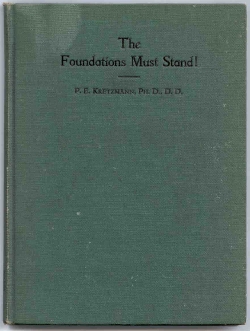
Popular Commentary of the Bible, by Dr. P. E. KretzmannThe name Dr. P.E. Kretzmann (1883-1965) ought to be a familiar one to Lutherans of the WELS and ELS, as well as those from other Lutheran church bodies tracing their lineage through the old Synodical Conference. His four volume commentary, Popular Commentary of the Bible, has graced the shelves of our church libraries since the 1920's, and has, throughout this time, been regarded as a reliable non-technical commentary on the Scriptures. Dr. Kretzmann was raised in a modest parsonage, yet grew to become a highly educated "doctor of the church," eventually holding three earned doctorates (Ph.D, Ed.D and D.D.) with which he served the LCMS in several prominent capacities, and the church at large through a prolific body of published works, including books and articles on history, education, theology, as well as children's stories and sermons. When troubles began to surface in the LCMS beginning in the 1930's, we see his commitment to the doctrines of plenary inspiration and biblical inerrancy and authority in his brilliant defense of these doctrines, The Foundations Must Stand! The Inspiration of the Bible and Related Questions – a brief work which begins by recounting the recent history of attacks against these vital Christian teachings, and which continues with an explication of Scripture's teaching concerning itself, a teaching which has been held by orthodox Christians throughout the history of the Church. From the Preface of this book, we read:
    Among all the doctrines of the Bible there is none that occupies a more critical position than that of the inspiration of Holy Writ. We commonly refer to the doctrine of Justification by Faith Alone as the central doctrine of the Christian religion, the articulus stantis et cadentis ecclesiae. But even this fundamental truth of personal faith is not a matter of subjective certainty. It depends, rather, as do all other articles of faith, on the objective certainty of the Word of God, as a whole and in all its parts. In this respect the doctrine of the inspiration of the Bible is fundamental for the entire corpus doctrinae. If Christians in general, and particularly Christian theologians, preachers, and teachers, cannot be sure of the matters which they present in their teaching, then the Bible will cease to be the one norm of doctrine and rule life, and Christianity will cease to be the one absolute religion.

    The Foundations Must Stand! The Inspiration of the Bible and Related Questions, by Dr. P. E. KretzmannThese considerations are so pertinent because, to all appearances, the systematic efforts to discredit, and rule out, the doctrine of inspiration which were made in Germany and elsewhere during the latter half of the last century [19th Century] have been gaining in boldness and strength during the past two decades, until practically every denomination is infested with men who either deny the truth of inspiration altogether or teach a form of inspiration which is so modified as no longer to resemble the clear truth which for centuries had been both foundation and bulwark of the Church.

    ...The present study is an attempt to set forth the meaning and the scope of the inspiration of the Scriptures, not with any recourse to subjective abstractions and philosophical speculations, but chiefly by having the Word of God speak for itself. The task is both delicate and critical, since our whole attitude, not only toward the Bible, but toward the entire Christian religion depends upon our position on this question. If we should feel compelled to make even the slightest concession to the demands of ancient and modern modifiers of the Truth, this would be equivalent to a denial of the Truth which has ruled the Church of God for more than three thousand years. Just as it is not possible to deny the deity of Jesus and then to proclaim Him the greatest man who ever lived, – for He is either, according to His own claims, the Son of God, or He is a deceiver, – so it is not possible to deny the divine inspiration of the Bible and yet to proclaim it the greatest book ever written; for it is either, according to its own claims, the verbally inspired oracles of God, or it is a collection of doubtful writings, which cannot possibly have any real religious value...

    Kretzmann, P. (1936). The Foundations Must Stand! The Inspiration of the Bible and Related Questions St. Louis, MO: Concordia Publishing House. pp. 3-4.
As we all know, despite this work of Dr. Kretzmann's, challenges to the doctrines of inspiration and inerrancy continued to grow in the LCMS, until by the 1960's the situation reached crisis proportions. The Crisis of the Word was the theme of that decade and into the one following, from which, to God's glory, the LCMS emerged affirming a fully orthodox position on the questions of inspiration and inerrancy, and rejecting the errors of the critics. In the meantime, however, Dr. Kretzman and others could not abide the error wrought by deniers of inerrancy, particularly the error of unionism. In 1951, Dr. P. E. Kretzmann left the LCMS along with sixteen other clergymen and laymen, forming the Orthodox Lutheran Conference (OLC). A brief, early history of the OLC, written by Dr. Kretzman, can be read here: A Short History of the Orthodox Lutheran Conference.

Although just a small collection of men, this group supplied such pressure on the LCMS, that the objections of the WELS and ELS over the same issues could not be ignored. In fact, the OLC was credited by their contemporaries in the LCMS with forcing that Synod to take the doctrinal concerns of WELS and ELS seriously. As all to often happens, unfortunately, division within this small group developed within a short period of time. Charges of unionism were levied against Dr. Kretzmann by some of the OLC members, leading, in 1956, to the separation of Dr. Kretzmann, and four others who supported him, from the Conference. Later, after the withdrawal of WELS and ELS from the Synodical Conference over the persistent errors of the LCMS, Dr. Kretzmann and his supporters joined the WELS. A more thorough history of the OLC, which includes many of these details, can be read here: A Popular History of the Concordia Lutheran Conference (through 1980).

(NOTE: Many thanks to Rev. Samelson for his corrections to the above paragraph. See his contributions in the comment section)

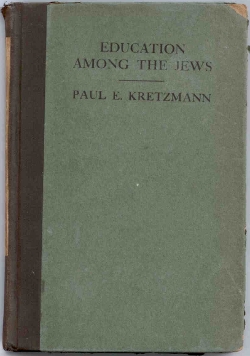
Dr. Kretzmann's resolve to stand on the Truth was not a product of his position within the church, his notoriety or experience. It was a product of his confidence in the teachings of Scripture – and we see evidence of this in his writings even as a young man. For example, in 1916, at age 32, he wrote a book for the The Boston Talmud Society, entitled, Education Among the Jews: From the earliest times to the end of the Talmudic Period, 500 A.D. He knew for whom he was writing, and he knew that they knew who the writer was and what he believed, yet, rather than water down his Christian rhetoric in order to be sensitive to Jewish readers, or to worldly scholars who profane the Biblical texts, he boldly declared his faith and confession in the Introduction, stating:
    Education Among the Jews from the earliest times to the end of the Talmudic Period 500 AD, by Dr. P. E. KretzmannIn publishing this little booklet, the author is very well aware that he is placing himself in the most unfavorable light and courting the most adverse and abject criticism of so-called scientific scholarship of the Bible. But he freely acknowledges and proudly confesses his absolute rejection of all scientific criticism of the Bible outside of textual research and stands squarely for the infallibility of Holy Scriptures. The Christ Whose words even the most rabid critics admit to be historically true: "The scripture cannot be broken," Jn. 10:35, "Till heaven and earth pass one jot or one tittle shall in no wise pass from the law, till all be fulfilled," Mt. 5:18, was either what He claimed to be, the eternal Son of God, Who gladly permitted the attribute of Omniscience to be ascribed to Him, and Who in these words is a frank exponent of the infallibility of Holy Scriptures, or He was the most despicable hypocrite and cheat the world has ever known. And I confess that I believe it far better to stand with Him foursquare against all criticism of His eternal word, which is the revelation of His divine Essence, than to stand on the uncertain ground of modern Biblical criticism and degenerate into a vapid spouter of moral platitudes. Much better by far to accept the inspired Scriptural account of the creation of the world and of the history of the Jewish people word for word which has stood the test of the ages and endured the vain mutterings of foolish criticism both here and abroad than to accept the inane theory of a so-called cosmic evolution. Which is the more reasonable and more conformable with common sense: the plain, unadorned Scriptural account that bears on its face the stamp of veracity, or the bolstered-up bombast of the forfenders of evolutionistic doctrines? The author's stand will not be misconstrued by people that have made a study of both sides of the question. In any question pertaining to this world's wisdom I believe in research and criticism to the full extent, but far be it from me to profane the Holy Book of God with sacrilegious hands. So much for the spirit in which the author has used the Bible as source material.

    Kretzmann, P. (1915). Education Among the Jews: From the earliest times to the end of the Talmudic Period, 500 A.D. Boston: The Talmud Society Publishers. pp. 5-6.
This is the voice of conviction – is it not? – the sound that a Christian makes as he lives by conscience while facing the enemies of the pure Gospel of Jesus Christ. Dear reader, is this the sound you make when the World attacks the Scriptures and would rob you of the peace and assurance you have in the promises of Christ? Is this the sound you are encouraged to make? Or are you told that it is "more winsome" to prevaricate, "more evangelical" to equivocate, "more loving" to just grin and bear it?

Tuesday, March 22, 2011

C.P. Krauth explains how orthodox Lutheran Synods descend into heterodoxy

Charles Porterfield KrauthThe name Charles Porterfield Krauth (d. 1883) may be unfamiliar to most WELS Lutherans. Perhaps this is because he was not WELS. Regardless of the reason, this unfamiliarity is most unfortunate, for Krauth was, in fact, a leading figure of the confessional Lutheran movement in 19th Century America, and his contributions to confessionalism remain vitally important. He was a Lutheran of the early Eastern synods and a student of Samuel Schmucker (d. 1873) – who taught that the Augsburg Confession was rife with error, envisioned a future for American Lutheranism which espoused union with Reformed and Methodist Christians, advocated a theological formula for doing so, and even founded an organization to advance these ideas. Krauth grew to oppose Schmucker, his former teacher, eventually retiring from parish ministry to combat unionism full-time and to work toward establishing confessional unity among Lutherans in America under the Unaltered Augsburg Confession. To this end, and under Krauth's leadership, the General Council was formed in 1867, serving as a significant and positive force for the advancement of Lutheran confessionalism. That work still being "relevant", portions of the General Council's output has even appeared on Intrepid Lutherans in the past – the Explanation of the Common Service being published on this blog last July (which is now available in book form from Emmanuel Press, should the reader desire a personal copy). Regarding Krauth and his significance, Rev. David Jay Webber (ELS), in his fine essay Charles Porterfield Krauth: The American Chemnitz, quotes a figure who should be familiar to WELS Lutherans – C.F.W. Walther:
    Krauth was... the most eminent man in the English Lutheran Church of this country, a man of rare learning, at home no less in the old than in modern theology, and, what is of greatest import, whole-heartedly devoted to the pure doctrine of our Church, as he had learned to understand it, a noble man and without guile.
Being in a position to witness firsthand the decline of confessional unity among Lutherans, and to observe and analyze its causes from both doctrinal and practical standpoints, Krauth can be regarded as an authority when he explains the process by which the leaven of heterodoxy is introduced to orthodox Lutheran church bodies and eventually comes to dominate their teaching:
    When error is admitted into the Church, it will be found that the stages in its progress are always three. It begins by asking toleration. Its friends say to the majority: 'You need not be afraid of us; we are few and weak; let us alone, we shall not disturb the faith of others. The Church has her standards of doctrine; of course we shall never interfere with them; we only ask for ourselves to be spared interference with our private opinions.' Indulged in for this time, error goes on to assert equal rights. Truth and error are balancing forces. The Church shall do nothing which looks like deciding between them; that would be partiality. It is bigotry to assert any superior right for the truth. We are to agree to differ, and any favoring of the truth, because it is truth, is partisanship. What the friends of truth and error hold in common is fundamental. Anything on which they differ is ipso facto non-essential. Anybody who makes account of such a thing is a disturber of the peace of the Church. Truth and error are two coordinate powers, and the great secret of church-statesmanship is to preserve the balance between them. From this point error soon goes on to its natural end, which is to assert supremacy. Truth started with tolerating; it comes to be merely tolerated, and that only for a time. Error claims a preference for its judgments on all disputed points. It puts men into positions, not as at first in spite of their departure from the Church’s faith, but in consequence of it. Their repudiation is that they repudiate that faith, and position is given them to teach others to repudiate it, and to make them skillful in combating it.

    Krauth, C.P. (1871). The Conservative Reformation and its Theology. Philadelphia: Lippincott. (pp. 195-196).
Has the leaven of heterodoxy entered the doctrine and practice of the WELS? If so, to which one of Krauth's stages might that leaven have progressed? Recall the recent Intrepid Lutheran blog post Lutheran Martyr: The story of Dr. Robert Barnes as a lesson in the realities of “Political Unity” – understanding, of course, that this post was as much about the travails of "political compromise" within the church as it was about Dr. Barnes. Is the concept of "political compromise" included in Krauth's explanation, above? How might continued compromise exacerbate, rather than alleviate, the problem of heterodoxy?

Monday, August 30, 2010

Pietism and Ministry in the WELS: A brief review of Craig Groeschel, Part 1

On Tuesday of last week, in the closing sentence of the post, Public Ministry and the Divine Call, I promised that we would have more to say in coming days and weeks regarding the sources we see repeatedly surfacing among congregations implementing practices of the Church Growth Movement. One such source is Craig Groeschel’s LifeChurch.tv, which, based on personal observation and the observations of numerous laymen and pastors who maintain contact with IL, seems to be rapidly growing in popularity among various churches and schools in our Synod.

LifeChurch.tv is online Church, with about a dozen physical locations throughout the United States. Of key interest to WELS churches, however, is the numerous resources that are made available for free, as a way of “equipping churches” to “bring people closer to God” (Church Resources). Chief among these “resources” are the sermons of celebrity evangelical preacher, Craig Groeschel.

Without going much further, already we see problems. WELS churches that enter into usage of these materials are doing so under the banner of being equipped for ministry by the heterodox. Further, as proof of their heterodoxy, we have the stated purpose of these materials: to bring people closer to God. This statement does many things, two of which are as follows:
  1. It attenuates the righteous severity of God’s Justice. If, apart from faith, apart from the benefits of Christ’s work on my behalf, I am separated from God, unable, because of my own inbred sin, to merit standing in His sight (Ro. 3:10-20), or to move myself closer to Him or to lay hold of Him (Is. 64:6-7), there is then a gulf between me and Him which cannot be traversed. I cannot get “closer to God. ” Any separation from Him is total separation from Him. Apart from the free gift of faith, there is no such thing as “closer to God” as if I can get closer and closer to enjoy the comfort of being “almost there.” Almost there merits eternal damnation in the fires of hell as surely as “nowhere near.” Everyone separated from God by unfaith stands equally as His enemy, and is equally doomed for eternity.
  2. It cheapens the value of salvation. If, through faith, I am God’s own dear child, how much closer to Him can I get? Through faith, the gulf of separation has been traversed, I am no longer God’s enemy, but am considered by Him to be the brother of Christ. Is there a status of “extra special child of God” for me to attain to? Perhaps there are levels of standing before God? Perhaps by pining and tarrying after Christ, or by some other regimen of pious exercise or form of right living, I may be granted the position of ruling at the right or left hand of Christ? The original disciples thought such things, and were corrected by Jesus for their error (Lk. 9:46-48; Mt. 18:1-4; Mk. 10:35-45). The fact is, as children of God, we all stand equally as the greatest in the Kingdom of Heaven – there is none greater or lesser, there is no Jew or Greek, male or female, all are one in Jesus Christ (Ga. 3:28-29). I do not attain “closer” standing with God than other believing Christians have, regardless of our relative “progress” in Sanctification. Once I have Faith, I have arrived – I am God’s own dear child, and immediately have the greatest standing in His kingdom. And to this faith I cling. For a Christian to speak of being “closer to God,” as if other Christians are somehow not as close to God, or as if one can gain greater “closeness” or “standing” in His sight is to view his relationship with God purely through worldly eyes.
But let’s examine Craig Groeschel and LifeChurch.tv a bit more closely. One interesting thing about Craig Groeschel is that he is not some fly-by-night, one-man-church-body with a theological perspective so unique that no one else agrees with him. He is not the non-denominational corner-church religious quack that has been so popular over the past two decades or so. He, and his online ministry, have religious affiliation with a bona fide church body, that has been in existence in the United States since 1885. He has gravitas.

The Evangelical Covenant Church
Craig Groeschel and LifeChurch.tv are affiliated with the Evangelical Covenant Church – a church body with roots in Scandinavian Lutheran Pietism:
    LifeChurch.tv is part of the Evangelical Covenant Church (ECC) - a rapidly growing multi-ethnic denomination in the United States and Canada with ministries on five continents of the world. Founded in 1885 by Swedish immigrants, the ECC values the Bible as the Word of God, the gift of God's grace and ever-deepening spiritual life that comes through faith in Jesus Christ, the importance of extending God's love and compassion to a hurting world, and the strength that comes from unity within diversity (Beliefs).
So what does the ECC believe? Surely, given their Lutheran roots, there is much with which a WELS Lutheran might find resonance! Let’s briefly examine their claims.
    From the Preamble to the ECC Constitution and Bylaws

    The Evangelical Covenant Church is a communion of congregations gathered by God, united in Christ, and empowered by the Holy Spirit to obey the great commandment and the great commission. It affirms its companionship in faith with other church bodies and all those who fear God and keep God's commandments.

    There are two problems here: the emphasis is on "obey," rather than "believe," – Law over Gospel. Also, their concept of "fellowship" is very broad and ecumenical, assuming such with all who “fear God and keep His commandments” – which is subjective and ultimately legalistic. This concept is, therefore, unscriptural and not at all compatible with the Lutheran Confession.

    The Evangelical Covenant Church adheres to the affirmations of the Protestant Reformation regarding the Bible. It confesses that the Holy Scripture, the Old and the New Testament, is the Word of God and the only perfect rule for faith, doctrine, and conduct. It affirms the historic confessions of the Christian Church, particularly the Apostles' Creed and the Nicene Creed, while emphasizing the sovereignty of the Word of God over all creedal interpretations.

    This sounds reasonable - at first. However, "emphasizing the sovereignty of the Word of God over all creedal interpretations" is an open invitation to any and all weak, false, and dangerous theology. It is an expression of a quatenus subscription to the Creeds, holding them up to qualification on the basis of personal interpretation of Scripture. Lutherans require an unqualified quia subscription to the Creeds as well as the Lutheran Confessions.

    In continuity with the renewal movements of historic Pietism, the Evangelical Covenant Church especially cherishes the dual emphasis on new birth and new life in Christ, believing that personal faith in Jesus Christ as Savior and Lord is the foundation for our mission of evangelism and Christian nurture. Our common experience of God’s grace and love in Jesus Christ continues to sustain the Evangelical Covenant Church as an interdependent body of believers that recognizes but transcends our theological differences.

    Here the ECC clearly and unabashedly embraces the false theology of Pietism. Thus, the obvious emphasis is on sanctification rather than justification, again Law instead of Gospel. In addition, the "experience" of Christ becomes the standard of measurement among them, and allows their members to hold different theological beliefs and yet remain in fellowship. Once again, the Biblical doctrine of fellowship is disregarded.

    The Evangelical Covenant Church celebrates two divinely ordained sacraments, baptism and the Lord's Supper.

    Recognizing the reality of freedom in Christ, and in conscious dependence on the work of the Holy Spirit, we practice both the baptism of infants and believer baptism. The Evangelical Covenant Church embraces this freedom in Christ as a gift that preserves personal conviction, yet guards against an individualism that disregards the centrality of the Word of God and the mutual responsibilities and disciplines of the spiritual community.


    Once again personal theological interpretation and rationalism, along with a fair dose of Calvinism, runs rampant in this ECC statement. Both infant baptism, but also the so-called "believer-baptism" is employed in the same church body. It wouldn't be surprising to find both used on a single individual at different points in his life! Consistency with “believer-baptism” would require it!

    The Evangelical Covenant Church has its roots in historical Christianity, the Protestant Reformation, the biblical instruction of the Lutheran Church of Sweden, and the great spiritual awakenings of the eighteenth and nineteenth centuries. These influences, together with more recent North American renewal movements, continue to shape its development and distinctive spirit. The Evangelical Covenant Church is committed to reaching across boundaries of race, ethnicity, culture, gender, age, and status in the cultivation of communities of life and service.

    By acknowledging and even exulting in the "great spiritual awakenings" of the past, the ECC clearly lays out its theological parentage. This church body was not and is not a confessional Lutheran church body, pure and simple. The ECC is thoroughly ecumenical in the worst sense of the word, and thus degrades and denigrates both its tenuous connection with its Lutheran past, and its supposed devotion to Christ and His Word. Simply put, this is a heretical church body, with which WELS churches and Pastors should have nothing whatsoever to do!


Craig Groeshel and LifeChurch.tv: The Beliefs they Pass Along to their Users
    In Non-Essential Beliefs, we have liberty. Accept him whose faith is weak, without passing judgment on disputable matters... Who are you to judge someone else's servant? To his own master he stands or falls... So then each of us will give an account of himself to God... So whatever you believe about these things keep between yourself and God.

    What makes the Covenant unique from other denominations is the fact that while it strongly affirms the clear teaching of the Word of God, it allows believers the personal freedom to have varying interpretations on theological issues that are not clearly presented in Scripture (Beliefs).
Prior to becoming Confessional Lutherans many years ago, my wife and I visited an ECC Church. Upon leaving, after a conversation with the Pastor and his wife, we were handed a pamphlet describing the teachings of the ECC. The glaring error it contained, which prompted our rejection of this church body's claim to orthodoxy and guaranteed that we would never return, was the distinction of Scriptural teachings it emphasized (and I quote from memory): We divide the teaching of Scripture into two categories – negotiable and non-negotiable. My good wife scoffed: “Precisely what teachings of Scripture are ‘negotiable’?” In the reference above we receive the answer: negotiable teachings are the teachings that are “non-essential” to Salvation, i.e., the “non-fundamental” teachings of Scripture. Of these, one is advised to keep his mouth shut and his “opinions” to himself. And so we see that association with Craig Groeschel will include the teaching (whether subtly or overtly) that non-fundamental doctrines are merely matters of opinion, or adiaphora. This is the heart of doctrinal indifferentism, a hallmark of Pietism as described in our post two weeks ago, Lay Ministry: A Continuing Legacy of Pietism. But let’s examine the perspectives of Craig Groeschel and LifeChurch.tv a little more closely, from their Vision and Values document:
  1. We are faith-filled, big thinking, bet-the-farm risk takers. We'll never insult God with small thinking and safe living.

    Interpretation: We like to tempt God.

    There is nothing laudable in casting Christian Stewardship aside, to openly take “bet-the-farm” risks with resources God has given to us, which he expects us to wisely invest. “Betting the Farm” is not wisdom, but foolishness.

  2. We are all about the "capital C" Church! The local church is the hope of the world and we know we can accomplish infinitely more together than apart.

    Interpretation: We're NOT all about the "Big C" Christ. We ARE all about ourselves!

    This is pure anthropocentrism – man “accomplishing” for God what He as defined as purely the Holy Spirit’s work. Moreover, this is expression of deep doctrinal error concerning the “Church” itself: the local congregation is not “capital C” church, it is visible Church, composed of hypocrites and believers together. We believe that the Church Militant is among the visible Church, but the local congregation is not, properly speaking, the Church Militant or the One True Church.

  3. We are spiritual contributors not spiritual consumers. The church does not exist for us. We are the church and we exist for the world.

    Interpretation: We don't need God to tell us or give us anything. We're the most important thing in the world!

    More doctrinal error resulting from a vacuous doctrine of The Church. The Church is the Bride of Christ. It exists for Him, and it serves Him. It does not exist “for the World.” The principle task of the Church Militant is to contend for the Faith – to hold on to the Truth – and, having it, to thus proclaim it before all Creation.

  4. We give up things we love for things we love even more. It's an honor to sacrifice for Christ and His church.

    Interpretation: We're very proud of our giving – boy howdy – and how!

    Here we have further obvious elements of Pietism emerging. Recall the quote from Professor Brenner contained in a previous blog post, Lay Ministry: A Continuing Legacy of Pietism:

    1. Pietism’s emphasis on Sanctification over Justification resulted in Legalism, by shifting the emphasis in the use of Law from the Second Use (as a mirror) to the Third Use (as a guide) and by prescribing laws of behavior in areas of Christian freedom, leading further to Perfectionism; and
    2. Pietism’s elevation of religious subjectivism ...also “separated God’s Word from the working of the Holy Spirit” (breaking down the Biblical teaching of the Means of Grace), “changed the Marks of the Church from ‘the gospel rightly proclaimed and the sacrament rightly administered’ to ‘where people are living correctly,’” and “divided the church into groups according to subjective standards of outward behavior.”

    Sacrifice is a virtue at LifeChurch.tv. It is also a measure of individuals.

  5. We wholeheartedly reject the label mega-church. We are a micro-church with a megavision.

    Interpretation: We are super-concerned about how people see US.

    The ECC is a church body, and LifeChurch.tv is a church within that church. Recall, again, from our blog post Lay Ministry: A Continuing Legacy of Pietism the phrase, Ecclesiolae in ecclesia – “little churches within the church.” LifeChurch.tv may be a “micro-church,” but it also a mega-conventicle. How much of this idea of “little churches within the church” is being passed on to WELS congregations who use Groeschel’s material?

  6. We will do anything short of sin to reach people who don't know Christ. To reach people no one is reaching, we'll have to do things no one is doing.

    Interpretation: We have a very, very broad definition of "sin," so just about anything we can think of, we can do!

    Do these phrases sound familiar? Do any of our WELS pastors make nearly verbatim use of the phrase, “To reach people no one is reaching, we'll have to do things no one is doing” and not only apply it to themselves but use it as the basis of their local ministry? Do any of our WELS pastors hail as a badge of honor, almost verbatim, that they “will do anything short of sin to reach people who don't know Christ?” If so, from where might they be absorbing these ideas? Is making such prominent and verbatim use of notoriously heterodox ministry fundamentals not tantamount to pan-unionism?

  7. We will lead the way with irrational generosity. We truly believe it is more blessed to give than to receive.

    Interpretation: Two points so far on our great giving! Have we mentioned that we're really, really great big givers, and the best and most givingest givers there ever were!?! WOW, are we good!

    Again with the Pietism. The Marks of the Church in these types of references are clearly “where people are living correctly” and division within the Church is established on the basis of outward behavior – in this case, outward displays of generosity.

  8. We will laugh hard, loud and often. Nothing is more fun than serving God with people you love!

    Interpretation: We totally reject what Jesus said about serving Him in His Kingdom having anything whatsoever to do with any kind of "cross," pain, trial, or hardship!

  9. We will be known for what we are for, not what we're against. There are already enough jerks in the world.

    Interpretation: Anyone and everyone who wants to talk to us about anything resembling "doctrine," or "theology," is a fat-head and a creep – not to mention, jerk!

    Consistent with Pietistic doctrinal indifferentism, discussion of doctrinal matters, or holding to a Confession extending beyond the so-called “fundamentals” of the Christian faith earns nothing but a pejorative reference. Indifferentism is by no means a source of peace, but a catalyst for conflict. It is the true seat of division within the Church.

  10. We always bring our best. Excellence honors God and inspires people.

    Interpretation: We forget, have we told you how good and great and wonderful we are yet? If not, we sure are – and then some!

    Again with the Pietism – of comparing one’s Sanctification with others, and using that as a defining characteristic. They “bring their best” in distinction to those who don’t, or who don’t on their terms.

  11. The only constant in our ministry is change. God is always doing a new thing. Why we do what we do never changes. How we do it must change.

    Interpretation: We think that guy in the Bible who said there wasn't ever anything new under the sun is an idiot (Ec. 1). Also, we think the way the Apostles and 2,000 years of Christianity has worshiped is dumb, boring, and stupid, and besides which – we like to have fun, remember!?

  12. We don't recruit volunteers; we release leaders. Volunteers do good things but leaders change the world.

    Interpretation: It is not Jesus and His work, but our goodness and greatness that will save the world!

    There is no Cross in this. There is only a Theology of Glory.

  13. We're living in the "good old days." We're thankful for God's blessings today and expect even more tomorrow.

    Interpretation: We don't believe in "tribulation," or persecution, or Judgment Day. We're getting better and better and greater and greater day by day until we reach heaven all by ourselves! Are we really something, or else?!
Use of Craig Groeschel’s material in WELS congregations and schools is a serious matter. Sure, it may be tempting to use material from a church body having roots in Lutheranism somewhere in the distant past, especially if the materials are essentially Public Domain. But it is a severe and disqualifying lapse of ministerial judgment to seek ministerial “equipping” from heterodox sources, to allow oneself to become openly associated with heterodox teachers, and, further, to willingly endanger the souls under one’s care by making verbatim use of such materials and thus expose Christians to faith killing error.

We will have more to say regarding the sermons of Craig Groeschel, and implications of their use in WELS churches, in coming days.

Mr. Douglas Lindee
Rev. Steven Spencer

Creative Commons License
This work is licensed under a Creative Commons Attribution-Noncommercial-No Derivative Works 3.0 United States License