Showing posts with label Christmas. Show all posts

Wednesday, December 19, 2012

The Real Story of “Christmas”

How the Observance of Our Savior’s Birth Became A Winter Festival of Holly, Deck the Halls, and Saint Nick!

'The Nativity at Night' by Guido Reni, 1640The term “Christmas”
The word “Christmas” comes from the Old English term Cristes Maesse, or the “Mass of Christ,” first found recorded in A.D. 1038. In Dutch it is “Kerst-misse,” and in Latin “Dies Natalis,” from which we get the French word “Noël.” In Italian it is “Il natale;” but in German “Weihnachtsfest,” named for the sacred vigil which takes place the night before Christmas. The word “Yule” simply comes from the Anglo-Saxon word “geol,” or feast, which was also the name of their month in which this feast took place. In Icelandic the term is “iol,” a feast still celebrated there each year in December.

As far as we can tell, Christmas as an observance of the birth of Jesus Christ, was not celebrated during the first hundred years of the Christian Church. The first evidence of the feast comes from Egypt. Sometime just before A.D. 200, Clement of Alexandria said that some Egyptian theologians set the year and the day of Christ’s birth, placing it on 25th day of the Egyptian month Pachon, or our May 20th, in the twenty-eighth year of Caesar Augustus. However, Clement also tells us that the Basilidians celebrated the Epiphany, and with it, the Nativity, most often on 11 Tybi, or our January 6th. Indeed, this double celebration became quite popular, partly because the appearance to the shepherds was seen as a manifestation of Christ’s glory, with the other being the worship of Magi from the East, which was already observed on that day. The December feast day did not reach the rest of the Church in North Africa until around the Third Century A.D.

When Was the first “Year of Our Lord?”
When was Jesus born? According to the present system of reckoning time, Jesus was born on December 25th before the year 1 (thus 1 B.C. as there is no year “zero”), or 754 years after the founding of Rome. This system was introduced by the Roman abbot, Dionysius Exigius in the Sixth Century, and is therefore called the “Dionysian System.” It was first used in historical writings in the Eighth Century by The Venerable Bede. Shortly after this, it was given official sanction in public documents by the French king Pepin the Short, and later by his son, Charlemagne. However, nearly all theologians are generally agreed that the year is not correct. The majority of the theologians of our day have accepted the year 749 or the early part of 750, four or five years before our era. This is based on the following facts:'Herod the Great' by Théophile Lybaert, 1883
  1. Jesus was born, according to both Matthew and Luke, before the death of Herod the Great. King Herod died during the 37th year after he had been appointed in Rome to rule over Judea. Thus his coronation took place in the Roman year 714. (Romans marked years from the founding of the City of Rome, which in our calendar took place in 753 B.C.) It was the Jewish custom that the royal years should always be counted from the 1st of Nisan (usually corresponding to our month of April), the first month of their religious year. Thus, his 37th year makes it’s beginning on the 1st of Nisan, 750, and runs to 751. Therefore Herod died in 750 or 751, four or five years previous to the present era. And since Herod ordered all the infant males in Bethlehem killed who were less than two years of age, Jesus would have to have been born in late 749 or very early in 750, that is, 5 or 4 B.C.
  2. The Jewish historian Josephus states that an eclipse of the moon took place shortly before the death of Herod. Astronomers have established that this happened in the night of March 12 to 13, 750. The death of Herod therefore falls in the latter part of March or early in April 750. At that time Jesus was already born, and as His circumcision, the Presentation in the temple, the visit of the wise men, and the slaughter of the innocents in Bethlehem belong between these two events, there must be a reasonable interval before the death of Herod. Herod died shortly after the murder of the children in Bethlehem. Jesus must have been born, then, in the final days of 749 or early in 750.
  3. In John 2: 19-20, we are told that when Jesus was in Jerusalem for His first Passover after His own baptism, He said, “Destroy this temple...” after which the Jews answered Him, “Forty and six years was this temple in building...” The sanctuary was not at that time completed, and we know that the work of reconstruction was begun in the 18th year of the reign of Herod.'St. John the Baptist' by Leonardo da Vinci, 1516 The first year Herod actually ruled in Judea came in 717, the 18th year then falls between 734 and 735. The year of this visit of Christ to Jerusalem must therefore be 780. Since Luke informs us that Jesus was about thirty years of age when He commenced His ministry shortly after His baptism (Luke 3:23), we therefore come once again to late 749 as the year of His birth.
  4. Luke 3:1 contains the account of John the Baptist and of his appearance as the Forerunner of Christ. According to his report, the activity of John dates from the 15th year in the rule of Tiberius. The emperor Augustus died August 19th, 767, and was succeeded on the throne by his stepson, Tiberius. However, we should note that Luke uses the word “hegemony,” not “monarchy,” when he mentions the fifteen years in the reign of Tiberius. The Roman historian, Tacitus, informs us that Augustus, in a manner consistent with Roman law, made Tiberius his co-ruler toward the close of 764 or in January 765. From that time on then Tiberius was also Caesar. The Baptist’s appearance upon the scene comes then in 779. After John had begun his work, Jesus came to him. Thus, we arrive at 779 as the year of Jesus’ baptism, which brings us yet again to the Winter of 749-750 as the time of His birth.

What Was the Month and Day of Christ’s Birth?
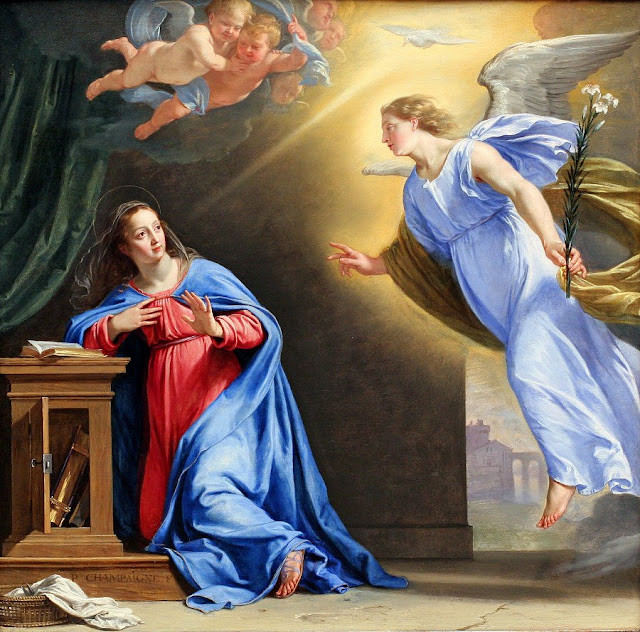
'The Anunciation' by Phillippe de Champaigne, 1644But, in which month and on what day was Jesus born? Our present system uses December 25th, as we all know. And this date was universally accepted in the Fourth Century by the Western Christian Church, while the Churches in the East observed either January 6th or 10th. According to the old Julian calendar, December 25th was the shortest day of the year, and referred to in Rome and elsewhere as “the birthday of the unconquerable sun” or Dies natatis invicti solis. After that day, the sun began to rise on the horizon, and the days began to lengthen once again. As Jesus is the light of the world, early believers felt it was eminently fitting that the day of His birth should also be December 25th. This date was first placed on record in Rome in connection with Christ’s birth in a chronicle dating from A.D. 354. The Christian writer Chrysostom said, “It is not yet ten years since this day (December 25) was made known. Even so, it is now just as seriously observed as if it has come to us from the beginning. It is very plain, according to the Evangelist [Luke], that Christ was born during the first census, and in Rome it is possible for anyone to deduce, with the aid of the public archives, when this came about. From persons who have intimate knowledge of these records and who still live in the city, we have obtained this day; for they who dwell there and who have kept the day in accordance with an age-long tradition have recently given us this information.” In writing on the 132nd Psalm of David, Augustine says, “John was born on June 24th, when the days already began to diminish; but the Lord was born December 25th in which the days began to lengthen; for John himself has said: ‘He must increase, but I must decrease (John 3:30).’”

'The Vision of Zacharias' by JamesTissot, 1899Also, in his account of the alternation of priests in the temple, Luke gives us additional information touching upon the date of Jesus’ birth. We read that the angel Gabriel came to Zacharias in the temple where he was carrying out the priest’s office before God. From I Chronicles 24 we find that there were twenty-four orders or classes in the priesthood. Each order took its turn eight days twice annually. Zacharias was of the order of Abijah, the eighth in the list given in the Chronicles (1 Chr. 24: 10). From the Talmud we learn that the first order, that of Jehoiarib, was charged with the service on the day the temple in Jerusalem was destroyed, and that this catastrophe occurred the 9th day in the month of Ab, the 5th month of the Roman year 823, corresponding to our August 4, A.D. 70. Working back from this date, we can therefore determine that the later turn of the order of Abijah came October 3rd to 9th in the year 748. Thus, Zacharias officiated for his order on one of these days. After this he returned home, with the conception of John the Baptist occurring sometime after his return. Six months later comes the Annunciation to Mary, in the spring of 749. After three months John the Baptist was born in midsummer 749. And six months after this comes the birth of Christ, in the Winter of 749, December 25th, or January 6th or even the 10th.

Still, if Jesus was born in the dead of Winter, how would this be reconciled with the presence of shepherds in the field, keeping watch over their flocks by night? Those who have traveled in Palestine will testify that weather conditions may remain almost perfect through the month of December, and even far into January.Thus, there is no reason why the last month of 749 or first month of 750 should not be settled upon as the time of Jesus’ birth. This would be our 5 or 6 B.C. Yes, it sounds odd to have Jesus born five or six years “Before Christ,” but unless we want to add five or six years to the number of our current year, we’ll just have to tolerate this little anomaly.

'Annunciation to the Shepherds' by Jacob Gerritz Cuyp, 1594-1650The feast of Christ’s birth was brought into the official life of the Church and the Empire by Constantine as early as A. D. 330. The Christian historian, Epiphanius, writing in Cyprus near the end of the Fourth Century, asserts that Christ was born on January 6th, and the Christian churches in Mesopotamia observed the birth of the Savior thirteen days after the winter solstice; that is, January 6th. But in Cappadocia December 25th was already celebrated as the anniversary of Christ’s birth before 380. About 385 Cyril of Jerusalem asked Pope Julius I to assign the true date of the nativity “from census documents brought by Titus to Rome;” and using this information Julius assigned December 25th. Jerome, writing about 411, chastises the Christian churches in Palestine for observing Christ’s birthday on Epiphany rather than the now accepted December date. In Antioch in A.D. 386, St. Chrysostom tries to unite Antioch in celebrating Christ’s birth on the 25th of December. Indeed, a large part of the community had already observed this festival on that day for at least the previous ten years. In the West, he says, the feast was thus kept, and goes on to say this was no novelty; for from Thrace (Greece) to Cadiz (Spain) this feast was celebrated. Finally, he asserts with authority that the census papers of the Holy Family were still at that time in Rome and could be used to verify the date of this celebration. Unfortunately, these records are no longer extant, otherwise there would be no mystery.

Is the Feast of Christmas Simply a Cover for a Pagan Holiday?
It is clear that the origin of Christmas did not come simply from the Roman festival of Saturnalia. True, the Emperor Aurelian, during his brief rule, tried to institute a lavish festival around the Birth of the Unconquered Sun, on December 25th, A.D. 274, borrowing heavily from the Mithras observances of Persia. He pushed this celebration in order to breathe new life into Roman idol-worship, which was already dying out. And Aurelian’s pronouncement came after Christians had already been associating this day with the birth of Christ for many decades in at least a few parts of the Empire. Indeed this “Sol Invictus” festival was almost certainly an attempt to create a pagan alternative to a date that was already of some significance to believers. Thus, Christians were not imitating the pagans, rather the pagans were imitating the Christians!


Where Did Some of the other “Traditions” of Christmas Come From?

Feasting and Partying
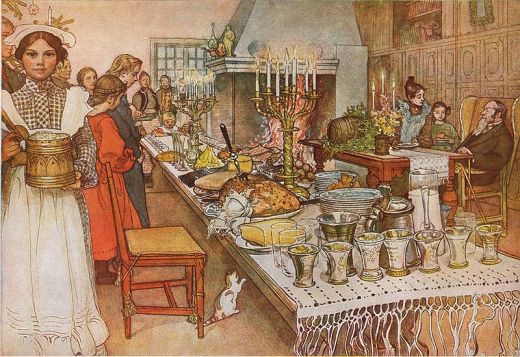
'Christmas Eve' by Carl Larsson, 1904This did not come from the Church. In fact, the Church attempted to impose strict discipline on this festival, and make it day of worship and contemplation. Emperor Theodoric, in A.D. 425, forbade Circus games on 25 December; though not until the time of Justinian III, in 529 is the cessation of all work imposed throughout the Empire on Christmas. The Council of Agde in 506 orders Holy Communion be celebrated on Christmas regardless of what day of the week it falls. The Second Council of Tours in 566 sets the sanctity of the “twelve days” from Christmas to Epiphany, and the duty of an Advent fast. Still, after that merry-making increased so much that the “Laws of King Cnut,” written around 1110, ordered a complete fast for all Christians from Christmas to Epiphany. In England, Christmas was forbidden by Act of Parliament in 1644; the day was to be a fast and a market day; shops were even compelled to be open on pain of a heavy fine; plum puddings and mince pies were condemned as indulgent and heathen. Even after the Restoration, Baptist and Puritan “Dissenters” continued to call Yuletide “Fooltide,” and refused to have anything to do with Christmas.

Christmas Pageants & Carols
Victorian CarolersThe tradition of putting on dramatic, sometimes spectacular, displays of the various incidents of the Nativity began early in the Middle Ages. Often the Apostles and Martyrs would be included with Old Testament prophets, angels, kings, popes, and even well-known poets and artists in honoring Christ in these plays. In fact, the old adage, “To out-herod Herod”, that is, to over-act, dates from the often vivid depictions of Herod’s cruel violence in these plays.

These plays also had a part in bringing about a great number of “noels,” and carols. Prudentius writes a hymn to the nativity in the Fourth Century, and Sedulius in the Fifth Century. The earliest German Weihnachtslieder date from the Eleventh and Twelfth centuries, the earliest French noels from the Eleventh, and the earliest English carols from the Thirteenth. “Adeste Fideles,” for example does not appear in its present form until the Seventeenth century. Most certainly however, these very popular tunes and words must have existed long before they were put down in writing.

Nativity Scenes or The “Crèche”
The word “crèche” comes from the French word for crib or cradle. St. Francis of Assisi in 1223 set up the first crèche outside of church. Normally these nativity scenes, some quite small, others actually life-size, were displayed only in churches, and mostly in the side altars. Almost immediately, however, these little replicas of the stable where Christ was born, along with the central characters of the story, became immensely popular in Christian homes and town squares throughout Europe. The presence of an ox and donkey were seen as a commentary on Isaiah 1:3 and Habakkuk 3:2, and they appear in the unique Fourth Century “Nativity” discovered in the St. Sebastian catacombs in 1877.

Christmas Tree
'Round the Christmas Tree' by Viggo Johansen, 1891In the Thirteenth Century, Gervase of Tilbury wrote that in England grain was exposed on Christmas night to gain fertility from the dew which then falls. Indeed, the tradition that trees and flowers blossomed on this night is first quoted from an Arab geographer of the Tenth Century, and from there the story made it’s way to England. In a Thirteenth Century French story, candles are portrayed on a flowering tree. In England it was Joseph of Arimathea’s rod which was supposed to bloom at Glastonbury and elsewhere. Ivy, holly, mistletoe, and evergreen trees were all used by the ancient Druids as symbols of life in the dead of Winter. These were then appropriated by Christians for the same use.

From these various sources then came the practice of many types of greenery being used as decorations during the Christmas season. One of these customs developed into the Christmas tree. It is thought Martin Luther first brought an evergreen tree into the home and placed small candles on its branches to illustrate everlasting life coming from Christ, the Light of the World. However the first definite mention of such a tree is in 1605 at Strassburg. From there the custom entered the rest of France during the next century, and finally came to England in 1840 by way of the Prince Consort, Albert, the Lutheran husband of Queen Victoria.

“Xmas”
Well-meaning Christians sometimes bemoan the use of the letter “X” in place of Jesus’ title of “Christ” when used to designate the term “Christmas.” Almost every year lately there are emotional calls from believers to “keep Christ in Christmas!” Rest assured, the Savior is still very much in “Xmas.”
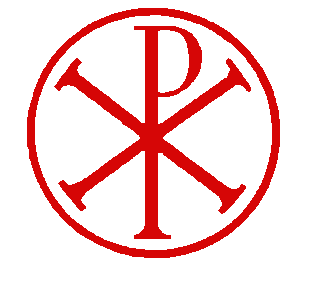
The Chi-RhoThe letter ’X’ of the English alphabet closely resembles the Greek letter “chi,” which in that language gives a sound much like our English ’k,’ as in cholera or chrome. From very early in the Christian Church the first two Greek letters of the word “Christ,” were used as a symbol for the Redeemer. The Greek letter for the “r” sound, or “Rho,” looks like our English letter “p”. We see this combination in the symbol used in many church decorations which we call the “Chi-Rho;” what looks like an “X” and a “P” superimposed over one another.

Eventually, just the single letter “X” also came to represent Jesus Christ. This symbolism came to England with Christianity. As the Anglo-Saxon language grew into first Old English and then common English, it was considered very acceptable to abbreviate “Christ,” or “Jesus Christ” with either the Chi-Rho, or just the Chi or “X”. We can see this done frequently in the Anglo-Saxon Chronicles beginning around A.D. 1050. This usage continued to be quite common through the Middle Ages, to the Victorian period, and of course is still used today. There was never any intention to do away with Jesus. “Xmas” means “Christmas,” period.

Santa Claus and Gift-giving
It is said that the origin for the mysterious benefactor of Christmas night: Knecht Ruprecht, Pelzmärtel on a wooden horse, St. Martin on a white charger, St. Nicholas, or Father Christmas, comes from Saints stepping into the shoes of the pagan god Oden, who, with his wife Frigga, descended during the nights between 25 December and 6 January on white horses to bless both earth and people. Welcoming fires were set on the hilltops, houses were adorned with many kinds of decorations and lights, work and trials suspended, and great feasts celebrated during these nights.

Indeed, it was quite common for peoples once they converted to Christianity to incorporate their one-time pagan deities into many of the customs and traditions of the new Christian Church. However, that is only part of the story, and it would not be fair not to give due acknowledgment to the individual most certainly more responsible than any other for the “Santa Claus” phenomenon, namely, Saint Nicholas of Myra.

Santa Claus with GiftsAs with many heroes of the early Christian Church; i.e. those that lived during that period of nearly three centuries before the faith could be practiced openly and without persecution; the life and works of Nicholas have acquired a great many myths and legends, some of them quite fantastic. In fact, one could say he is perhaps the most honored and venerated of any of Saints of this period. These facts we know: He was born about A.D. 270 at Patara in Lycia in the Roman province of Asia, now modern Turkey, to well-to-do Christian parents. Both his parents died in a plague when he was quite young and left him very wealthy, and he was raised by an uncle who was the Bishop of Patara. From very early in his childhood he was known for his piety and zeal for the Lord and the Church. He underwent severe hardship and imprisonment during the intense persecution of the Emperor Diocletian, but survived to see the legalization of the Christian faith during the rule of Constantine. When the office of Bishop at Myra, the provincial capital went vacant, the people persuaded him to take on this office, even though he was still quite young at the time. He was said to have attended the great Council of Nicaea in A.D. 325, and the story is that he walked right up to the arch-heretic Arius and slapped him in the face before the entire assembly. He is said to have died on December 6th, A.D. 343, in Myra, and buried there under the altar of his church. After the Muslim Saracens took over the area in the Eleventh Century, his bones were removed to the town of Bari in Italy, where they remain today.

Among the nearly countless stories of amazing miracles attributed to Nicholas, two stand out as explanations for why he became the model for Santa Claus. During a severe famine a man of Patara lost all his money and was about to lose his home and property. He had three daughters of marriage age, but because they had no dowry they had no prospects of finding husbands. The father planned, it is said, to force his daughters into prostitution so that the family could survive. Nicholas heard of his plans, and one night, tossed three bags of gold in though an open window where the daughters were sleeping. Finding the gold when they awoke the next morning, they now had their dowries and soon were married off successfully.

In some versions, the bags were given in three successive nights, or even years on the same date, and by some accounts the bags were thrown – where else – down the chimney. Another variant has the daughters wash out their stocking and hang them to dry, the gold bags landing in them to be found the next morning. All these variants were widely known throughout the Christian world as early as the A.D. 700s. Another story takes place during yet another famine. An innkeeper on an island just off the coast of Myra supposedly killed and butchered three little children, and put them in pickling barrels to sell them to unsuspecting guests. Visiting the island to give aid to the needy, Nicholas surmised the evil deed done by the innkeeper. He brought the children back to life and returned them to their parents, thus becoming seen as the special protector and benefactor to all children.

From these pious legends it is easy to see how Saint Nicholas could become so dear and important to people of many countries down through the centuries. That his “saint day” was so close to Christmas also lent itself to a close association between the two. Once we throw in various other aspects left over from early pagan sources, such as elves, reindeer, sleighs, coal, and the like, and stir the whole mixture together with an excuse for merry-making at the end of the year and the natural commercialism of free enterprise – viola! – Santa Claus!

Christmas Eve at ChurchOf course, Christian believers, should, can, and do filter out all this interference with their worship of the Christ-child, and the celebration of the great fact of Christmas, which is Immanuel – God with us! As the Apostle John writes so beautifully by the inspiration of the Holy Spirit, “And the Word became flesh, and dwelt among us, and we saw His glory, glory as of the Only Begotten from the Father, full of grace and truth.” (John 1:14)

A very blessed and joyous Christmas to one and all!

Pastor Spencer

[Once again, no claim is made for originality in this material. It has been collected from many sources over many years, for the benefit of my local congregation.]

Thursday, October 11, 2012

Confessional Lutheran Evangelism: Confessing Scripture's Message about Advent & Christmas


The Feast of the Nativity of our Lord, Jesus Christ

The Church Calendar and Evangelism: Reformation

In my previous post, entitled Confessional Lutheran Evangelism: Confessing Scripture's Message about the Reformation, I promised in this final installment to feature the evangelism mailing our congregation had developed for Advent/Christmas – and in the case of this mailing, Advent definitely made a prominent showing. We did this on purpose – just as we recognized of the term “Lent” (see my post covering the development of our Lenten mailing), we realized that most folks in the upper midwest have probably at least heard the word “Advent,” and have maybe even heard it used in connection with Christmas, but probably don't really know what it is. Since our congregation takes the season of Advent as seriously as it does Lent, holding mid-week Advent services in the weeks prior to Christmas, and since most folks have already heard of Christmas (though many are confused about its true meaning), we decided to develop a mailing that would share the message of Law and Gospel by making use of the term “Advent” in a way that prominently connects it to Christmas and to as many of the other topics we shared throughout the year as possible – using and reinforcing terms and concepts from our Lenten, Good Friday, Easter, Pentecost and Reformation mailings. Thus, it begins by both telling and depicting the Old Testament prophecy of the Messiah, continues by depicting the fulfillment of that prophecy with the birth of Jesus Christ, and then concludes by telling the reader of His second Advent – of His imminent Return as a victorious King and righteous Judge – and pointing the reader to his very real need for Righteous standing before God, to his very real need for Faith, in order to be prepared for that Day.

But I also promised to share some brief personal thoughts regarding the vocational needs of the evangelizing congregation and the Evangelical Church at large.

Nurturing the Fine Arts in the Church
If the Church, or the individual Christian, has any “job to do,” if there is anything which the individual Christian, or the Church, ought to become “effective” at, or strive to become excellent at, it is this one thing: communication. The Church is a herald, and Christians tell, of the Good News of Jesus Christ in the Message of Law and Gospel. The Holy Spirit works through that Message to create and strengthen Faith and to teach and remind its hearers of all that Christ taught. We communicate the Message. Period. The Holy Spirit does the rest. But we do communicate.

As was discussed at length toward the end of the 2011 Christmas Season, in my post, Music for the Twelve Days of Christmas, Part 2: Heinrich Schütz ... and other thoughts to ponder over the New Year Holiday..., true Art isn't just dazzling technical skill, it's compelling conversation or communication; and in the comments of that post I elucidate further that skilled communication, as represented in true and compelling Art, represents mastery of the highest stage of learning: the Rhetoric Stage. Thus, true Art isn't “unbridled natural creativity,” which often succeeds in communicating little more than gibberish. Moreover, developing creativity has very little to do with nurturing a child's “natural creative instincts” with a box of crayons or by providing “outlets for creative expression” – although this sort of thing may well develop some technical skill while providing enjoyment and developing interest. The fact is, almost no one has enough creativity of their own, “nurtured” or not, to produce anything compelling, on its own. On the contrary, and as also discussed in that post, true creativity is nurtured by studying the Masters, the very best that Western Civilization has produced throughout its history, by understanding their idiom in its context, and then adding to it one's own pittance of creativity as he communicates in his own context. In other words, the creativity required to to produce a widely compelling work, is not just one's own, it is mostly the creative genius of others plus one's own. In this sense, true Art isn't radical. It's conservative. That is, it is conserving something, namely, the creative genius of the past, carrying it forward through the present and into the future.

This emphasis on “conserving the past” comes up frequently on this blog. In fact, it was the major theme of the paper I delivered at the 2012 Conference of Intrepid Lutherans. That is because it is in this sense that the very character of Lutheranism is historical. As Charles Porterfield Krauth explains in his monograph, The Conservative Reformation and its Theology, the Lutheran Reformation was not a radical reformation, it was conservative. His Preface helps to explain the difference:
    The history of Christianity, in common with all genuine history, moves under the influence of two generic ideas: the conservative, which desires to secure the present by fidelity to the results of the past; the progressive, which looks out, in hope, to a better future. Reformation is the great harmonizer of the two principles. Corresponding with Conservatism, Reformation, and Progress are three generic types of Christianity; and under these genera all the species are but shades, modifications, or combinations, as all hues arise from three primary colors. Conservatism without Progress produces the Romish and Greek type of the Church. Progress without Conservatism runs into Revolution, Radicalism, and Sectarianism. Reformation is antithetical both to passive persistence in wrong or passive endurance of it, and to Revolution as a mode of relieving wrong. Conservatism is opposed to Radicalism both in the estimate of wrong and the mode of getting rid of it. Radicalism errs in two respects: in its precipitance it often mistakes wheat for tares, and its eradication is so hasty and violent that even when it plucks up tares it brings the wheat with them. Sober judgment and sober means characterize Conservatism. Reformation and Conservatism really involve each other. That which claims to be Reformatory, yet is not Conservative, is Sectarian; that which claims to be Conservative, and is not Reformatory, is Stagnation and Corruption. True Catholicity is Conservatism, but Protestantism is Reformatory; and these two are complementary, not antagonistic. The Church problem is to attain a Protestant Catholicity or Catholic Protestantism. This is the end and aim of Conservative Reformation.
Thus, the Catholicity claimed by the Lutheran Confession is necessary to what it, and True Christianity, really is – it represents the outflowing of two thousand years of Christian faith and practice into the present, and projects it into the future.

But this character is not independent of the times and influences in and under which the Lutheran Reformation took place. It was the period of the Renaissance, the guiding principle of which was ad fontes”, or “to the sources.” The Renaissance rediscovery of the past, and re-acquaintance with the Masters of previous millenia through study of their works, not only gave birth to the Reformation, but gifted the world with a veritable explosion of creativity in every area of study, and resulted in some of the finest works of art the West has yet produced. In fact, one could say that all great accomplishments in the West since the time of the Renaissance, has flowed from the principles of Renaissance Humanism, of “returning to the sources” that we may be carried forward on the shoulders of history's giants.

Not only that, and as also explained in last year's post, Music for the Twelve Days of Christmas, Part 2: Heinrich Schütz ... and other thoughts to ponder over the New Year Holiday..., the Renaissance, and the Lutheran Reformation in particular, produced the kind of education that is necessary to conserve the past in this way: called The Great Tradition until the time of John Dewey's “Education Revolution” early last century, which entirely overthrew the “conservative” education of The Great Tradition and replaced it with his pragmatic task-oriented theories of “Progressive Education,” it is today making a comeback under the banner of Classical Education. As I had also explained in that 2011 Christmas Season post:
    “To be sure, there are those in the secular world who yet value this form of education: St. John’s College and Nova Classical Academy are two such examples. Among Lutherans, Classical Education is making a comeback as well: ...the Consortium for Classical and Lutheran Education has made significant progress in advocating and effecting a return to Classical Education in the LCMS [and among other Lutherans as well]. To the shame of confessional Lutherans everywhere, however, credit for the return of Classical Education to American Christianity really belongs to the Reformed, who, influenced by the leadership of groups like the Association of Classical and Christian Schools, have about a two decade head-start on Lutherans in bringing Classical Education back to Christianity. Christian Home Educators are well-known for having adopted this model of education in great numbers early on. In fact, many of the underground Home Educators of the 1970’s were Roman Catholics who wanted their children brought up with Latin and the Classics, but found that both had swiftly disappeared after Vatican II mandated that the Mass be conducted in the vernacular. Yet it remained essentially Evangelical Reformed sources which, apparently being far more attuned to and suspicious of educational movements in secular academia, developed educational resources and supplied encouragement and assistance to Classical Home Educators. The trend proceeded a little more slowly among Christian day schools, but these days the number of Christian schools adopting Classical Education is nearly proliferate... Even the subtitle of Veith & Kerns’ well-known work on the subject, Classical Education, was changed by their publisher in its recent second edition, from 'Towards the Revival of American Schooling' to 'The Movement Sweeping America' – and this is true, largely due to the efforts of the Reformed and of Home Educators.”
To engage in the kind of compelling conversation in which the Gospel of Jesus Christ naturally belongs, it behooves the Church to nurture the Fine Arts, rather than the contemporary entertainment arts (which are “compelling” only as much as they are, and only for as long as they are, entertaining, and thus are in their very nature entirely contrary to the serious Message of Law and Gospel, which confronts its hearer with the weight of eternal significance). To engage in “excellent communication” befitting the nature of the Gospel's message, the Church needs competent thinkers, it needs competent writers, it needs competent poets, it needs competent orators, it needs competent musicians and artists; and to acquire them, it must engage in the difficult task of preparing them with a competent education, one which seats students of the Liberal Arts directly at the feet of history's finest examples and conserves their excellence for our use and for the benefit of those who hear and engage our attempts to communicate with them.

What the reader of this series has seen is a very meager attempt to communicate the Message of the Gospel to the general public in just this conservative fashion, by using the language of the Church and speaking as the Church speaks. This is obvious from the words and phraseology used in the prose itself. It is equally obvious in the artwork used throughout this series, where, again, the artist made use of the familiar artistic language of the Church that it has developed over the millenia to simply represent complex theological Truths and communicate the weighty and joyous Message of the Gospel. For example, in the mailing featured in this post, we see, quite obviously, the Nativity of Christ depicted, with the Protestant use of the nimbus to designate the divinity of the Christ child, and the woman holding the Baby Jesus as His mother, Mary. This is still a familiar image. But I stated above that not only was the Nativity depicted, so was the Old Testament prophecy of the coming Messiah. Where is that depicted? Here is the specific prophecy from the Old Testament that may give the reader a clue:
    There shall come forth a Rod from the stem of Jesse, And a Branch shall grow out of his roots... And in that day there shall be a Root of Jesse, Who shall stand as a banner to the people; For the Gentiles shall seek Him, And His resting place shall be glorious.” (Is. 11:1,10 NKJV)
The dead stump, or “stem,” with a new live branch growing out of it, is a common image long-used by the Church to represent the Old Testament prophecy of the coming Messiah. This image is reinforced with the use of leaves and berries from the Holly Oak, another common Christmas symbol, used by the Church to symbolize the Passion of Christ, specifically, the crown of thorns because of its thorny leaves, and Christ's blood because of the red berries (Holly, being an evergreen, is also said to have been the tree of the Cross, but that is only legend). While some of this artistic language may be lost on the viewer – just as the meaning of the prose may be lost on the reader – this would be the case no matter the artwork or the prose. One thing is clear, however: the Church is speaking, and it is directly speaking the Good News of Jesus Christ. The reader knows this the instant he sees it, and any continued reading and viewing of this content is nothing other than his willingness to hear what the Church says about Jesus. We have every confidence that the Holy Spirit will use those aspects of the Message received by such a hearer to perform within him His work of creating and sustaining faith, and that as his faith grows, he will be compelled by love of God and His Truth to learn more – from whatever source to which the Holy Spirit may guide him.

No, the unregenerate do not need to be tricked into hearing the Gospel through community events, social groups, the allure of entertaining worship, or educational services offered by the congregation – those so-called “pre-evangelism” techniques promoted by the Church Growth Movement are just crutches to prop up a visible Church in steep decline, that has lost the art of compelling communication, that has lost the compelling art of communicating Wisdom with eloquence.

Friday, January 6, 2012

Music for the Twelve Days of Christmas, Part 3: Johann Sebastian Bach

Johann Sebastian BachOur Third and final installment1 of Music for the Twelve Days of Christmas, features a famous Christmas piece by Johann Sebastian Bach (1685-1750). Before introducing that piece, however, it may be interesting to review a little about Bach and his artform. As we summarized last April in the post, Music for Holy Week, Part 1 – excerpts from Matthäus Passion,
    Bach perhaps needs little introduction: he was and remains the master of counterpoint and represents the pinnacle of Baroque musical achievement. In addition to his many secular works, as Cantor of St. Thomas Church in Leipzig he composed a full series of Cantatas to accompany the Lutheran liturgy for each week of the Church Calendar, along with many other Sacred works as he was commissioned... It is worth noting, however, than in addition to his status as a composer, Johann Sebastian Bach was also fiercely orthodox in his Lutheranism. Being active as a composer during the rise of German Pietism2 and attempting to ward it off through the Sacred works he was often commissioned to compose, his professional library was proliferate with personally annotated works of Lutheran theology – he had the library of a theologian, and he used it as reference material in the composition of his works.
Bach's genius as a composer was not entirely his own. He is known to have studied the Masters of the previous generation and incorporated their genius into his own art: men like Michael Praetorius, Samuel Scheidt, Johann Schein, and especially Heinrich Schütz – who was the subject of Part Two of this Music for the Twelve Days of Christmas series. Indeed, Bach's relationship to Schütz is almost serendipitous. Recall from Part Two the concern Schütz had in the second third of his life over the decline in compositional integrity he had been witnessing, for "
    the advent of the chordal style dispensing with linear but rich polyphonic textures made it possible for technically less accomplished composers to shine with concertante figured-bass music. According to Schütz, there were hardly any younger composers in Germany willing to deal with the more profound aspects of composition. So their tonal idiom was bound to become increasingly shallow and banal.
As a result, he published his Geistliche Chormusik (Sacred Choral Music) in 1648, dedicating it to the choir of St. Thomas Church in Leipzig, to "encourage budding German composers, before they would try their hand at the concertante style ...to first demonstrate their skill in this area."

It seems to be unknown whether Bach took the recommendation of Schütz to heart, or whether those responsible for calling Bach to be Cantor at St. Thomas in Leipzig were seeking to diligently live up to the encouragement Schütz obviously meant for them, or whether his Geistliche Chormusik had any such impact by that time at all. But it is, at least, an interesting coincidence. Other interesting coincidences include Bach's place in time: Heinrich Schütz died as Pia Desideria (published 1675) was percolating in the mind of Philipp Jakob Spener (1635-1705); Bach was born as plans for the Pietist learning center, University of Halle were being drawn; while Bach served in Leipzig, the last of the Lutheran theologians from the Lutheran Age of Orthodoxy," and vigorous opponent of Pietism, Valentin Ernst Löscher (1673 - 1749), served as Superintendant and as pastor at the Kreuzkirche in Dresden (practically a stones-throw from the Royal Court, and a place known to benefit from regular collaboration with Schütz); and both Bach and Löscher, being in such proximity, battled with fierce dedication against Pietism in their respective vocations. Löscher and Bach died at the opening of the Enlightenment, in 1749 and 1750, respectively – with no one, really, to take their place.

Art following the Enlightenment ceases to speak of objective subjects
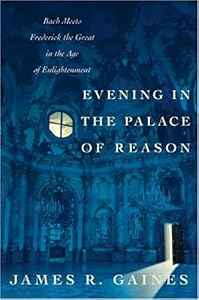
The opening of the Enlightenment, around 1750, marks the end of the Baroque Period, and the beginning of the Classical Period. This period lasts roughly until the period in which German Romantic philosophy began to have cultural significance, around the turn of the 19th Century; this is about the time that Romanticism began to displace Classical expressions of the Enlightenment. But what is it about Baroque music that sets it apart? What really were the "the more profound aspects of composition" referred to by Heinrich Schütz (above)? Why does there appear to be a rigid structure and order in the Baroque period, to the point where J.G. Walther (a cousin of Bach) would define such music as "a heavenly philosophical and specifically mathematical science?"3 From the time of Plato and re-emphasized by Martin Luther, music was viewed as a direct reflection of and "evidence of divine order,"4 in the world and in the Universe. Johannes Kepler wrote "Now one will no longer be surprised that man has formed this most excellent order of notes or steps into the musical system or scale, since one can see that in this matter he acts as nothing but the Ape of God, the Creator, playing, as it were, a drama about the Order of celestial motions."5Evening in the Palace of Reason, by James R. Gaines

As a result of such a lofty view of music and composition, Baroque composers infused their music with numerical code and allegory, attaching meaning to specific numbers and ratios, and in this way, the learned composer attempted "to replicate in earthly music the celestial harmony with which God had joined and imbued the Universe."6 Therefore, as Luther put it, music is the "faithful servant of theology" and ought to deliver "sermons in sound."7

Contrary to those of later era's, like the Classical and Romantic, the Baroque composer saw
    "himself as an artisan: not an artist 'expressing' a personal idea or feeling – a conception the Baroque composer would have found entirely strange – but as a professional with an assigned task and learnable, teachable methods of doing it. Combined with the Baroque infatuation with encoded allegory, this concept of music as an oratorial craft inspired a vast compositional vocabulary of passages, rhythms, key changes, and other devices that could telegraph in music the meaning of a text, the language of which came to be known as musical-rhetorical figures."8
Thus we see the force of Natural Law9, observations of Divine Order and understanding of their significance, informing the expression of Baroque "artisans."
    "The rich acoustic medium of the medieval stone church had encouraged composers' experiments writing note against note (punctus contra punctum) and eventually of braiding related vocal lines through one another to form increasingly rich weaves of melody. The most rigorous of part-writing, such as cannon and fugue, came to be known collectively as learned counterpoint."10

    "For Bach and his musical ancestors ...composing and performing music was ...a deeply spiritual enterprise whose sole purpose, as his works were inscribed, was for the glory of God. [And to His glory], Bach represented Church music and especially the learned counter-point of cannon and fugue"11
Yet, as the Age of Lutheran Orthodoxy came to a close, as the strong Lutheran voice in culture began to wane, as fidelity to God's Word in thought, word and deed gave way to new ways of thinking, and as man in his natural state of rebellion thereby sought freedom from God and the Church, clinging to the only other tools available with which to make sense of the world, empiricism and reason, the necessity and reality of Divine grace also gave way to "confidence in human perfectibility."12 Oddly, the result in artistic expression was that instead of outward or objective subjects, the work of the composer became significantly more subjective, especially by the time of the Romantic Era, standing as much as self-projection as anything else:
    "the expression of feeling in music was all, and the affectation that mattered was not a text or other object for depiction but the feeling state of the performer and composer... the new 'enlightened' composer wrote for one reason and one only: to please the audience."13
In this way, the subject of musical compositions following the Enlightenment became the composer, became his thoughts and his feelings as he struggled to give voice to them through his art, while the performer strove to abscond with that subject by embodying and personifying the composition in his own performance of it, thus making himself the subject of the art.

By the time of Frederick the Great of Prussia, Enlightenment composers had thoroughly
    "denigrated counterpoint as the vestige of an outworn aesthetic, extolling instead the 'natural and delightful' in music, by which they meant the easier pleasure of song, the harmonious ornamentation of a single line of melody... For Frederick, the goal of music was simply to be 'agreeable,' an entertainment and a diversion, easy work for the performer and audience alike. He despised music that, as he put it, 'smells of the Church,' and Bach's chorales specifically as 'dumb stuff.'"14

Bach's Evening in the "Palace of Reason"
Frederick the Great of PrussiaLater in life, Bach was given the opportunity to respond to the Enlightenment, in one of his most outstanding works. As one who represented the modern philosophies of his day, Frederick the Great of Prussia grasped an opportunity to summon the elderly Johann Sebastian Bach to his palace in 1747, for the purpose of presenting "history's greatest master of counterpoint the most taxing possible challenge to his art,"15 for what seems to have been simply a joke out of contempt for the "old" style of music which Bach so ably represented – that of the "learned counterpoint" of cannon and fugue which had been used for centuries to mirror the celestial harmony of heaven and nature. Frederick proceeded to play for Bach a melody of twenty-one notes which had been "constructed to be as resistant to counterpoint as possible"16 and then challenged the elderly composer to improvise a three-part fugue using the theme he had played. Bach, who had mastered the art of his craft and who understood the mechanics as well as the power of music to communicate, was able then and there to improvise "a three-part fugue on Frederick's Royal Theme [which] had all the intellectual rigor of a finished work."17 Not impressed, Frederick demanded that Bach start over, this time composing a fugue in six parts – something which Bach had never done. Bach agreed, but added that he would need time to work out the composition. Two months later, Bach had finished his six-part fugue – but not only this, for Bach had something to say to the monarch who had not simply challenged him, but who had rejected God and the music of the Church. In that time he had composed two fugues, the first being the three-part fugue requested by Frederick, the second being the six part fugue he had also requested, along with ten cannons (each representing the Ten Commandments) and a sonata, bundling them in a single work he titled, Musikalisches Opfer (Musical Offering). The two fugues he named Ricercar, a term he had never used as a title for a fugue. The term is at once a Latin acronymn representing the words Regis Iussu Cantio Et Reliqua Cononica Arte Resoluta (At the king's command, the song and the remainder resolved with cannonic art), and is also a Latin word meaning, "to search out with diligence."18 Bach wove his message to Frederick throughout his composition, using musical-rhetorical tools such as rising and sinking keys. For example, inscriptions were written to the king in the cannons, telling him in one cannon to "Seek and ye shall find" (referring to God's mercy), and indicating the fate of Enlightenment thinking in another cannon which was inscribed to represent the king's glory: though the notes would rise, it never seemed to have left its original key or to go anywhere. One could say that this "Musical Offering to Frederick represents as stark a rebuke of his beliefs and worldview as an absolute monarch has ever received,"19 and at the same time "it is one of the great works of art in the history of music."20 And this is but a small taste of what was going on in art of the Baroque Period. Not just vague sentiment the artist attempted to evoke in the heart of his viewer or hearer, but a specific message using a system long developed according to observation of God's General Revelation.

Bach: Weinachts Oratorium
For this final installment of Christmas Music, we present Bach's Weinachts Oratorium. It's six parts were intended for the context of worship on three generally observed Church holidays immediately following Christmas Day: Parts 1 and 2 for the Feast of Christ's Circumcision (celebrated on January 1), Parts 3 and 4 for the Sunday following the New Year, and Parts 5 and 6 for the Feast of Epiphany. There are multiple recurring themes in Bach's Christmas Oratorio – one of which is a Lutheran lenten theme the reader may recognize from Bach's use of it in his Matthäus Passion. What does he do with this theme throughout the Oratorio? As you listen, what else do you hear?


Johann Sebastion Bach: Weinachts Oratorium
The standard recording of this piece in our household, should the reader be interested,
has become that of the Dresdner Kreuzchor, under Martin Flämig

This full recording of Bach's Weinachts Oratorium is broken into two videos, which play consecutively. It is about 2.5hrs in length.


------------
Endnotes:

  1. I had planned additional installments, but illness has prevented me from getting to them – so I publish this post, even though it is no longer Christmas, but the first day of Epiphany. In fact, credit for most of the content of this post belongs to my wife, who, as an accomplished vocalist and skilled artist, knows these details better than I do. Since her interest and growing area of expertise is cultural apologetics, I asked her to help me out, giving her a few guidelines from which she produced most of the above...
  2. Radical German Pietism, its causes and impact on orthodox Lutheranism, was briefly described in the following post on Intrepid Lutherans: Law and Gospel: What do they teach? -- Part 3.2, What Happened to the Events of the Gospel? (The Church Responds to the Enlightenment: Pietism)
  3. Gaines, James. (2005). Evening in the Palace of Reason: Bach meets Frederick the Great in the Age of Enlightenment. New York: Fourth Estate. pg. 116.
  4. Ibid., pg. 49.
  5. Ibid., pp. 49-50.
  6. Ibid., pg. 47.
  7. Ibid., pg. 81. Note also, that numbers not only had significance in music, they had significance in Lutheran theology at the time and even today, particularly in the interpretation of prophetic books of the Bible: the numbers 1, 3, 4, 6, 7, 10 & 12 have long been recognized as significant – Dr. Siegbert Becker's (WELS) work on Revelation, Revelation: The Distant Triumph Song, and Rev. Wayne Mueller's (WELS) follow-up commentary on Revelation for the People's Bible Commentary series, are evidence of this significance. Rev. Jack Cascione (LCMS) published a work studying the use of number in prophetical books of the Bible, entitled In Search of the Biblical Order, and the publisher of this book, Biblion Publishing, used his research in their typesetting of of the Book of Revelation that appeared in the Lutheran translation of the New Testament, God's Word to the Nations (1988), to visually, and very effectively, impress upon the reader how number was being used in the text.
  8. Ibid., pg. 81. See also this Wikipeadia article on "'musical-rhetorical' figures," a.k.a. Musica Poetica
  9. Intrepid Lutherans featured a piece which included a brief explanation of General Revelation or Natural Law. For more information, read Law and Gospel: What do they teach? -- Part 2, The Teaching of the Law
  10. Gaines, James. (2005). Evening in the Palace of Reason: Bach meets Frederick the Great in the Age of Enlightenment. New York: Fourth Estate. pg. 50.
  11. Ibid., pp. 7-8.
  12. Ibid., pg. 8.
  13. Ibid., pp. 117,220.
  14. Ibid., pp. 7,8.
  15. Ibid., pg. 11.
  16. Ibid., pg. 9.
  17. Ibid., pg. 226.
  18. Taken from the liner notes of the album, Bach: Die Kunst der Fugue & Musikalisches Opfer
  19. Gaines, James. (2005). Evening in the Palace of Reason: Bach meets Frederick the Great in the Age of Enlightenment. New York: Fourth Estate. pg. 12.
  20. Ibid.

Friday, December 30, 2011

Music for the Twelve Days of Christmas, Part 2: Heinrich Schütz ... and other thoughts to ponder over the New Year Holiday...

The Nativity, by Matthias Grunewald
Art is a conversation
Competent art is hard to come by these days. True, there are many who have been trained in the techniques of their particular artform, or who have practiced on their own, and have developed an impressive skill. But the execution of technical skill alone is not art. The most that such accomplishes is to showcase the skill of a work's creator, while reducing the measure of art’s usefulness to the act of gratifying consumers. True art has little to do with either the artist or his immediate consumers, but centers on a subject which is external to both. More than just centering on a subject matter, compelling art succeeds at drawing the viewer, reader or hearer of it into a conversation regarding the subject. And this is no small task for the artist! In a single work, he must initiate a conversation and say everything he intends in a way that holds his end of the conversation throughout the inquiries and developing thoughts of those who may engage in it. If the artist is to avoid babbling, this requires that he have such a thorough familiarity with his subject that he can anticipate questions or objections associated with his expression of it, and respond to them while also reinforcing areas of agreement. Sometimes, the subject is simple and the conversation is short. Other times the conversation is longer. Sometimes, the artist points toward or draws conclusions. Other times, he only questions. Sometimes he is speaking for himself. Other times, he represents the voice of others. Regardless of the type of conversation, enduring art is that to which its viewers, readers or hearers return again and again, to admire how the conversation is carried out by the artist, or even to renew it again for themselves. Thus, in addition to technical skill, true, compelling and enduring art requires an abundance of creativity.

Adoration of the Magi, by Albrecht DürerIn the case of Christian art, the creation of a compelling and enduring work is truly an amazing accomplishment. The subject matter of Christian art itself is generally despised by the World; and ambiguity, which is inherent to art and very often its most appreciated aspect, is at the same time a great enemy of Christian subject matter – fidelity to which requires clarity and closure. Thus, Christian art that remains beloved and acclaimed by all, over centuries and across cultures, which succeeds at engaging its viewers, hearers or readers in unambiguous conversation regarding the reality of Christ and the impact of His Gospel, represents skill and creativity towering over that which produces ambiguous works of profane subject matter for which people already have natural affinity. Why? Because it is an easy task to produce works of art having the World’s approval by appealing to fleshly desires and worldly sensibilities, relative to the task of producing generally acclaimed works which militate against what naturally appeals to man and which serves to lift up the offense of the Cross instead.

Creativity is refined through study and emulation of the Masters
Descent from the Cross, by Peter Paul RubensOne would think that such Christian artists have been endowed by God with a superabundance of creativity. And this is undoubtedly so. But is this as far as any explanation extends? No, it isn’t. For, excepting the rare savant, such artists also acquired training and education: training, that they might develop the technical skill required for their vocation; and education to cultivate the intellect and equip them with the Tools of Learning1, and prepare them for a lifetime of inquiry, study, thought and expression. But what of creativity? It is no accident that, in the West, we see an explosion of enduring creative expression in the realms of art and science beginning with the Renaissance2. It was this period of Western history which called for “a return to the sources” – ad fontes!, as we often hear in our own circles today, was the principle of Renaissance Humanism itself – and this call applied to all areas of inquiry. As a result, Renaissance era students and scholars found themselves “returning to the sources,” and in so doing, learning directly from the greatest and most creative minds that the West had produced; and to this greatness they added their own portion of creativity by using the “tools of learning” with which they had been equipped.

Christian artistic expression during the Renaissance, and its impact on the Baroque
Throughout the Renaissance, patronage of the arts was supplied mostly by powerful Italian families. In the abundance of extant art that they commissioned, it is often very clear that the inspiration behind it (and in many cases, even the subject matter) was derived directly from the pagan works of ancient Greece and Rome – such were “the sources” which one would consult. These sources were the novelty of the period, of course, since inspiration was also to be found and built upon in the works of previous “little Renaissance’s,” like that of Charlemagne (Carolingian Renaissance) or the Renaissance of the 12th Century which was essentially book-ended by the careers of St. Anselm and Thomas Aquinas. Nevertheless, non-Christian influences were not always negative. Of great positive influence on Western Art, for example, were the ideas of the ancient Ionians and of the Pythagorean Brotherhood, whose pre-Socratic philosophies dictated “Everything is Number” (or “integer”) and elevated wholeness and perfection in unity (or the number “1”), which, having constituent harmonies of integer ratios, served as the basis for the development of our Western system of music (a perfect octave comprised of twelve discrete whole- and semi-tones, perfect ratios of which create harmonic chords) and thus also the design of musical instruments, and also led to the study of perspective, proportion and combinations of color in visual art – “Mighty are numbers,” said the ancient Greek playwright Euripides, “joined with art, resistless.”

The Risen Christ at Emmaus, by RembandtAs these Italian families used the Church in their power struggles against one another, and even began to occupy the papacy, the Church became a patron of the arts as well. Ruinously so, in fact. As a result of the opulent artistic tastes and ceaseless spending of Pope Leo X, of the prominent Medici family, the Roman Church faced insolvency, resulting in corruption of various forms in attempt to replenish its treasury: sale of bishoprics, for instance, and most famously, the sale of indulgences. The infamous peddler of indulgences, Johann Tetzel, who raised the ire of Dr. Martin Luther and prompted him to post his 95 Thesis in 1517, worked under the direction of Leo X. While slowing Rome’s investment in artistic expression, the onset of the Reformation hardly ended it. In fact, the arts were vigorously employed by both the Roman Catholics and the Reformers, who, each seeking to be justified in their religious positions in the eyes of the other and looking ever more intently into Scripture and/or the teachings of the Church for inspiration, employed the arts as a means of engaging the discussion, with one another and with the masses, of unity under pure doctrine. And this is especially the case as the Catholic Counter Reformation began to exert pressure on the movement begun by the Reformers. The pressure of theological warfare, the vastly overriding value of ultimate truth, and the urgency of keeping that truth pure in the face of its enemies, propelled Renaissance and Baroque Christian artists to the heights of creative expression such as the world had never seen before, and rarely since. By the close of the 16th Century, the cemetaries of lower mid- and southern Europe were strewn with monuments to the masters such pressures, learning, and sources of inspiration produced – the Church’s own uniquely Christian masters, from whom successive generations of Christians could learn without having to draw their inspiration directly from pagan sources. This had radical influence on the Christian Baroque period of the 17th Century.

Heinrich Schütz: The greatest German composer before Bach
Renaissance Master of Antiphonal and Polyphinal Music - Giovanni GabrieliEnter Heinrich Schütz (1585-1672). Born in 1585, he was raised the gifted son of a prominent Hessian businessman. He became a talented student of law, but so strong was his giftedness for music that in 1609, the Landgrave of Hesse, insisting that he study music instead, procured for him a scholarship to study under the Renaissance Master of antiphonal and polychoral composition, Giovanni Gabrieli, at the St. Mark’s Basilica in Venice. At that time, St. Mark’s enjoyed a quasi-independence from Rome – while residing within its precincts, it was not a church of the Western Rite, but of the Alexandrian Rite (or Coptic rite). As a result, many of Europe’s most gifted students and composers flocked to Venice to study; yet, so remarkable was Heinrich Schütz’s performance as a student, that Master Gabrieli was compelled to assure the Landgrave that “In Schütz you will have a musician such as one will not find in many other places”3. Indeed, upon his death in 1612, Gabrieli willed his signet ring to Schütz. Thus the influence of Gabrieli was brought to Germany and upper Europe. Schütz was appointed Kapellmeister at the Royal Court in Dresden in 1615, and from there through the remainder of his career, he masterfully wedded the highest musical art of the Renaissance with the German language , the purest manifestation of which, for him, was Martin Luther's translation of the the Bible. Thus, it is impossible to substantively confront the compositions of Heinrich Schütz without also being confronted by the message of the Holy Scriptures.

Heinrich Schütz died in 1672. Having lived for 87 years, he was active composing from 1611 through the rest of his life. Of his compositions, over 500 remain extant, and they distinctly represent the nature of the changing times and the needs of Christians throughout his career. Interestingly, the first third of his life was enjoyed in the lucrative and relatively peaceful times following the Reformation, as Luther’s program of universal education began to have the civic benefit he was certain would result, and we see this in lavish and massive compositions like the Psalmen Davids (Book 1, 1619), and the rather avant-garde Cantiones Sacrae (1625).Heinrich Schütz, by Rembrandt Composed for the context of worship, these pieces appeal to the pocketbook, and the intellectual predispositions, of the wealthy and well-educated. Yet his Auferstehungshistorie (1623) of this same period (which was featured on Intrepid Lutherans on Easter 2011) was clearly a piece that would be edifying for all.

On the other hand, the second third of Heinrich Schütz’s life was scarred by the devastation of the Thirty Years’ War4, and in works of this period we see an ever increasing focus on Scripture texts preaching assurance in the promises of Christ in the face of what seems to be never-ending death and destruction, while his compositions simultaneously grow simpler and more modest over time to accommodate the increasing lack of highly skilled vocalists and instrumentalists, culminating in 1648 with a collection of music containing what are considered his greatest works: Geistliche Chormusik. Written for the context of worship, as all of these pieces were, also of prime consideration to Schütz in the composition of this collection was the significant decline in skill – no doubt wrought by the War – demonstrated by the younger composers of that time. He wrote Geistliche Chormusik to teach them the finer points of contrapuntal composition (counterpoint) and to encourage them to study the masterly techniques of previous generations and carry such expertise along with them in their own musical creativity:
    Geistliche Chormusik (Sacred Choral Music) was published in Dresden in 1648... It is dedicated to the Leipzig City Council and St. Thomas’ choir. The original title provides a clue to the performing practice which Schütz had in mind. It reads in full:

      “Sacred Choral Music for 5, 6 and 7 vocal or instrumental parts composed by Heinrich Schütz... and provided with a figured bass not out of necessity, but for reasons of expediency.”

    Schütz was clearly concerned about the decline of polyphonic writing which the widespread adoption of the figured bass had brought in its wake, notable in Germany. The advent of the chordal style dispensing with linear but rich polyphonic textures made it possible for technically less accomplished composers to shine with concertante figured-bass music. According to Schütz, there were hardly any younger composers in Germany willing to deal with the more profound aspects of composition. So their tonal idiom was bound to become increasingly shallow and banal, for there was

      “no doubt among the well-trained musicians that only those who are sufficiently versed in the basso continuo style are capable of coping successfully with an exacting contrapuntal style in other types of composition.”

    As Schütz made abundantly clear, his aim was to

      “encourage budding German composers, before they would try their hand at the concertante style, to crack this tough nut (the right ‘kernel’ and foundation for good contrapuntal writing) and first demonstrate their skill in this area.”

    We can see here that Schütz was by no means looking backwards in artistic terms. He was not opposed to the new basso continuo style as a matter of principle, but merely insisted that it should be employed only by composers who made the most exacting demands on themselves and who were unwilling to jettison the masterly compositional techniques of the past, seeking instead to combine it in creative fashion with their own new insights and thus keep it alive.5
The Triumph of Christ over Sin and Death, by Peter Paul RubensNot only had the number and quality of musicians declined, so had the musical integrity of the compositions. Increasingly, new composers were unwilling to study the Masters and add to their accomplishments their own pittance of creativity, but seemed to prefer jettisoning those accomplishments for something of their own novel creation, something comparatively shallow and banal.

The final third of Schütz’s life saw the challenges of reconstruction after the War. Not only infrastructure, but commerce and community needed to be rebuilt everywhere. Most significantly, the Church in Germany had been thrashed in many places from Protestant to Catholic, as various territories exchanged hands during the War, or suffered manic reversal of religious sentiment as a result of political pressures and deal making. In many places the churches had been physically razed to the ground, and in many more had grown severely dilapidated from the ravages of war, misuse and neglect. The laity was utterly demoralized. He had by this time buried his wife and all of his children. Schütz continued to compose, although as he grew older his compositions seemed to grow more spartan, as if his intentions lay more with serving the Court by serving the needs of the laity. Thus, it is from this period of his that we receive his Passions (many of which were featured in the Music for Holy Week 2011 series on Intrepid Lutherans), and it is from this period of his life that our current selection comes: Weinachtshistorie (or the History of the Birth of Christ), composed in 1664. The recording below is a performance given by the very excellent MonteverdiChor. Available on YouTube in five parts, each part is automatically played in succession below:


Heinrich Schütz, Weinachtshistorie
performed by the MonteverdiChor
One recording of this piece we've enjoyed this Christmas Season can be found here


What kind of learning cultivates the intellect, nurtures creativity and passes along a society’s culture to successive generations?
'Praeceptor Germaniae' - Dr. Philip MelanchthonOver the centuries, the form of learning described above, which equips a person with the “tools of learning” and prepares him for a lifetime of learning and creative expression, had been termed within educational circles as “The Great Tradition;” and right away during the period of the Renaissance, it became the means of passing along Western culture to each successive generation, to which each generation added their own accomplishments and by which Western Society advanced. It was this form of education that was systematized by Melanchthon (along with the important contributions of Bugenhagen, Trotzendorf, and especially Sturm) at the request of Luther, advocated by him among the German princes and eventually adopted as the form of education provided to both boys and girls, not only in Germany, and eventually not only across the continent and in England, but was adopted early in America as our Founding Fathers realized the need for a universal education in our own country6. When the German Lutherans came to America in the mid-19th Century, it was Luther’s form of education that they adopted as a pedagogical framework for Lutheran Education in America7, and which equipped generations of Lutheran theologians, pastors, businessmen, artisans, and homemakers.

The Great Tradition of education, terminated by John Dewey and utopian industrialists
An intellectually capable and creative citizenry militating against the utopian ideals of late 19th Century Western industrialists8, they determined that what they required was a labor pool which was merely trained to perform tasks well, and intellectually suited only to follow the orders of their superiors. So they plotted together, planning over time the overthrow of the “The Great Tradition” as the form of universal education in our Nation, because it equipped individuals with the tools of learning and prepared them for a life of creative independence as free men. Reserving this form of education only for the elite (for those who would lead others in business and government), industrialists of the late 19th Century desired that the “The Great Tradition” be replaced with something more pragmatic, more well-suited to the needs of industry, to prepare the masses in the arts of efficient labor rather than the arts of free men – to replace education with training. To this end they enlisted the assistance of the radical pedagogue, John Dewey (Dewey's connection to Rockefeller and other industrialists is well-documented...), and with him taking the lead, their educational coup d'état was accomplished early in the 20th Century. It is referred to as the “Educational Revolution” of John Dewey9, who, responding to the calls of the industrialists (who also financed him), systematized and aggressively advocated his educational philosophy of Progressivism – a pragmatic pedagogy focusing only on what is useful in immediately tangible terms, eliminating “idea” from the content of education as superfluous to the need for “doing”10. By the 1950’s, succumbing to the pressure of Naturalistic and Progressivistic pedagogics being pushed in secular academia, “The Great Tradition” had also disappeared from the LCMS11, and by the 1970’s, had disappeared from WELS ministerial education schools as well12. Dewey’s Progressivism served the pragmatic needs of the industrialist quite well, up until the 1980’s when America ceased to be a nation that produced tangible goods. A new learning theory was required which would serve the West as it exited the “production” era, and entered the “service” era: post-Modern Social Constructivism, which scoffed at shallow task oriented education as much as it scoffed at an education in which students imbibed the enduring ideas and accomplishments of the past as a foundation on which to build the future. On the contrary, according to Social Constructivism (a post-Modern "epistemological learning theory"), truth and value are discerned through common experience with one’s immediate social collective13. Hence, contemporary education strives to provide learners with ever broadening “experience” (which is really nothing more than “interface with phenomena in a social context”) that works to liberate them from the constraints of “underdeveloped schemata” (i.e., “shared narrative”). Emerging from twelve years of dependence upon one's social collective, individuals are (supposedly) fully equipped as socially relevant persons able to tap the collective knowledge and creativity of his milieu. Today “The Great Tradition” is conflated with Dewey's “Progressive Education,” both being referred to together, without distinction, as “Traditional Education,” and is referenced by post-Modern educators in conjunction with a scornful laugh, or even a dramatic spit upon the ground. Only, post-Modern Social Constructivism is no educational panacea, either. Even if the social nature of Social Constructivism advantageously positioned America for dominance in the Services Industry, today that industry has been shipped overseas, along with the production of tangible goods. Today, America’s single most lucrative export isn’t the production of tangible goods, nor is it services, nor is it science and research, nor is it even art: it’s Entertainment – movies, games, pop-music and all of the associated gadgetry that exploit mankind’s weakness for self-indulgence and sloth. Thus, America’s public educational institutions, and the private institutions which have followed them, are left destitute of genuine education when our Nation and our Christian Confession seem to need it most.

Bringing back “The Great Tradition”: A plea to consider Classical Lutheran Education
'The Great Reformer' - Dr. Martin LutherThose of us who see that in a free society the artes liberalis are to be valued by free men far above the artes servilis, and those of us Christians who are convinced that in order to effectively learn and hold on to pure doctrine and to express it eloquently and persuasively to one another and to the World there is no better educational model than the Trivium, and who therefore wish to see the return of “The Great Tradition,” work toward this objective referring to it by another name: Classical Education.14 To be sure, there are those in the secular world who yet value this form of education: St. John’s College and Nova Classical Academy are two such examples. Among Lutherans, Classical Education is making a comeback as well: the Evangelical Lutheran Synod had attempted to promote Classical Education among Lutherans with their Lutheran Schools of America initiative, and the Consortium for Classical and Lutheran Education has made significant progress in advocating and effecting a return to Classical Education in the LCMS. To the shame of confessional Lutherans everywhere, however, credit for the return of Classical Education to American Christianity really belongs to the Reformed, who, influenced by the leadership of groups like the Association of Classical and Christian Schools, have about a two decade head-start on Lutherans in bringing Classical Education back to Christianity. Christian Home Educators are well-known for having adopted this model of education in great numbers early on. In fact, many of the underground Home Educators of the 1970’s were Roman Catholics who wanted their children brought up with Latin and the Classics, but found that both had swiftly disappeared after Vatican II mandated that the Mass be conducted in the vernacular. Yet it remained essentially Evangelical Reformed sources which, apparently being far more attuned to and suspicious of educational movements in secular academia, developed educational resources and supplied encouragement and assistance to Classical Home Educators. The trend proceeded a little more slowly among Christian day schools, but these days the number of Christian schools adopting Classical Education is nearly proliferate – even in the small northwest Wisconsin village of 1500 people where I live, a sound K-12 Classical Education can be had just a few miles down the road, near the Christian Reformed and OPC (Orthodox Presbyterian Church) congregations (although the school is run by Christian parents in the surrounding area, not the congregations). Even the subtitle of Veith & Kerns’ well-known work on the subject, Classical Education, was changed by their publisher in its recent second edition, from “Towards the Revival of American Schooling” to “The Movement Sweeping America” – and this is true, largely due to the efforts of the Reformed and of Home Educators.

What shall be the lot of us Lutherans? Right now, the real brain-trust in Lutheran Education seems to be congregating among the scholars, pastors and laity of the Consortium for Classical and Lutheran Education. I know for a fact that over the years they have made several overtures to the WELS, officially contacting our ministerial education college (Martin Luther College), and Wisconsin Lutheran College (which is independent of the WELS political structure but is still 'affiliated' with WELS), and others within WELS leadership; yet, as reported in their 2009 business meeting following their Ninth Annual Conference, their overtures have been met with utter silence. It was reported, with no small amount of frustration, that there has been no return communication. In 2010, after another year of attempting to stir some interest among WELS leadership, WELS was mentioned at the business meeting with a resounding “humph,” and written off. I know for a fact, that all they want is an audience with receptive listeners, to whom they can make their case for Classical Education – perhaps a struggling high-school or elementary school having little left to lose by giving Classical Education a try. Many confessional Lutheran schools have made the switch under similar circumstances, with surprising results – both in terms of student appreciation, academic achievement, teacher satisfaction and enrollment growth. Is there any interest in sound Classical Lutheran Education in WELS?

Something to Ponder in the New Year,

Mr. Douglas Lindee

P.S.: Don't forget to read the footnotes!

------------
Endnotes:
  1. Sayers, Dorothy. (1947). The Lost Tools of Learning. (First delivered at Oxford in 1947, by Dorothy L. Sayers, this little essay stands at the foundation of today’s strong movement to return to Classical Christian Education. The “Tools of Learning,” which had been lost by the time of Miss Sayers’ essay in 1947, are the Trivium and Quadrivium. The Trivium is the structure of all learning: Grammar, Dialectic, and Rhetoric – every area of study having its own knowledge structure (Grammar), its own process of deciphering meaning (Dialectic), and means of expressing it (Rhetoric). And the Grammar of Learning itself is the medium in which human thought is expressed: Language. That the Grammar of Learning is learned through study of either Latin or Classical Greek is due precisely to the facts that both (a) are complete grammars, and (b) are dead, or unspoken, languages and therefore must be learned through deductive epistemological processes. The Quadrivium is the four Classical areas of study to which the tools of learning are applied: Arithmetic, Music, Geometry, Astronomy. The Grammar of the Quadrivium is Arithmetic. Simply described, Arithmetic is the study of numbers, Music is the study of numbers in time, Geometry is the study of numbers in space, and Astronomy is the study of numbers in space and time15.)

  2. Kopff, E. Christian. (2008). Greek to Us: The Death of Classical Education and Its Consequences. (An address delivered by Dr. Kopff at the H.L. Mencken Club’s Annual Meeting; November 21-23, 2008)

  3. Quoted from the liner notes of Heinrich Schütz: Cantiones Sacrae (Manfred Cordes, Rogers Covey-Crump; Weser-Resiassance)

  4. Lindee, Douglas. (2011). Law and Gospel: What do they teach? – Part 3.2, What Happened to the Events of the Gospel? (The Church Responds to the Enlightenment: Pietism). This essay includes a section summarizing the impact of the Thirty Years’ War on Lutheranism.

    See also: Thirty Years’ War

  5. Quoted from the liner notes of Heinrich Schütz: Geistliche Chormusik (Rudolf Mauersberger; Dresdner Kreuzchor)

  6. Kopff, E. Christian. (2011). How Classical Christian Education Created the Modern World. Classical Lutheran Education Journal, 5(1). pp 12-17.

  7. Korcok, Thomas. (2011). Lutheran Education: From Wittenberg to the Future. St. Louis, MO: Concordia Publishing House. pp. 163-236.

  8. Hein, Steven. (2011). A Politically Incorrect Review of American Progressive Education: What was it intended to be and do? Classical Lutheran Education Journal, 5(1). pp 1-12.

    see also this work by former New York State & New York City Teacher of the Year, John Taylor Gatto:

    Gatto, John. (2006). The Underground History of American Education: an Intimate Investigation into the Prison of Modern Schooling. Oxford, NY: Oxford Village Press.

  9. Nock, Albert. (1931). The Theory of Education in the United States. (From the 1931 Page-Barbour Lectures at the University of Virginia.)

  10. Kern, Andrew. (2009). Classical Education: Theory & Praxis. The Plenary Lecture delivered at the Ninth Conference of the Consortium for Classical and Lutheran Education in 2009.

  11. Hein, Steven. (2009). Classical Lutheran Education: What is it and Why is it Good?. Lecture delivered at the Ninth Conference of the Consortium for Classical and Lutheran Education in 2009. He did also state that the precise reasons for this disappearance remain uninvestigated.

  12. Lange, Lyle. (2006). A publicly offered comment by Professor Lyle Lange (Martin Luther College) in response to a direct question asked by Rev. Dr. Edward Bryant (ELS) during Q&A following his lecture, Truth and Uncertainty: Assumptions, Message and Method in American Education at the last Confessional Christian Worldview Seminar in 2006, who asked whether Classical Education was being promoted or discussed in the WELS ministerial education program (and I quote from memory): “I’ve been at DMLC since the 1970’s, and in that time I don’t ever recall this being discussed as a part of our curriculum, much less emphasized or promoted”.

  13. Lindee, Douglas. (2011). Post-Modernism, Pop-culture, Transcendence, and the Church Militant. Summarized from paragraph 7.

    I will add the following, however, in this footnote: The post-Modern epistemological learning theory, Social Constructivism, has several tangible and observable consequences on the roles of “teacher and student,” the goals of education and the manner of assessment. For example, since according to Social Constructivism, “teacher and students” are merely co-learners, there is no “master/learner” relationship between the two. Rather, their relationship is principally a social arrangement in which the elder learner becomes a sort of social peer to the younger learners, rather than the outmoded professional separation between teacher/student or adult/child (especially at the high school level). Thus, the “teacher” disappears from Social Constructivist educational settings. Having more experience as a learner, therefore, the “elder learner” instead becomes the “learning facilitator” or “mentor” of the collective (or “cadre” as they are being called now). This has the deliberate effect of diminishing authority structure, resulting in a “shared authority” across co-learners. This “shared authority” collaboratively determines not only the rules of social order, but most significantly, the “meaning” to be found in the object of the cadre's collective interface with new phenomena. That is, in a Social Constructivist learning environment, “meaning” is generally not something predetermined and lectured upon by a “teacher,” but is precisely what is "negotiated" among the co-learners in a given cadre through various social experiences contrived by the learning facilitator for this purpose – like group projects, group investigation, group discussion, open ended questioning and other mechanisms of arriving at group consensus through "negotiated meaning." In addition to disappearing “teachers,” the “classroom” also disappears from Social Constructivist education settings, instead becoming a “learning laboratory” in which co-learners experience phenomena and negotiate its meaning together, and in this way construct their collective knowledge schemata (or “shared narrative”) – all of which requires considerably more space (two-thirds again the space, approximately... at least that was the rule of thumb back in the 1990’s – even then we knew that Social Constructivism would result in sharply higher property taxes and educational costs, though none of the research showed any kind of improvement in academic achievement). From here, assessment devolves considerably. Rather than individual assessment where there is “right or wrong” answers – a procedure which is “deeply disrespectful of the students’ point of view” – assessment is preferably administered to the group all at once for the purpose of determining whether the negotiated conclusion of the collective is consistent with its own schemata, and if not, whether their schemata has been altered to accommodate it; if it is administered individually, the purpose is to test whether the learner was a genuine participant with the collective by determining if his answers are consistent with those of his cadre and the schemata of the collective. That is to say, and this is emphasized among post-Modern Social Constructivists, individual learners are not expected to be owners of their own knowledge. Instead, the collective owns knowledge and determines meaning. Of course, this sort of assessment doesn't very often get to the point of praxis these days, as “No Child Left Behind” mandates require that “students” measurably achieve at certain quantifiable academic standards – in other words, the Federal Government says that public school students have to answer right or wrong. This is why most post-Modern educators in America agree that government should get out of education...

  14. The following web resources are eminently useful introductory resources for understanding this term:


  15. Veith, Gene. (2010). The mathematical part of classical education.


Creative Commons License
This work is licensed under a Creative Commons Attribution-Noncommercial-No Derivative Works 3.0 United States License