NOTE: The following article was originally published in May 2010 on the blog, The Finkelsteinery. It is reproduced here by permission, with only minor revision.
The Steeple and the Cross
The church steeple is that part of the Romanesque and Gothic church architectures which include the tower – often housing bells for announcing
Cathédrale Notre-Dame-de-Strasbourg Strasbourg, France
Located at the center of European commerce, from 1647-1874 the Strasbourg Cathedral was the tallest structure in the world (466 feet). Lutheran during the Reformation, it alternated between Roman and Lutheran control as the Alsace was exchanged by successive military conquest between France and Germany. One can see how high the steeple rose above the city-scape in the this 19th Century color image: 19th Century Strasbourg city-sccape
Liturgical Hours, the Divine Service, and various other aspects of church life to the countryside – atop of which was often mounted the spire. In congregations not suffering from the poison of iconoclasm, the spire would support a large Cross, visible from the ground and all over the countryside. Here is a technical description from one of my favorite authors, Dr. P.E. Kretzmann:
A tower should never be omitted in building a Lutheran church. And if this is crowned with a spire, the symbolism of which has always been recognized, the effect will be all the greater. There is a certain factor of incompleteness about a mere tower, even if surmounted by slender turrets, which somehow renders it incongruous. The battlemented towers of many churches with Norman characteristics remind one more strongly of a castle or of a fortress than of a church. A graceful spire rising from a strongly-built tower is always a pleasing, and often an inspiring sight. The tower will, of course, be an integral part of the church, although it will not be built flush with the facade, but stand out one-fourth to one-half its width. "The tower, as a sign and summons, stands properly over the chief entrance, at the west..." (Mothes, quoted in Horn, 112). ...In larger churches, two towers of equal height and identical construction are erected at the two western corners. If the work is properly done, the effect is most imposing. The cost, however, is an item which is apt to discourage many congregations, for towers and spires are very expensive. The entire tower must be buttressed very firmly, since in most cases it is intended to include the belfry and must bear the weight of the bells as well as that of the spire. The careful anchoring of the spire in the walls of the tower is an essential point, since the stress to which it is exposed, even in a mild wind, is one whose force is generally underestimated. The belfry of the tower, if it is to serve the purpose well, should be situated above the roof, in order that the sound of the pealing bell or bells may travel without hindrance in every direction. It is hardly necessary to add that the architecture of the tower must harmonize perfectly with that of the rest of the building. It will usually be a strong test of the architect's ability to plan the tower in such a way as to give it the appearance of an integral part of the church and also preserve its solidity and beauty.
The Cross of Christ and the Harvest of Souls
Who is it that Christ has sent us to harvest? Answer: those whom the Holy Spirit has prepared for harvest.
Behold, I say unto you, Lift up your eyes, and look on the fields; for they are white already to harvest. And he that reapeth receiveth wages, and gathereth fruit unto life eternal: that both he that soweth and he that reapeth may rejoice together. And herein is that saying true, One soweth, and another reapeth. I sent you to reap that whereon ye bestowed no labour; other men laboured, and ye are entered into their labours (Jn. 4:35b-38).
Those who have laboured before us, making public use of God’s Word to communicate the Gospel’s message to “gather fruit unto life eternal,” have employed the Means through which the Holy Spirit has also begun the work of drawing the unregenerate unto Himself and into fellowship with other Christians in the Body of Christ – that is, in the Church.
Spring Creek Lutheran Church Clarkfield, MN
This old Norwegian Lutheran church, like many others on the Minnesota prarie, stood tall against the barren landscape for over a century, announcing the Gospel of Jesus Christ to the entire countryside. Symbolic of the times we live in, the building was demolished a few years ago.
“He that reapeth” is merely “entering into the labours” of many Christians who have gone before, some whose use of Law & Gospel has served to plant, others whose use of Scripture has served to tend budding faith, until the soul has been fully prepared by the Holy Spirit for harvest. This does not mean that, in the evangelical task, some go planting, some go tending, and some go harvesting. No one knows, after all, where any given person is at in the Holy Spirit's calling and gathering process. Rather, all go harvesting, as these are the tools with which God has equipped us, but such use of the Means of Grace serves to plant and tend as well.
The Cross is the single perfect heraldic icon for the purpose of evangelism, for in the Cross is simultaneously the message of the Law – symbolizing the punishment of death and separation from God that we deserve on account of our sin – and the message of the Gospel – symbolizing Christ’s innocent suffering and death on our behalf and on behalf of all sinners. Mounted high atop the steeple spire for every eye to see and for every soul to consider – upon the highest point in the local landscape – the Cross is seen to cover all. Such a location is the perfect place from which to herald the cross of Christ. Just as the life and work of Jesus Christ was done on behalf of all, the Cross and its full meaning is for all. The repentant sinner, including the soul ready for harvest, is drawn to the Cross and entrance to the Church of Christ. Those who come to the cross, have been compelled to do so, drawn to it by the work of the Holy Spirit who has worked in them by Means of the Message of Good News. They are His work, through the simple message of Law & Gospel.
Over the years, the steeple and Cross has fallen out of favour, ridiculed for being passe, and it seems to me that the decline of Christianity in America has accompanied these opinions. Perhaps truly evangelical churches should once again consider returning the Cross of Christ to a place of prominence in America’s landscape? Using the building as a herald of the Gospel is good evangelical stewardship.
“Programs” in Place of the Cross: Harvesting Green Tomatoes?
Yet, these days, many people fret that the simple heraldic preaching of the Cross fails to produce a harvest of souls, fails to adequately “build the Church,” in their opinion. Assuming faithful and rightly divided preaching of the pure Word, why would this be the case?
The answer has already been provided above, but is worth repeating: the souls to whom the message is preached in these cases are simply not ready for harvest. We are equipped with tools of harvest, to reap that which has been prepared by the working of the Holy Spirit. But, if such preaching fails to reap, then, is this preaching in vain? Hardly! Similar to Christ, in the words of John 3, above, Paul explains in his first letter to the Corinthians:
Who then is Paul, and who is Apollos, but ministers by whom ye believed, even as the Lord gave to every man? I have planted, Apollos watered; but God gave the increase. So then neither is he that planteth any thing, neither he that watereth; but God that giveth the increase. Now he that planteth and he that watereth are one: and every man shall receive his own reward according to his own labour. For we are labourers together with God: ye are God’s husbandry, ye are God’s building. According to the grace of God which is given unto me, as a wise masterbuilder, I have laid the foundation, and another buildeth thereon. But let every man take heed how he buildeth thereupon (1 Co. 3:5-10).
At first glance, it may seem that St. Paul is using essentially the same analogy as Jesus, who was talking about the harvest of souls into the Church. But this is not so. Rather than the harvest of souls, rather than the Holy Spirit's work through the Means of Grace to bring the unregenerate into new life in Christ, St. Paul is here, speaking of the Church and her ministers. He does so using two figures: one, a field, and the other, a building. When St. Paul speaks of planting in this reference, he is referring to planting the Church at Corinth; such planting can be considered roughly equivalent to both sowing and reaping in the analogy used by Jesus in John 3, above. When St. Paul speaks of watering, it is referring to keeping the fruit after the harvest Christ spoke of in His analogy. One man plants, another waters, and God uses this labour to grant the increase. Jesus indicates likewise: one man sows, another reaps. The one who realizes numeric increase has no basis for pointing to something he has done – he has entered into the labour of many labourers who have preceded him, and together they rejoice in God’s work of increasing his Church, Who uses such labour merely as an instrument of the Means of Grace, through which God works to give, and keep, increase. The tools for planting and watering in the example of Paul are the same as they are for sowing and reaping in the analogy used by Jesus: faithful and rightly divided preaching of the pure Word. Indeed, recognition is deserved NOT for “success,” but for the “labour:” every man shall receive his own reward according to his own labour
In this reference, however, it is interesting to note that St. Paul transitions from the picture of the minister as gardener, to the minister as builder.
Église Saint-Paul de Strasbourg Strasbourg, France
Originally Lutheran, the Church of St. Paul, was built as a Prussian military church during their last occupation of France. It was finished in 1897. The dual spires rise to 249 feet, and can be seen for quite some distance in the city Strasbourg.
Emphasizing in the first picture that those who come to faith and stay in faith are God’s work not man’s, he shifts in the second picture to give dire warning: how the minister participates in the work of God is no trivial matter. Paul continues:
For other foundation can no man lay than that is laid, which is in Jesus Christ. Now if any man build upon this foundation gold, silver, precious stones, wood, hay, stubble; Every man’s work shall be made manifest: for the day shall declare it, because it shall be revealed by fire; and the fire shall try every man’s work of what sort it is. (1 Co. 3:11-13)
When Christians get impatient with the Holy Spirit, lose trust in the Means of Grace, and begin to doubt the efficacy of the Word, they resort to laying a foundation other than that which is laid in the simple preaching of the Cross, other than the foundation laid in Jesus Christ. In their impatience for the Lord to prepare His harvest, and “grant them their wages,” they exclaim:
– Merely preaching the pure Word does not work! – Merely telling the message of Law & Gospel to our neighbors does not work! – Articulating and holding dogmatically to true Scripture teaching does not work! – Maintaining an orderly, reverent, christocentric liturgy which shows forth the Marks of the Church and elevates the Means of Grace, doesn’t work! – We must do something different! – We must do something more! – We must do something more exciting! – We must do something more meaningful! – We must do something more real, more relevant, and more relational!
And so these impetuous Christians busy themselves with laying a foundation other than Jesus Christ, as He is found in the faithful preaching of the pure Word in Law and Gospel. They really have no choice: those not prepared by the Holy Spirit for harvest will not be harvested by these reaper’s tools. To harvest souls not yet prepared for harvest, the reaper must use tools not given him by God for this purpose. He must use his own tools. He must lay a foundation other than Jesus Christ, alone. He must rely, not on the “foolishness of God,” but on the “wisdom of Man.” In doing so, he pick’s fruit otherwise not intended for harvest. He’s intent upon plucking Green Tomatoes. These unripened fruit don’t care about the preaching of the Cross or pure doctrine, nor would they respond to it; they respond to programs for the family and children. They are not drawn as a matter of conscience, by the Holy Spirit’s working, to the Church of Christ; they are drawn by titullating Sunday morning entertainment. The foundation laid by such approaches makes use of man’s tools: popular and common devices used by commercial enterprise to stimulate consumer patronage. But the structure built on this foundation does not look like the Church.1
The Place of the Cross in Western Society
In a recent lecture I attended, the Rev. Dr. Frederic Baue (LCMS) commented rather poignantly (and I summarize from memory):
The monuments erected by man are an indication of his culture’s priorities.
Lecturing from aspects of his book2, The Spiritual Society: What Lurks Beyond Postmodernism?, he was drawing from the recently “rediscovered” writings of Russian-American sociologist Pitirim Sorokin and highlighting the nature of cultural transition as they oscillate from Ideational to Sensate to Ideational modalities.
St. John Lutheran Church Popple Creek, WI
St. John Lutheran Church (WELS), Popple Creek, WI. Still heralding the Cross of Christ.
According to Sorokin, transitional periods between these modalities are marked by cultural upheaval of various sorts. For example, the First Advent of Christ occurred deep in the sensate Roman Era. As happens in Sensate cultures, over time, they become more sensate as they progress toward their demise, making way for Ideational change. With the fall of Rome, the Roman Era gave way to the Mediaeval Era – the most previous era of Ideational modality, an era dominated by Christian thought. Following this, the Renaissance – a “rebirth” of ancient cultural priorities – was a transitional period back to an era of Sensate modality, an era known as the Modern Era.3
The Rise and Fall of Modernism Christian influence from the previous era dominating this transition and leaving the distinct mark of Christian thought upon the foundations of Modernism, the Visible church largely oversaw and was an influential participant and contributor to this cultural change; and in nearly every quarter her theology followed suit – with one peculiar exception: the Lutheran Reformation in Germany. While the Roman Church was the primary sponsor of the Renaissance transition, and the forward looking Swiss Reformation under Zwingli, Calvin, Beza and others was responsible for developing distinctly Modern theological systems, the Lutheran Church looked back4. The Lutheran Church preserved the teaching of the apostles, which teaching preceded and prepared for the rise of the Mediaeval Era. Resting in conscience, standing on Confession, embracing the mysteries of the Sacraments, the hypostatic union of natures in Christ, and the Holy Spirit’s work through the Means of Grace, the Lutheran Church, in her theology, remained distinctly Mediaeval, distinctly “Ideational,” and preserved this character over following generations, though in ever diminishing influence as the withering onslaught of heterodoxy and pragmatic political machinations worked against her. By the time of the Prussian Union and Evangelical mergers of the early 19th Century, true confessional Lutheranism, and the mediaeval theological perspectives she preserved, had nearly been extinguished.
The late 19th Century, however marked the beginning of a transition to a New Ideational Era – and the beginning of the end of Modernism. We see this in the dramatic changes that occurred in the arts, and in political ideology beginning at about this time.
St. John Lutheran Church Hermansfort, WI
The Golden Steeple of St. John Lutheran Church (LCMS), Hermansfort, WI. Drawing all eyes to the Cross of Christ.
We see this in the political and social upheaval that resulted and intensified into the 20th Century, and in the increasing diffusion of academic focus through this time. The Holocost, while horrifying solely for the sake of the peoples involved, was particularly galvanizing for a larger reason, also: it permanently extinguished any optimism for Modernism, and marked the end of the Modern Era.
We see the result of this upheaval in greater Christianity today. As Christian perspectives based on Modernistic, “sensate-oriented” cultural modalities slink into irrelevancy, we witness among them the marks of flailing confusion. Modern Evangelicalism is one example. The pragmatic clarion call of the pop-church Evangelical, “We must be Real, Relevant, and Relational,” is incoherent nonsense when placed next to the clear teachings of Scripture, and is itself a recipe for failure. And fail it has. Barna Research – a Christian research firm formerly dedicated to the theories of the Church Growth Movement (CGM), whose mission it was to provide Evangelicals with marketing data and analysis to assist congregations in their implementation of CGM – declared in 2005, after a string of very shrill warnings regarding the demise of the American Church over previous years, that the theories of the Church Growth Movement are a statistical failure. Having invested over $500 billion dollars implementing the methods of CGM over the course of 30 years, no evidence of growth was discernible in American Christianity. None. Denominational shift is all that can be observed or attributed to these methods. In an effort to understand and pragmatically react to cultural change, Modernistic Christians, still stuck in the previous cultural era, reveal that they are oblivious to the real and monumental changes that have occurred in the past century, and are continuing to occur right now.
Confessional Lutheranism, Liturgical Expression, and the Rise of the New Cultural Era We see the beginning of the end of Modernism in the late 19th Century in two other respects. One is the collection and emergence of organized efforts among Christian remnants of the previous Ideational Era – that is, the return of a forceful and learned articulation of confessional Lutheranism. The Confessional and Liturgical movements we observe today, which, more and more, we Christians are attaching ourselves to, didn’t just begin a few years ago.
St. Nikolai Kirche Hamburg, Germany
A 19th Century church of Gothic Revival5 architecture, The Church of St. Nikolas in Hamburg, Germany was destroyed in the bombings of WWII. Yet, the steeple remains as a monument, elevating the Cross of Christ 483 feet above the landscape.
They are an extension of what was renewed by the Henkel’s (Tennessee Synod), Walther’s (Lutheran Church Missouri Synod), Preuses (Norwegian Synod), Krauth’s (General Council), Bading’s and Hoenecke’s (Wisconsin Evangelical Lutheran Synod) and the Pieper’s (WELS & LCMS) of the 19th and early 20th Centuries. In point of fact, “relevant” Christianity in our new Ideational cultural era will be informed by and take its direction from the perspectives of the previous such era, of Mediaeval Christianity, while Modernist systems, outside of the most resilient and tenacious of the Reformed confessions, will mostly just go away6. Adopting and incorporating increasingly irrelevant Modernist perspectives into Lutheran teaching and practice is, more than it ever was before, theological suicide.
Cultural Change marked in the Monuments of Man A second respect in which we can see the beginning of the end of Modernism, is revealed in the increasingly “sensate” nature of the most prominent monuments of Modernism. From the late Mediaeval Era forward until the beginning of the close of the Modern Era, the largest, tallest and most impressive structures built by man were monuments to God: Christian Churches, with steeples reaching as high as 525 ft, atop of which were mounted the Cross of Christ, as a herald of Law & Gospel to the entire countryside, and an announcement that the Word of Peace and Reconciliation with God could be received, along with all of its eternal benefits, in His Church.
But what happened in the late 19th Century? The most impressive of man’s monuments, far from being reserved for the special honor of God, were instead directed to man himself, boasting of his achievements, and proclaiming that his priorities were no longer his faith in God and his acknowledgment of gratitude toward God, but of accumulating wealth and honor for himself.
St. John Lutheran Church Emerald, WI
Located along a well traveled highway, the building of St. John Lutheran Church (LCMS), Emerald, WI, though sparsely attended on Sundays, continues to remind sinners of their need for forgiveness, and to point them to Christ.
From A.D. 1311 to 1884, the tallest, most adorned, and most impressive structures in the Western world were churches. In 1884, the Washington Monument became the tallest structure, and then in 1889 the Eiffel Tower was built to kick-off the World’s Fair in Paris, completely dwarfing all other structures in the Western world. From 1930 onward, the worlds tallest and most impressive structures have been office buildings – monuments of man to the priority of commercial enterprise and the accumulation of wealth and power7. Accompanying the dramatic decline of Modernism in the 20th Century, we see that man’s priorities became dramatically more “sensate.”
Today, throwback modernistic Christians consider the church steeple to be passe, impractical, and more expense than it is worth – and then boast of their stewardship. Yet these same Christians will line up to throw away $500 billion dollars over thirty years on worthless entertainments and other human inventions, to build anthropocentric organizations on a foundation of hedonism. They call it “church” but what is it really? Emptied of Scripture teaching, shunting aside the Marks of the Church, rejecting the straightforward preaching of Law & Gospel and reliance on the Means of Grace, removing Christ from His central position and replacing him with the priorities of man, these organizations look and sound nothing like “the Church.” Their work is being tried, and revealed for what sort it is: after a generation of trying to pluck “Green Tomatoes” using tools contrived by man, and succeeding mostly in just robbing “harvest fruit” from other church bodies, while little by little depriving it of preservative preaching of Law & Gospel, Christians find they have indigestion. Thus, these church-like organizations are now in dramatic decline – precipitous decline – as spoiled fruit oozes out from the organizational structures they have built.
And yet the old stone church buildings remain. Even though some are emptied of people, and others are emptied of sound teaching, these monuments to God continue to herald the Cross of Christ, to focus the eyes of all on Him and His Gospel message, and to draw people to Christ and His Church. The people may be mute, but the stones still conspicuously cry out, publicly assigning worth to God.
St. John Lutheran Church Milwaukee, WI
An historical landmark listed in the National Registry of Historic Places, Evangelische Luth. St. Johanneskirche in Milwaukee, WI, was a congregation formed in 1848 and led by Rev. Johannes Bading – the second President of the Wisconsin Evangelical Lutheran Synod (WELS), and the leader responsbile for bringing WELS out of doctrinally ambivilant pietistic ecumenism, into a strong Confessional stance. Symbolic of the times we live in, St. John's now lies dormant, as intrigue and corruption seem to have conspired to dispossess the congregation of its building. Nevertheless, the building itself continues to witness to the city of Milwaukee, lifting the cross of Christ for all to see at almost 200 feet.
Built on the Rock the Church doth stand, Even when steeples are falling. Crumbled have spires in every land, Bells still are chiming and calling Calling the old and young to rest, But above all the soul distressed Longing for rest everlasting.
Grant then, O God, wher’er men roam, That, when the church bells are ringing Many in Jesus’ faith may come Where He His message is bringing “I know mine own, mine own know me, Ye, not the world, my face shall see: My peace I leave with you, Amen”
This book is necessary reading for any Christian who would be a student of culture.
This is, of course, Sociological theory, which, in the end, probably holds about as much water as Psychological theories. There are so many different theories because of the difficulty in testing hypothesis, each theory is found wanting by observation. Nevertheless, the recent “rediscovery” of Sorokin’s writings has generated much interest in his ideas, and given a boost to Social Dynamic theories, which for the most part have been based on demographic rather than cultural/ideological criteria. He is considered a “giant” of 20th Century sociological research.
All of the structures featured on this page were constructed either in the late Mediaeval Era, or are structures built in the late 19th Century during the later Gothic Revival, coinciding with “Ideational” influences as they are thought to have been showing their influence.
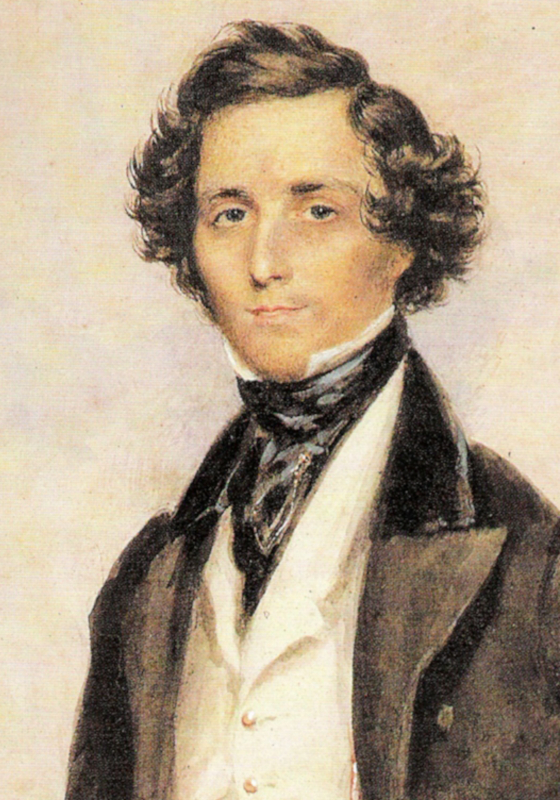
The 19th Century, Romantic Era composer Felix Mendelssohn, as the reader may know, was known as a staunch Lutheran – much like his protégé Johannes Brahms. Unlike Brahms, however (who was born into a Lutheran family), Mendelssohn was, like the 19th Century church historian Dr. Alfred Edersheim, an adult convert to Christianity from Judaism. Residing and composing in Leipzig – the home of Johann Sebastian Bach (who has been featured on Intrepid Lutherans on many occasions) – he was more than merely an important composer of the Romantic Era who happened to be a Lutheran. He was a key figure in the resurrection of appreciation for the works of Bach, which had been forgotten following the time of Frederick the Great of Prussia, with whom Bach valiantly contended for the sake of Christianity.
Not only this, however, Mendelssohn became an ardent opponent of the extravagant Wagnerian philosophy of "Total Art," which, overtaking Europe for a time and eventually infecting America, required very expensive venues to house simultaneous lengthy performances of Ballet, Symphony and Opera, and was successful enough to cause such a drought in these individual genres as to threaten their existence.
In 1830, Felix Mendelssohn penned his Fifth Symphony, in honor of the 300th anniversary of the Presentation of the Augsburg Confession. Circumstances prevented its timely completion. It was finally published in 1868, twenty-one years after his death, during the peak of Wagnerian artistic philosophy and the consequent trough of the symphonic form itself. It was entitled, the Reformation Symphony. In a manner typical of the Romantic Era, the music was composed as a tonal representation of the struggle for the Truth of the Gospel throughout the Reformation, beginning with John Wycliffe – the "Morning Star of the Reformation" – and Jan Huss up through the German Reformation led by Dr. Martin Luther. It isn't until the latter third of the symphony that the Lutheran can recognize the triumphant strains of Luther's Reformation hymn, A Mighty Fortress.
More than a tonal representation of the Reformation, Mendelssohn's Reformation Symphony was singularly responsible for reviving the symphonic form throughout Europe and America, as well. With it's clearly Lutheran tonal imagery, it was instantly popular among European immigrants in America, most of whom settled in the midwest, and being a relatively short and simple composition, it was within the talent spectrum of the average German or Scandinavian immigrant, many of whom had acquired a superb education in Europe prior to their journey here, many more of whom had at least average if not advanced musical skill. In fact, many local and regional symphonies and music societies were created specifically to play this piece, and survived for many years thereafter, reviving the symphony and the musical arts not only in the midwest and America, but in Europe as well. Indeed, the popularity of Mendelssohn's Reformation Symphony in the 19th Century has been credited with felling Wagner's philosophy of "Total Art."
A fitting piece to spend a few minutes with this evening as we remember and celebrate the Reformation, this is a full recording of Mendelssohn's Symphony No. 5 in D major/D minor, Reformation Symphony, performed by the New York Philharmonic, and led by Leonard Bernstein.
Mendelssohn's Reformation Symphony NY Philharmonic, Leonard Bernstein
The Explanation we published two weeks ago was taken directly from catechetical materials developed by the General Council for the distinct purpose of educating Lutherans regarding the doctrinal integrity and catholicity of genuine Lutheran worship. Indeed, this Explanation of the Common Service, published in 1908, was dedicated to the “Young Lutheran who asks the meaning of the beautiful liturgy of the Lutheran Church.” In our introductory remarks preceding the explanation, we marveled at this. Lutherans these days don't educate their youth about Lutheran worship, and if they do, they don't do so in a way that extolls it's beauty as a work of Fine Art, nor do they do so in a way that reinforces its doctrinal integrity, nor do they do so in a way that embraces its catholicity. One of the bright shining exceptions to the lamentable reality that contemporary Lutherans no longer value their heritage of worship enough to bother passing it down to their youth, is the LCMS-affiliated organization, Higher Things. Outside of this organization, the best one can hope for is a one- or two-lesson explanation of Lutheran worship which neither extolls its beauty nor places value on its doctrinal integrity and catholicity, but uses the opportunity to deride our heritage by vaunting its status as “an adiophoron” and setting it on equal footing with just about any form of Sectarian Worship imaginable – as long as one wears the appropriate set of blinders as he goes about imagining. Yeah, sure, you can do it, but why would you want to? In answer to this one needs but a “reason,” and in the world of adiaphora that merely means “opinion.” Thus one “reason” is as good as another, and anything one can “justify” has open license attending it.
But we further asked the reader to notice the use of language this Explanation employed. It was not written for functionally illiterate Lutherans who find reading and understanding anything written above the sixth-grade reading level to be a hopeless struggle. On the contrary, being dedicated to the “Young Lutherans,” it was written to Lutheran Youth, and plainly assumed that they had command of their own language. If it was written above their level, then it served the noble purpose of lifting them out of their immature literacy and colorless task-oriented-use of language, through the rich vocabulary and precise grammar employed in the distinctive and enculturating language of the Church. Contemporary Lutherans, it seems, no longer value the uplifting qualities of higher literacy, either.
Regardless of what the so-called wise-men of contemporary times insist upon, I am not ready to succumb to such disrespect for others that my operative assumption is that they are all functionally illiterate. I don't think all, or most, or even a significant minority of educated Lutherans are just a bunch of dumb-dumbs who can't read. Some very-well may refuse to read anything more complex than a comic book, but that is a separate matter – a matter of sinful obstinacy, and perhaps even rebellion. It is not a matter of literacy. So today, we are going to continue our use of materials having high-literary quality to provide a brief explanation of Lutheran hymnody.
What is a Hymn? A Canticle? A Carol? An Anthem?
We begin with the source pictured at the top left: The Handbook to the Lutheran Hymnal, by W. G. Polack – who was the chairman of The Lutheran Hymnal committee. This work first appeared in 1942, essentially accompanying the publication of The Lutheran Hymnal, and went through several revisions thereafter. It is a book which catalogs all of the hymns used in The Lutheran Hymnal, identifying their authors and sources, providing a history of the circumstances under which the hymn was written (if notable), reproducing the hymn in its original language alongside the English version which appeared in the hymnal and identifying (sometimes justifying) alternate readings from the original composition. It is considered a classic in the field of hymnology.
Today is the Vernal Equinox, the first day of Spring, and in 1685, the same can be said of musical excellence, both in the Church and in the West, as within them the full vibrance of musical life was born, as well – with the birth of Johann Sebastian Bach (1685-1750), the man known as the Greatest Composer in the History of Western Civilization. We have written much on Intrepid Lutherans about this creative Master, a fiercely orthodox Lutheran who infused his faith into his compositions through the language of counterpoint, in it battling not only Pietism but, as we detailed in our post, Music for the Twelve Days of Christmas, Part 3: Johann Sebastian Bach, the apostasy of the Enlightenment. The first post in which we first featured J.S. Bach, Music for Holy Week, Part 1 – excerpts from Matthäus Passion, we summarized Bach's life and accomplishments, as follows:
“Bach perhaps needs little introduction: he was and remains the master of counterpoint and represents the pinnacle of Baroque musical achievement. In addition to his many secular works, as Cantor of St. Thomas Church in Leipzig he composed a full series of Cantatas to accompany the Lutheran liturgy for each week of the Church Calendar, along with many other Sacred works as he was commissioned... It is worth noting, however, than in addition to his status as a composer, Johann Sebastian Bach was also fiercely orthodox in his Lutheranism. Being active as a composer during the rise of German Pietism and attempting to ward it off through the Sacred works he was often commissioned to compose, his professional library was proliferate with personally annotated works of Lutheran theology – he had the library of a theologian, and he used it as reference material in the composition of his works.”
Schütz studied under the Renaissance Master of antiphonal and polychoral composition, Giovanni Gabrieli, at St. Mark’s Basilica in Venice. So remarkable was his performance as a student, that Master Gabrieli was compelled to recommend him with the words, “In Schütz you will have a musician such as one will not find in many other places”. Indeed, upon his death in 1612, Gabrieli willed his signet ring to Schütz. Heinrich Schütz was appointed Kapellmeister at the Royal Court in Dresden in 1615, and from there through the remainder of his career, he masterfully wedded the highest musical art of the Renaissance with the German language, the purest manifestation of which, for him, was Martin Luther's translation of the the Bible.
“the advent of the chordal style dispensing with linear but rich polyphonic textures made it possible for technically less accomplished composers to shine with concertante figured-bass music. According to Schütz, there were hardly any younger composers in Germany willing to deal with the more profound aspects of composition. So their tonal idiom was bound to become increasingly shallow and banal.”
As a result, he published his Geistliche Chormusik (Sacred Choral Music) in 1648, dedicating it to the choir of St. Thomas Church in Leipzig, to “encourage budding German composers, before they would try their hand at the concertante style ...to first demonstrate their skill in this area.” O that today's Lutheran composers would follow this advice, and avoid their own “shallow and banal tonal idiom!”
It seems to be unknown whether Bach took the recommendation of Schütz to heart, or whether those responsible for calling Bach to be Cantor at St. Thomas in Leipzig were seeking to diligently live up to the encouragement Schütz obviously meant for them, or whether his Geistliche Chormusik had any such impact by that time at all. But it is, at least, an interesting coincidence. Other interesting coincidences include Bach's place in time: Heinrich Schütz died as Pia Desideria (published 1675) was percolating in the mind of Philipp Jakob Spener (1635-1705); Bach was born as plans for the Pietist learning center, University of Halle were being drawn; while Bach served in Leipzig, the last of the Lutheran theologians from the Lutheran Age of Orthodoxy, and vigorous opponent of Pietism, Valentin Ernst Löscher (1673-1749), served as Superintendent and as pastor at the Kreuzkirche in Dresden (practically a stone's-throw from the Royal Court, and a place known to benefit from regular collaboration with Schütz); and both Bach and Löscher, being in such proximity, battled with fierce dedication against Pietism in their respective vocations. Löscher and Bach died at the opening of the Enlightenment, in 1749 and 1750, respectively – with no one, really, to take their place.
With the death of Bach, accompanied by the demise of the Lutheran Age of Orthodoxy, the Spring of musical expression also came to an end, and along with it was left behind the Source of New-Life, the True teaching of God's Word upon which this Spring emerged. God's Truth gave way to Man's pride, the searing heat of Enlightenment notions, such as the “perfectibility of man,” invading both the Fine Arts and Christian Theology, first vaunting the objectivity of man's intellect, then vaunting the subjectivity of man's social and emotional existence, each iteratively warring against the other. Today, we live in the Autumn of both the Arts and the visible Church, the clouds of post-Modernism increasingly obscuring the light of Truth, upon which true art and true theology depend. We await with dread the dark Winter that is fast upon us, ready to endure it for the sake of Christ and the benefit of our neighbor, yet wondering what misery it will bring. But we remember the Spring. And we long for its return.
Johann Sebastian Bach is recognized as the Greatest Composer in the history of Western Civilization; and the work recognized as the Greatest Work of the Greatest Composer is nothing other than a Lutheran Mass – Bach's Lutheran Mass in B-Minor. We offer for our readers today, in celebration of the birth of the Greatest Composer to have ever lived, and in fond remembrance of the Spring that once was, this, a full performance of Bach's Greatest Work.
Lutheran Mass in B-Minor – by Johann Sebastian Bach
Last week, we published an article entitled, Lutheranism and the Fine Arts: Dr. P.E. Kretzmann and the Necessity of Continuing Catechesis. It stood in stark contrast against the depraved junk being pushed by the Church Growth Movement (CGM), which, though vaulting the latest in “scientific methodology”, nurtures anti-intellectualism as much as it promotes mediocrity, turning its back on the preaching and teaching of sound doctrine and repudiating the hard work of rigorous catechesis in order to make Christianity more outwardly attractive to the unregenerate who despise Christ and the teaching of His Word. Another term for this among CGM advocates is, “Evangelism.”
But most importantly, that post emphasized the need not only for rigorous catechesis, but of a broad catechesis that includes more than just Bible study. In that post, Dr. Kretzmann and the Walther League strongly encouraged complementary catechesis in areas of Church History, of Christian Missions, of Distinctive Lutheran Doctrines, Customs and Usages of the Lutheran Church, of Church Art, of Science, and of Literature. And within the category of Church Art was included the very important topic of Liturgics.
In fact, the catechesis of the Lutheran Worshiper was the topic of another recent post on Intrepid Lutherans, The Catechesis of the Lutheran Worshiper: An antidote to the “itching ears” and “happy feat” of CGM enthusiasts?. In that post we drew the distinction between those who favor so-called “contemporary worship,” as those who Congregate before Entertainers, with those who retain a wholesome catholicty and still embrace the distinctive practices of historic Lutheran liturgy, as those who Congregate before the Means of Grace.
But what is such “wholesome catholicty”? What is the “distinctive practice of historic Lutheran liturgy”? Do American Lutherans of the 21st Century even have such a thing? If so, is it at all in general use? Maybe they do, maybe they don't, but one thing is for sure: they certainly had such in the 19th and 20th Centuries, AND they had catechetical materials to go along with it for the purpose of teaching successive generations about Lutheran worship.
Lutherans of these bygone times highly valued the wholesome catholicty of their historic Lutheran worship practices, that served to starkly contrast them with the American sects which surrounded them — which had in many cases been given over to the evangelical revivalism of Charles Finney, and to practices emanating from the Holiness movements within American Methodism (as discussed in our recent post, The Church Growth Movement: A brief synopsis of its history and influences in American Christianity). Even in confessional Lutheran churches in America, the allure of the Anxious Bench became increasingly difficult to resist, and Methodist hymnals were, distressingly, in growing demand (as Dr. C.F.W. Walther laments, in our post, C.F.W. Walther: Filching from sectarian worship resources equals “soul murder”). It was within this environment that the confessional and liturgical movements of the 19th Century grew, and worked toward the establishment of confessional unity among Lutherans in America, and to distinguish and insulate American Lutheranism from the poison of sectarian influences.
In 1908, the General Council of the Evangelical Lutheran Church in America published an Explanation of the Common Service – a harmony of sixteenth century Lutheran liturgies published in 1888, in the English language. This is the same Common Service found in The Lutheran Hymnal, which was published by the Synodical Conference in 1941, and which is still used in many Lutheran congregations even today. It is my understanding that, in many circles, this liturgy of the Divine Service is still referred to as a benchmark of liturgical excellence. Indeed, in our recent post, Lutheranism and the Fine Arts..., Dr. Kretzmann refers to the Common Service as “unsurpassed in the entire history of the Christian Church.” Sadly, however, though many Lutherans still use it, most Lutherans, and nearly all young Lutherans, are completely ignorant of this fine and beautiful liturgy, having never had the privilege of being consistently guided through worship under the rubrics of this Common Service.
Interestingly, the Explanation published in 1908 by the General Council of the Evangelical Lutheran Church in America, was dedicated to this very group of people, to the “Young Lutherans who ask the meaning of the beautiful liturgy of the Lutheran Church.” As you read this Explanation, notice its use of language. Consider the fine education and catechesis “Young Lutherans” must have enjoyed a century ago, which was deliberately reinforced by the church in books such as this. Do Lutheran publishing houses have such respect and concern for the youth of today? Certainly, they target young people with a great deal of material, so concern unquestionably exists — but does the quality of these materials generally rise to this level? Does it specifically advocate and reinforce Confessional practice? Does it refer to the liturgy as something “beautiful” and as something to be valued? I don't believe I've seen this sort of thing coming from the main Lutheran publishers.
Therefore, in the interest of those who would otherwise never have the opportunity to know, the following Explanation of the Common Service is offered. It explains Lutheran worship according to what has been considered the definitive Lutheran liturgy yet produced – a liturgy which is nevertheless disappearing under the short-sighted tyranny of “contemporary relevance,” and an explanation whose need has long been disregarded as counterproductive to progress and to the future of Evangelical church practice.
Note: the reader may recognize this Explanation as having appeared on Intrepid Lutherans in the past. In fact, it was published as a series in the Summer of 2010, as follows:
Note also that this explanation, though long out of print, is now available in book form from Emmanuel Press, one of the fine confessional Lutheran publishers listed in the right-hand column of this blog.
“Competent art is hard to come by these days. True, there are many who have been trained in the techniques of their particular art form, or who have practiced on their own, and have developed an impressive skill. But the execution of technical skill alone is not art. The most that such accomplishes is to showcase the skill of a work's creator, while reducing the measure of art’s usefulness to the act of gratifying consumers. True art has little to do with either the artist or his immediate consumers, but centers on a subject which is external to both. More than just centering on a subject matter, compelling art succeeds at drawing the viewer, reader or hearer of it into a conversation regarding the subject. And this is no small task for the artist! In a single work, he must initiate a conversation and say everything he intends in a way that holds his end of the conversation throughout the inquiries and developing thoughts of those who may engage in it. If the artist is to avoid babbling, this requires that he have such a thorough familiarity with his subject that he can anticipate questions or objections associated with his expression of it, and respond to them while also reinforcing areas of agreement. Sometimes, the subject is simple and the conversation is short. Other times the conversation is longer. Sometimes, the artist points toward or draws conclusions. Other times, he only questions. Sometimes he is speaking for himself. Other times, he represents the voice of others. Regardless of the type of conversation, enduring art is that to which its viewers, readers or hearers return again and again, to admire how the conversation is carried out by the artist, or even to renew it again for themselves. Thus, in addition to technical skill, true, compelling and enduring art requires an abundance of creativity.”
With these words, I opened the blog post, Music for the Twelve Days of Christmas, Part 2: Heinrich Schütz ... and other thoughts to ponder over the New Year Holiday..., which used the story of the Lutheran composer Heinrich Schütz as a pretense for discussing the nature of Fine Art and its sources. The attentive reader of that post can't help but notice the stark contrast that is drawn between what the Church has always prized as genuine and uplifting artistic expression, and what passes for such these days: the highest, yet least appreciated forms of art finding a place in today's contemporary pop-Church rise only to some expression of folk art, while those most highly sought after are among the lowest forms of expression, the mere spectacle of entertainment art which serves only to “gratify consumers” without requiring much thought from them. We saw clear examples of this in our recent post, Real? Relational?? Relevant??? O THE HORROR OF IT ALL!!!.
The notion that artistic expression ought to center about the observer of it – his feelings, his emotions – or worse, ought to draw observers into the “experience of the art” itself by exploiting human passions, is a distinctly post-Baroque idea that is absent from our most cherished Lutheran music which comes to us largely from the “Age of Lutheran Orthodoxy” (coinciding with the Baroque Era) and centers on the objective message of the Gospel. On the contrary, such notions find their root in the Enlightenment myth of “human perfectibility,” a myth which serves to drive people away from recognizing their fundamental need for Divine Grace. Indeed, such notions were, notably, repeated by enemies of the Church as a means of deriding both the Church and Christian contributions to the Fine Arts. This fact was touched upon in a following blog post, Music for the Twelve Days of Christmas, Part 3: Johann Sebastian Bach. Such ideas ought to have no place in considerations leading to artwork that is created in the name and in the service of the Church.
Genuine artistic expression is a potent means of substantive conversation, of engaging the mind of one's fellow conversant through the language of art; and as such, it represents the highest stage of human learning: the Rhetoric Stage. Thus, genuine artistic expression requires genuine education. Moreover, for those who would meaningfully engage such works of art, an understanding of art's idiom is also necessary if it is to be properly appreciated. And, such understanding is also a product of Education, requiring the effort of catechists in the Church toward this end.
Recognizing the Need for Continued Catechesis of Lutheran Young People The Walther League recruits Dr. Kretzmann
Enter Dr. Paul. E. Kretzmann – Educator (Ed. D.), Theologian (D.D), Historian (Ph. D.). We posted a blog entry about this very important figure of 20th Century American Lutheranism in our post, Dr. P. E. Kretzmann: Standing on God's Word when the World opposes us. In 1894, a grassroots Lutheran youth organization, called the Walther League, was formed, focusing on youth who had completed their catechism and had been admitted to communicant membership of their local congregations. Their purpose was as follows:
“
The purpose of this association shall be to help young people grow as Christians through
WORSHIP — building a stronger faith in the Triune God; EDUCATION — discovering the will of God for their daily life; SERVICE — responding to the needs of all men; RECREATION — keeping the joy of Christ in all activities; FELLOWSHIP — finding the power of belonging to others in Christ.
Sometime during the 1930's, long before its eventual demise and probably during the period of its peak involvement, and before his departure from the LCMS, Dr. Kretzmann was asked to write a little book for Walther League Chapter leaders, that they could follow as a guide to the continuing catechesis of Lutheran young people. Printed by Northwestern Publishing House, the name of this little book was Knowing and Doing, and the need for it was expressed in its Foreword by Rev. Paul Prokopy. He justifies the need for continuing catechesis, and for this little book, as follows:
“It goes without saying that our Lutheran young people should know very definitely what the Lutheran church stands for and just why they are Lutherans, and that in all cases they should be ready and able to present the doctrine of their church and to defend it intelligently and ably against attacks. Yet we find that our young people are ofttimes at a loss to testify clearly and sometimes they are even ashamed to confess boldly that they are Lutherans, the reason being that they are not sufficiently informed and that they have not an intelligent understanding of the very important issues involved...
“Knowledge certainly is power, and if this applies anywhere, it applies to church activity... Placing first things first, Bible Study stands at the head, followed by study of Church History and Missions, the Study of the Distinctive Doctrines, Customs and Usages of the Lutheran Church, and [the study of] Practical Questions and of Church Art...
“But it is not enough that our young people know, they must also do – Knowing and Doing, as the title [of this little book] indicates, must go together... We must have a well-informed, intelligent and efficient [laity].”
It is interesting to know that only a generation ago the idea of “a well-informed, intelligent and efficient laity” was founded on the basis of broad KNOWLEDGE – not just of the Scriptures, although this was most important and stood at the head of all areas of study, but included other important areas of study, as well: Church History, Missions, Distinctive Doctrines, Customs and Usages of the Lutheran Church, Church Art... The full listing of the Table of Contents includes these, and other important areas of study and of practice:
PART I: KNOWING Chapter 1: Bible Study Chapter 2: The Study of Church History and Missions Chapter 3: The Study of Distinctive Doctrines, Customs and Usages of the Lutheran Church Chapter 4: Practical Questions Chapter 5: Church Art Chapter 6: Science and Inventions in the Light of Scriptures Chapter 7: Literature in the Light of the Bible
PART II: DOING Chapter 1: The Work of Young People within the Home Congregation Chapter 2: The Work of Young People in the City and District Chapter 3: The Work of Young People in the Church at Large
Dr. Kretzmann's thoughts in Chapter 5, on teaching Lutheran Young People how and why to appreciate the rich treasure we Christians have in the gift of Church Art, is most helpful as we contemplate the important role of the Fine Arts in Lutheran church-life. It is reproduced here, in its entirety.
Appreciating Fine Art in Service to the Church An Important Aspect of the Young Lutheran's Catechesis
Few members of the Lutheran Church realize what a splendid heritage is ours in the field of the arts. The work of Luther and his collaborers was not one of senseless destruction, as that of many self-styled reformers in his days and since, but it was a true reformation of the Church, both toward the inside and toward the outside. It is true, of course, that he eliminated all false doctrine from the teaching of the Church. It is true, also, that he removed, or attempted to remove, all that savored of false doctrine, even in the external usages of the Church. But he never became a mere iconoclast, just as he never degenerated into a mere demagogue. He never tore down merely for the sake of seeing things fly. And if he found the superstructure rotten, he carefully examined the foundation, lest he spoil something that was fundamentally good and had only been contaminated and sullied by false doctrine. Carlstadt and the Zwickau prophets, followed by practically the entire Reformed branch of the Church, attacked and destroyed many things which were in themselves not dangerous or which contained a germ of splendid value. Luther and his coworkers preferred to keep the kernel, even if the shell had to be discarded.
Lutheranism and the Fine Arts
“But especially in sacred song has the Lutheran Church a grand distinctive element of her worship. 'The Lutheran Church,' says Schaff, 'draws the fine arts into the service of religion, and has produced a body of hymns and chorals, which, in richness, power, and unction, surpasses the hymnology of all other churches in the world.' 'In divine worship,' says Goebel, 'we reach glorious features of pre-eminence. The hymns of the Church are the people's confession, and have wrought more than the preaching. In the Lutheran Church alone, German hymnology attained a bloom truly amazing. The words of holy song were heard everywhere, and sometimes, as with a single stroke, won whole cities for the Gospel'” (Krauth, C. (1871). Conservative Reformation and its Theology. Philadelphia: Lippincott. pp. 152-154)
In pursuing this course, the Lutheran reformers set a good example to all who bear the name of the true Reformer himself, and we should be proud to follow in their footsteps. Luther himself stated that he was in no sense an enemy of the arts, but that he desired to see them all in the service of the Gospel. His interest in the field of art, therefore, was profound. That he was a powerful poet and writer we all know. He was also a musician of no mean ability, he was well versed in liturgics, and he took an intelligent interest in other branches of art as it concerned the work of the Church.
What the fathers of the sixteenth century began the Lutherans of the next century continued; what Luther and Melanchthon and Bugenhagen and others advocated, the latter preserved. It is true that the riches of the Church in the field of Christian art have been largely lost during the age of Pietism, followed by that of Rationalism, but it is fortunately also true that the Lutheran Church of America is awakening to an appreciation of the heritage of the reformers and that proper steps have been taken and are being taken to reintroduce the precious monuments of art which the Church possessed in the sixteenth century.
All this is not being done in the desire for innovations, nor is an enthusiastic minority trying to foist something unwelcome upon a suspicious majority. The Word of God tells us: “let all things be done decently and in order,” (1 Cor. 14:40). A very clear word is that written by St. Paul: “Let every one of us please his neighbor for his good to edification” (Rom. 15:2). And again, the same apostle writes: “Whatsoever ye do in word or deed, do all in the name of the Lord Jesus, giving thanks to God and the Father by Him,” (Col. 3:17). Moreover, we have evidence that it is by no means displeasing to the Lord if we, in a proper way, and without omitting the more important matters pertaining to the spread of His Kingdom here on earth, take an intelligent interest in Christian art and adorn our houses of worship in a manner befitting the majesty and beauty of Him who is fairer than the sons of men. When Mary of Bethany had poured out over Him her pound of ointment of spikenard and Judas, with a great show of interest in the poor, protested against the waste which was practiced by the deed, Jesus calmly took Mary's part, bidding the assembled company let her alone (John 12:7).
Among the foremost subjects to which the attention of the younger members of our church might well be directed is that of church architecture and ecclesiastical art in general. This interest is aroused and sustained by the very complete accounts of the building of the Tabernacle and the Temple of Solomon, together with the minute descriptions of the various appointments and pieces of furniture which were prepared at God's command in the wilderness and afterward copied by Solomon. If we add to the account of the Bible what has been found in the course of the last century concerning Oriental architecture, the subject becomes fairly fascinating. With our interest in the subject aroused in this manner, it is only natural that we desire to know more about the second Temple and then about that of Herod. Our admiration is aroused by the splendor and magnificence of the buildings crowning Mount Zion and many references to the Temple, not only in the Old Testament, but in the gospels as well, become clear to us.
However, our interest does not cease here. We are anxious to know in what kind of buildings the early Christians worshiped, when and how the first Christian churches were built. We study art of the early Christians as displayed in the catacombs and learn how closely their art was connected with, and expressive of, their belief. We view with surprise and misgivings the erection of the Byzantine cathedrals under Constantine and Justinian; we see the development of the Romanesque style until the limit of its possibilities was reached, only to find that the Gothic style practically removed all limits, making the erection of cathedrals possible which are marvels of human ingenuity and the very apotheosis of ecclesiastical art.
At the same time, we see that the pictorial and plastic arts are placed in the service of the Church, that the arts are, in fact, for centuries dominated by religion, that the greatest works of the greatest masters are performed largely in the interest of Christianity. Add to this the appeal of the minor arts, the work in tapestry and embroidery, in iron and brass and wood, the use of bells and the development of organs in the service of Christian worship, and we have subjects of such intense and absorbing interest as to challenge study, even with absorbing application... Possibly eight [one hour] illustrated lectures would be sufficient to give at least a proper idea of the subject.
Lutheran Worship and Artistic Expression: The Divine Service is NOT a Concert Performance
“It may be conceded, of course, that the matter of organ music of every kind is an adiaphoron. There is no commandment of God which gives to the organ either a primary or a secondary position, or makes music either essential or subsidiary for divine worship. And yet, it is not a matter of indifference... A Lutheran congregation will strive to bring out its doctrinal position also in its cultus, and will avoid everything that may be misconstrued as though the Lutherans had abated one whit from their position toward the means of grace. The Word and the Sacraments must always occupy the most prominent place before the congregation, and everything that will detract the attention of the audience from these most important parts of the service must be avoided with the greatest care...” (pg. 406)
“[A]ttempts at artistic playing were frowned upon. All efforts which savored of concert playing were not looked upon with favor. Motets or other strange pieces in the service proper were not permitted, the organ being strictly in the service of the congregation and its singing. The organist might give evidence of his art in the postlude... Above all, secular music was strictly taboo, secular songs and fantasies, as well as popular melodies being under the ban...” (pg. 407)
“The organist will therefore prepare himself very carefully for each service. His music must be selected with the purpose of bringing out the lesson or the character of the day... The hymns must be studied both as to text and music to emphasize the spirit in them. All the shadings of joy up to the veriest exultation, all the blendings of sorrow, longing, repentance, and whatever other disposition is brought out in the text, must be correctly interpreted in the music... Above all, extemporaneous playing and improvising is inexcusable at the organ during regular church-services. An artist of the first rank may attempt it at a church concert, but for anyone else to test the patience of the congregation in such a manner is little short of an insult. The sacredness of public worship and the exclusive emphasis which we must place upon the means of grace forbid such performances...” (pg. 407)
“A Lutheran organist will remember, above all, that the classical choral melodies of the sixteenth and seventeenth centuries should always occupy first place in his repertoire.” (pg. 408)
“The organ deserves special attention in its relation to the singing of church-hymns and the liturgy... [but] to educate the congregation in the ability to sing, the organ is neither needed nor is it adapted for that purpose; but it is good and appropriate for accompanying good church-singing, which is learned by singing and in no other way. And since the organ occupies this accompanying position only, it must be retained in this position... Long preludes, postludes, and interludes must be discontinued, but, above all, the insertion of self-composed fugues and other devices, by which the congregation assembled for services is changed into a concert audience.” (pg. 408)
We have a very similar case where we broach the subject of liturgics and hymnology. Luther very properly retained all that was in itself unobjectionable in the orders of service of his day, not only in the communion service, but also in the minor services and occasional sacred acts. In the many church orders, also, which fixed the order or worship in the various German countries in the sixteenth century, not to speak of the Scandinavian countries and England, the most beautiful sections of the ancient liturgy were retained. The Lutheran Church in America has very wisely selected the very best that was to be found in the sixteenth century liturgies, the result being a Communion Service which is unsurpassed in the entire history of the Christian Church [i.e., the Common Service developed by the General Council, and published in the old The Lutheran Hymnal of 1946]. But it ought to be studied and appreciated. – By the same token, the treasure of hymns which the Lutheran Church possesses is a special blessing of God's grace. Not only in the sixteenth century did the fountain of religious poetry flow in rich measure, but it has come down to us in a practically uninterrupted stream. There are hundreds of hymn-writers of the first and second rank, not only in Germany, but also in Denmark, in Norway, in Sweden, in England, in America, and elsewhere, and the products of their pens are numbered by the thousands and tens of thousands. To know the men and women whom God has gifted in such a remarkable manner, to study the hymns and songs which have imparted strength and consolation to untold numbers of Christians throughout the world, that is in itself a privilege which we have not sufficiently appreciated in the past. [As in the case of pictorial, plastic and architectural art that has been created in service to the Church], eight lessons should be devoted to the study of fundamental points of liturgics and hymnology, [as well].
Moreover, when the foundation has been laid and there is some understanding of the pricelessness of the heritage which we possess, the significance and the symbolism of the Lutheran form of worship may well be made a special topic of study. Every real piece of art is worthy of the most careful, detailed, and painstaking study, and we shall appreciate all the more what we have if we examine it in an intelligent manner. Eight lessons will barely suffice for this purpose. However, the interest of our people having once been properly aroused, most of them will surely want to know more about church music as such and about sacred music in general, including the history of the great Passions of Bach, the oratorios of a number of great masters, and the cantatas, motets, and choruses of scores of other musicians. Here again, eight hours or lessons are hardly sufficient, but they may serve to awaken the right kind of interest, which will direct reading and study into the proper channels.
(Kretzmann, P. (~1935). Knowing and Doing: A book of practical suggestions for young people and young people's societies, with special reference to Walther League Work. Chicago: Walther League of the Ev. Lutheran Synodical Conference [printed by Northwestern Publishing House, Milwaukee, WI]. pp. 36-41)
“In the case of Christian art, the creation of a compelling and enduring work is truly an amazing accomplishment. The subject matter of Christian art itself is generally despised by the World; and ambiguity, which is inherent to art and very often its most appreciated aspect, is at the same time a great enemy of Christian subject matter – fidelity to which requires clarity and closure. Thus, Christian art that remains beloved and acclaimed by all, over centuries and across cultures, which succeeds at engaging its viewers, hearers or readers in unambiguous conversation regarding the reality of Christ and the impact of His Gospel, represents skill and creativity towering over that which produces ambiguous works of profane subject matter for which people already have natural affinity. Why? Because it is an easy task to produce works of art having the World’s approval by appealing to fleshly desires and worldly sensibilities, relative to the task of producing generally acclaimed works which militate against what naturally appeals to man and which serves to lift up the offense of the Cross instead.”
Note: Intrepid Lutherans cannot endorse all the content found at the following links, and expects that the visitor accessing them will exercise mature Berean judgment in assessing and making use of them.