Showing posts with label Church Year. Show all posts

Monday, September 23, 2013

Divine Service Explanation #2 - The Church Year and Lectionary

For over a thousand years, the Christian Church has ordered her prayer life after the life of Christ by means of a yearly review of His life and teachings in her Divine Service.  Readings (“lections”) from the Holy Gospels and from the Epistles (the New Testament “letters” written by the Apostles) have been assigned to each Sunday and other festival days of the “church year.”  The year is divided in two (a “festival half” and a “non-festival half”), and further divided into “seasons,” each season having a certain number of Sundays, each with its own special emphasis.  Different colors help us to remember the emphasis of each season. The seasons are:
Advent:     We prepare for Christ’s coming (His first coming in the past and His second coming in the future) in repentance and quiet meditation. (The “festival half” of the Church Year begins.) (Color: Violet for repentance or Blue for hope) 
Christmas:  We celebrate the birth of Christ and the mystery of His incarnation. (Color: White for purity and divinity) 
Epiphany:   We marvel at how Christ was manifested as the Savior of all nations. (Color: Green for life or White for purity and divinity) 
Pre-Lent:   We begin slowing down in preparation for Lent, fortifying ourselves in the doctrine of salvation by grace alone, Word alone, and faith alone (“Gesima” season). (Color: Green for life or Violet for repentance) 
Lent:          We observe the 40-day fast (either bodily and spiritually, or a spiritual fast only) in repentance as we watch our Savior go to battle for us against sin, death and the devil. (Color: Violet for repentance) 
Holy Week: We meditate on the Passion (“suffering”) and death of our Lord as He earned for us the forgiveness of sins, life and salvation. (Color: Violet for repentance) 
Easter:     We rejoice in the resurrection of Christ and in its significance for us who believe in Him. (Color: White for purity and divinity) 
Pentecost:  We give thanks for the coming of the Holy Spirit, the Comforter. (The “festival half” of the Church Year ends.) (Color: Red for fire and blood) 
Trinity:     We grow in the grace and knowledge of our Lord, who sustains His Church on earth through Word and Sacrament until He returns in glory to judge the living and the dead. (The entire Trinity season makes up the “non-festival half” of the Church Year.) (Color: Green for life)  

_______________________________________________
Divine Service Explanation #1 - The Purpose of the Divine Service

Wednesday, December 19, 2012

The Real Story of “Christmas”

How the Observance of Our Savior’s Birth Became A Winter Festival of Holly, Deck the Halls, and Saint Nick!

'The Nativity at Night' by Guido Reni, 1640The term “Christmas”
The word “Christmas” comes from the Old English term Cristes Maesse, or the “Mass of Christ,” first found recorded in A.D. 1038. In Dutch it is “Kerst-misse,” and in Latin “Dies Natalis,” from which we get the French word “Noël.” In Italian it is “Il natale;” but in German “Weihnachtsfest,” named for the sacred vigil which takes place the night before Christmas. The word “Yule” simply comes from the Anglo-Saxon word “geol,” or feast, which was also the name of their month in which this feast took place. In Icelandic the term is “iol,” a feast still celebrated there each year in December.

As far as we can tell, Christmas as an observance of the birth of Jesus Christ, was not celebrated during the first hundred years of the Christian Church. The first evidence of the feast comes from Egypt. Sometime just before A.D. 200, Clement of Alexandria said that some Egyptian theologians set the year and the day of Christ’s birth, placing it on 25th day of the Egyptian month Pachon, or our May 20th, in the twenty-eighth year of Caesar Augustus. However, Clement also tells us that the Basilidians celebrated the Epiphany, and with it, the Nativity, most often on 11 Tybi, or our January 6th. Indeed, this double celebration became quite popular, partly because the appearance to the shepherds was seen as a manifestation of Christ’s glory, with the other being the worship of Magi from the East, which was already observed on that day. The December feast day did not reach the rest of the Church in North Africa until around the Third Century A.D.

When Was the first “Year of Our Lord?”
When was Jesus born? According to the present system of reckoning time, Jesus was born on December 25th before the year 1 (thus 1 B.C. as there is no year “zero”), or 754 years after the founding of Rome. This system was introduced by the Roman abbot, Dionysius Exigius in the Sixth Century, and is therefore called the “Dionysian System.” It was first used in historical writings in the Eighth Century by The Venerable Bede. Shortly after this, it was given official sanction in public documents by the French king Pepin the Short, and later by his son, Charlemagne. However, nearly all theologians are generally agreed that the year is not correct. The majority of the theologians of our day have accepted the year 749 or the early part of 750, four or five years before our era. This is based on the following facts:'Herod the Great' by Théophile Lybaert, 1883
  1. Jesus was born, according to both Matthew and Luke, before the death of Herod the Great. King Herod died during the 37th year after he had been appointed in Rome to rule over Judea. Thus his coronation took place in the Roman year 714. (Romans marked years from the founding of the City of Rome, which in our calendar took place in 753 B.C.) It was the Jewish custom that the royal years should always be counted from the 1st of Nisan (usually corresponding to our month of April), the first month of their religious year. Thus, his 37th year makes it’s beginning on the 1st of Nisan, 750, and runs to 751. Therefore Herod died in 750 or 751, four or five years previous to the present era. And since Herod ordered all the infant males in Bethlehem killed who were less than two years of age, Jesus would have to have been born in late 749 or very early in 750, that is, 5 or 4 B.C.
  2. The Jewish historian Josephus states that an eclipse of the moon took place shortly before the death of Herod. Astronomers have established that this happened in the night of March 12 to 13, 750. The death of Herod therefore falls in the latter part of March or early in April 750. At that time Jesus was already born, and as His circumcision, the Presentation in the temple, the visit of the wise men, and the slaughter of the innocents in Bethlehem belong between these two events, there must be a reasonable interval before the death of Herod. Herod died shortly after the murder of the children in Bethlehem. Jesus must have been born, then, in the final days of 749 or early in 750.
  3. In John 2: 19-20, we are told that when Jesus was in Jerusalem for His first Passover after His own baptism, He said, “Destroy this temple...” after which the Jews answered Him, “Forty and six years was this temple in building...” The sanctuary was not at that time completed, and we know that the work of reconstruction was begun in the 18th year of the reign of Herod.'St. John the Baptist' by Leonardo da Vinci, 1516 The first year Herod actually ruled in Judea came in 717, the 18th year then falls between 734 and 735. The year of this visit of Christ to Jerusalem must therefore be 780. Since Luke informs us that Jesus was about thirty years of age when He commenced His ministry shortly after His baptism (Luke 3:23), we therefore come once again to late 749 as the year of His birth.
  4. Luke 3:1 contains the account of John the Baptist and of his appearance as the Forerunner of Christ. According to his report, the activity of John dates from the 15th year in the rule of Tiberius. The emperor Augustus died August 19th, 767, and was succeeded on the throne by his stepson, Tiberius. However, we should note that Luke uses the word “hegemony,” not “monarchy,” when he mentions the fifteen years in the reign of Tiberius. The Roman historian, Tacitus, informs us that Augustus, in a manner consistent with Roman law, made Tiberius his co-ruler toward the close of 764 or in January 765. From that time on then Tiberius was also Caesar. The Baptist’s appearance upon the scene comes then in 779. After John had begun his work, Jesus came to him. Thus, we arrive at 779 as the year of Jesus’ baptism, which brings us yet again to the Winter of 749-750 as the time of His birth.

What Was the Month and Day of Christ’s Birth?
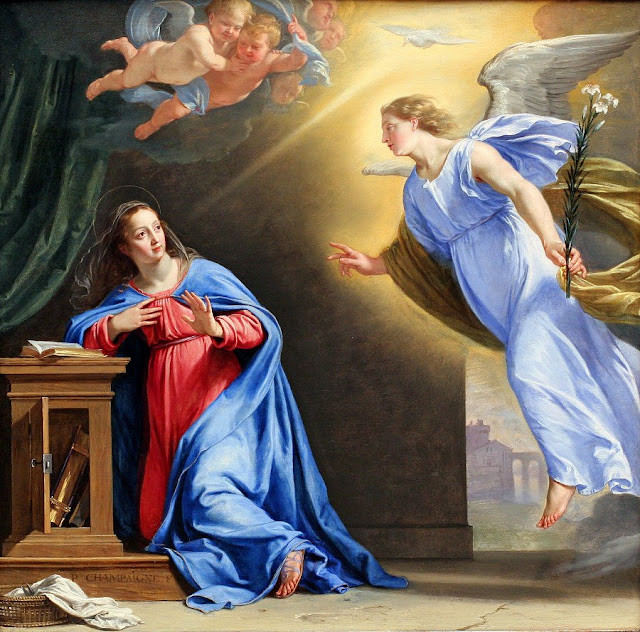
'The Anunciation' by Phillippe de Champaigne, 1644But, in which month and on what day was Jesus born? Our present system uses December 25th, as we all know. And this date was universally accepted in the Fourth Century by the Western Christian Church, while the Churches in the East observed either January 6th or 10th. According to the old Julian calendar, December 25th was the shortest day of the year, and referred to in Rome and elsewhere as “the birthday of the unconquerable sun” or Dies natatis invicti solis. After that day, the sun began to rise on the horizon, and the days began to lengthen once again. As Jesus is the light of the world, early believers felt it was eminently fitting that the day of His birth should also be December 25th. This date was first placed on record in Rome in connection with Christ’s birth in a chronicle dating from A.D. 354. The Christian writer Chrysostom said, “It is not yet ten years since this day (December 25) was made known. Even so, it is now just as seriously observed as if it has come to us from the beginning. It is very plain, according to the Evangelist [Luke], that Christ was born during the first census, and in Rome it is possible for anyone to deduce, with the aid of the public archives, when this came about. From persons who have intimate knowledge of these records and who still live in the city, we have obtained this day; for they who dwell there and who have kept the day in accordance with an age-long tradition have recently given us this information.” In writing on the 132nd Psalm of David, Augustine says, “John was born on June 24th, when the days already began to diminish; but the Lord was born December 25th in which the days began to lengthen; for John himself has said: ‘He must increase, but I must decrease (John 3:30).’”

'The Vision of Zacharias' by JamesTissot, 1899Also, in his account of the alternation of priests in the temple, Luke gives us additional information touching upon the date of Jesus’ birth. We read that the angel Gabriel came to Zacharias in the temple where he was carrying out the priest’s office before God. From I Chronicles 24 we find that there were twenty-four orders or classes in the priesthood. Each order took its turn eight days twice annually. Zacharias was of the order of Abijah, the eighth in the list given in the Chronicles (1 Chr. 24: 10). From the Talmud we learn that the first order, that of Jehoiarib, was charged with the service on the day the temple in Jerusalem was destroyed, and that this catastrophe occurred the 9th day in the month of Ab, the 5th month of the Roman year 823, corresponding to our August 4, A.D. 70. Working back from this date, we can therefore determine that the later turn of the order of Abijah came October 3rd to 9th in the year 748. Thus, Zacharias officiated for his order on one of these days. After this he returned home, with the conception of John the Baptist occurring sometime after his return. Six months later comes the Annunciation to Mary, in the spring of 749. After three months John the Baptist was born in midsummer 749. And six months after this comes the birth of Christ, in the Winter of 749, December 25th, or January 6th or even the 10th.

Still, if Jesus was born in the dead of Winter, how would this be reconciled with the presence of shepherds in the field, keeping watch over their flocks by night? Those who have traveled in Palestine will testify that weather conditions may remain almost perfect through the month of December, and even far into January.Thus, there is no reason why the last month of 749 or first month of 750 should not be settled upon as the time of Jesus’ birth. This would be our 5 or 6 B.C. Yes, it sounds odd to have Jesus born five or six years “Before Christ,” but unless we want to add five or six years to the number of our current year, we’ll just have to tolerate this little anomaly.

'Annunciation to the Shepherds' by Jacob Gerritz Cuyp, 1594-1650The feast of Christ’s birth was brought into the official life of the Church and the Empire by Constantine as early as A. D. 330. The Christian historian, Epiphanius, writing in Cyprus near the end of the Fourth Century, asserts that Christ was born on January 6th, and the Christian churches in Mesopotamia observed the birth of the Savior thirteen days after the winter solstice; that is, January 6th. But in Cappadocia December 25th was already celebrated as the anniversary of Christ’s birth before 380. About 385 Cyril of Jerusalem asked Pope Julius I to assign the true date of the nativity “from census documents brought by Titus to Rome;” and using this information Julius assigned December 25th. Jerome, writing about 411, chastises the Christian churches in Palestine for observing Christ’s birthday on Epiphany rather than the now accepted December date. In Antioch in A.D. 386, St. Chrysostom tries to unite Antioch in celebrating Christ’s birth on the 25th of December. Indeed, a large part of the community had already observed this festival on that day for at least the previous ten years. In the West, he says, the feast was thus kept, and goes on to say this was no novelty; for from Thrace (Greece) to Cadiz (Spain) this feast was celebrated. Finally, he asserts with authority that the census papers of the Holy Family were still at that time in Rome and could be used to verify the date of this celebration. Unfortunately, these records are no longer extant, otherwise there would be no mystery.

Is the Feast of Christmas Simply a Cover for a Pagan Holiday?
It is clear that the origin of Christmas did not come simply from the Roman festival of Saturnalia. True, the Emperor Aurelian, during his brief rule, tried to institute a lavish festival around the Birth of the Unconquered Sun, on December 25th, A.D. 274, borrowing heavily from the Mithras observances of Persia. He pushed this celebration in order to breathe new life into Roman idol-worship, which was already dying out. And Aurelian’s pronouncement came after Christians had already been associating this day with the birth of Christ for many decades in at least a few parts of the Empire. Indeed this “Sol Invictus” festival was almost certainly an attempt to create a pagan alternative to a date that was already of some significance to believers. Thus, Christians were not imitating the pagans, rather the pagans were imitating the Christians!


Where Did Some of the other “Traditions” of Christmas Come From?

Feasting and Partying
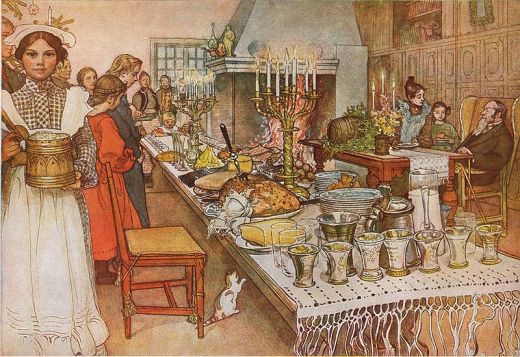
'Christmas Eve' by Carl Larsson, 1904This did not come from the Church. In fact, the Church attempted to impose strict discipline on this festival, and make it day of worship and contemplation. Emperor Theodoric, in A.D. 425, forbade Circus games on 25 December; though not until the time of Justinian III, in 529 is the cessation of all work imposed throughout the Empire on Christmas. The Council of Agde in 506 orders Holy Communion be celebrated on Christmas regardless of what day of the week it falls. The Second Council of Tours in 566 sets the sanctity of the “twelve days” from Christmas to Epiphany, and the duty of an Advent fast. Still, after that merry-making increased so much that the “Laws of King Cnut,” written around 1110, ordered a complete fast for all Christians from Christmas to Epiphany. In England, Christmas was forbidden by Act of Parliament in 1644; the day was to be a fast and a market day; shops were even compelled to be open on pain of a heavy fine; plum puddings and mince pies were condemned as indulgent and heathen. Even after the Restoration, Baptist and Puritan “Dissenters” continued to call Yuletide “Fooltide,” and refused to have anything to do with Christmas.

Christmas Pageants & Carols
Victorian CarolersThe tradition of putting on dramatic, sometimes spectacular, displays of the various incidents of the Nativity began early in the Middle Ages. Often the Apostles and Martyrs would be included with Old Testament prophets, angels, kings, popes, and even well-known poets and artists in honoring Christ in these plays. In fact, the old adage, “To out-herod Herod”, that is, to over-act, dates from the often vivid depictions of Herod’s cruel violence in these plays.

These plays also had a part in bringing about a great number of “noels,” and carols. Prudentius writes a hymn to the nativity in the Fourth Century, and Sedulius in the Fifth Century. The earliest German Weihnachtslieder date from the Eleventh and Twelfth centuries, the earliest French noels from the Eleventh, and the earliest English carols from the Thirteenth. “Adeste Fideles,” for example does not appear in its present form until the Seventeenth century. Most certainly however, these very popular tunes and words must have existed long before they were put down in writing.

Nativity Scenes or The “Crèche”
The word “crèche” comes from the French word for crib or cradle. St. Francis of Assisi in 1223 set up the first crèche outside of church. Normally these nativity scenes, some quite small, others actually life-size, were displayed only in churches, and mostly in the side altars. Almost immediately, however, these little replicas of the stable where Christ was born, along with the central characters of the story, became immensely popular in Christian homes and town squares throughout Europe. The presence of an ox and donkey were seen as a commentary on Isaiah 1:3 and Habakkuk 3:2, and they appear in the unique Fourth Century “Nativity” discovered in the St. Sebastian catacombs in 1877.

Christmas Tree
'Round the Christmas Tree' by Viggo Johansen, 1891In the Thirteenth Century, Gervase of Tilbury wrote that in England grain was exposed on Christmas night to gain fertility from the dew which then falls. Indeed, the tradition that trees and flowers blossomed on this night is first quoted from an Arab geographer of the Tenth Century, and from there the story made it’s way to England. In a Thirteenth Century French story, candles are portrayed on a flowering tree. In England it was Joseph of Arimathea’s rod which was supposed to bloom at Glastonbury and elsewhere. Ivy, holly, mistletoe, and evergreen trees were all used by the ancient Druids as symbols of life in the dead of Winter. These were then appropriated by Christians for the same use.

From these various sources then came the practice of many types of greenery being used as decorations during the Christmas season. One of these customs developed into the Christmas tree. It is thought Martin Luther first brought an evergreen tree into the home and placed small candles on its branches to illustrate everlasting life coming from Christ, the Light of the World. However the first definite mention of such a tree is in 1605 at Strassburg. From there the custom entered the rest of France during the next century, and finally came to England in 1840 by way of the Prince Consort, Albert, the Lutheran husband of Queen Victoria.

“Xmas”
Well-meaning Christians sometimes bemoan the use of the letter “X” in place of Jesus’ title of “Christ” when used to designate the term “Christmas.” Almost every year lately there are emotional calls from believers to “keep Christ in Christmas!” Rest assured, the Savior is still very much in “Xmas.”
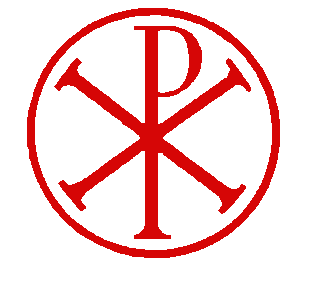
The Chi-RhoThe letter ’X’ of the English alphabet closely resembles the Greek letter “chi,” which in that language gives a sound much like our English ’k,’ as in cholera or chrome. From very early in the Christian Church the first two Greek letters of the word “Christ,” were used as a symbol for the Redeemer. The Greek letter for the “r” sound, or “Rho,” looks like our English letter “p”. We see this combination in the symbol used in many church decorations which we call the “Chi-Rho;” what looks like an “X” and a “P” superimposed over one another.

Eventually, just the single letter “X” also came to represent Jesus Christ. This symbolism came to England with Christianity. As the Anglo-Saxon language grew into first Old English and then common English, it was considered very acceptable to abbreviate “Christ,” or “Jesus Christ” with either the Chi-Rho, or just the Chi or “X”. We can see this done frequently in the Anglo-Saxon Chronicles beginning around A.D. 1050. This usage continued to be quite common through the Middle Ages, to the Victorian period, and of course is still used today. There was never any intention to do away with Jesus. “Xmas” means “Christmas,” period.

Santa Claus and Gift-giving
It is said that the origin for the mysterious benefactor of Christmas night: Knecht Ruprecht, Pelzmärtel on a wooden horse, St. Martin on a white charger, St. Nicholas, or Father Christmas, comes from Saints stepping into the shoes of the pagan god Oden, who, with his wife Frigga, descended during the nights between 25 December and 6 January on white horses to bless both earth and people. Welcoming fires were set on the hilltops, houses were adorned with many kinds of decorations and lights, work and trials suspended, and great feasts celebrated during these nights.

Indeed, it was quite common for peoples once they converted to Christianity to incorporate their one-time pagan deities into many of the customs and traditions of the new Christian Church. However, that is only part of the story, and it would not be fair not to give due acknowledgment to the individual most certainly more responsible than any other for the “Santa Claus” phenomenon, namely, Saint Nicholas of Myra.

Santa Claus with GiftsAs with many heroes of the early Christian Church; i.e. those that lived during that period of nearly three centuries before the faith could be practiced openly and without persecution; the life and works of Nicholas have acquired a great many myths and legends, some of them quite fantastic. In fact, one could say he is perhaps the most honored and venerated of any of Saints of this period. These facts we know: He was born about A.D. 270 at Patara in Lycia in the Roman province of Asia, now modern Turkey, to well-to-do Christian parents. Both his parents died in a plague when he was quite young and left him very wealthy, and he was raised by an uncle who was the Bishop of Patara. From very early in his childhood he was known for his piety and zeal for the Lord and the Church. He underwent severe hardship and imprisonment during the intense persecution of the Emperor Diocletian, but survived to see the legalization of the Christian faith during the rule of Constantine. When the office of Bishop at Myra, the provincial capital went vacant, the people persuaded him to take on this office, even though he was still quite young at the time. He was said to have attended the great Council of Nicaea in A.D. 325, and the story is that he walked right up to the arch-heretic Arius and slapped him in the face before the entire assembly. He is said to have died on December 6th, A.D. 343, in Myra, and buried there under the altar of his church. After the Muslim Saracens took over the area in the Eleventh Century, his bones were removed to the town of Bari in Italy, where they remain today.

Among the nearly countless stories of amazing miracles attributed to Nicholas, two stand out as explanations for why he became the model for Santa Claus. During a severe famine a man of Patara lost all his money and was about to lose his home and property. He had three daughters of marriage age, but because they had no dowry they had no prospects of finding husbands. The father planned, it is said, to force his daughters into prostitution so that the family could survive. Nicholas heard of his plans, and one night, tossed three bags of gold in though an open window where the daughters were sleeping. Finding the gold when they awoke the next morning, they now had their dowries and soon were married off successfully.

In some versions, the bags were given in three successive nights, or even years on the same date, and by some accounts the bags were thrown – where else – down the chimney. Another variant has the daughters wash out their stocking and hang them to dry, the gold bags landing in them to be found the next morning. All these variants were widely known throughout the Christian world as early as the A.D. 700s. Another story takes place during yet another famine. An innkeeper on an island just off the coast of Myra supposedly killed and butchered three little children, and put them in pickling barrels to sell them to unsuspecting guests. Visiting the island to give aid to the needy, Nicholas surmised the evil deed done by the innkeeper. He brought the children back to life and returned them to their parents, thus becoming seen as the special protector and benefactor to all children.

From these pious legends it is easy to see how Saint Nicholas could become so dear and important to people of many countries down through the centuries. That his “saint day” was so close to Christmas also lent itself to a close association between the two. Once we throw in various other aspects left over from early pagan sources, such as elves, reindeer, sleighs, coal, and the like, and stir the whole mixture together with an excuse for merry-making at the end of the year and the natural commercialism of free enterprise – viola! – Santa Claus!

Christmas Eve at ChurchOf course, Christian believers, should, can, and do filter out all this interference with their worship of the Christ-child, and the celebration of the great fact of Christmas, which is Immanuel – God with us! As the Apostle John writes so beautifully by the inspiration of the Holy Spirit, “And the Word became flesh, and dwelt among us, and we saw His glory, glory as of the Only Begotten from the Father, full of grace and truth.” (John 1:14)

A very blessed and joyous Christmas to one and all!

Pastor Spencer

[Once again, no claim is made for originality in this material. It has been collected from many sources over many years, for the benefit of my local congregation.]

Tuesday, December 4, 2012

The Christian Church Year

In the Lutheran Confessions it is stated,

"Of Usages in the Church they teach that those ought to be observed which may be observed without sin, and which are profitable unto tranquility and good order in the Church, as particular holy days, festivals, and the like. Nevertheless, concerning such things men are admonished that consciences are not to be burdened, as though such observance was necessary to salvation." (Augsburg Confession, Article XV: Of Ecclesiastical Usages)

"Holy days, festivals, and the like" can be seen as representing what we know today as the ancient and historic Christian Church Year. Throughout the Confessions our Lutheran forefathers repeatedly make two excellent and necessary points with regard to things like the Church Year: 1.) That the Lutheran Church has been and shall always be known for its faithful practice of following various human church customs like this; indeed that to continue to observe such is very beneficial for believers and 2.) That such observances are NOT necessary for salvation. Note well: To be continued, not to merit righteousness, but still to be continued. This is one of things that makes us confessional Lutherans.

Below is an outline and explanation of the Christian Church Year. This was shared with my congregation some years ago in a series of bulletin inserts. I've revised and edited it a bit and post it here for your information and edification. This may be "old news" to many of our readers, but I hope it will encourage us all to continue to make use of this salutary tool for our worship and spiritual education. Since Sunday, December 2nd is the First Sunday in Advent and thus begins a new Christian Church Year I thought it good to share this with you, our readers, today. Enjoy!


THE CHRISTIAN CHURCH YEAR

The Church Year developed slowly, and began and centered around what was regarded, and rightly so, as the highlight of the Christian faith – the Resurrection of Jesus Christ.

The Christian calendar can first be divided into two main sections. The first runs from Advent, the preparation for Christ's Nativity, through the Festival of Pentecost, that day being the completion of His promise to send the Paraclete to His Church. This part of the Church Year then deals with the Biblical facts surrounding the life and ministry of Jesus Christ, God's Son, Savior. Beginning with the Feast of the Holy Trinity and running through the rest of the Church Year, the focus falls on the teachings of Christ in the New Testament.

Advent
The The Church Year is then divided into six seasons, beginning with Advent. The first Sunday in Advent is always the Sunday closest to St. Andrew the Apostle's Day (November 30th). The early part of this season is devoted to Christ's Second Coming in the lessons and liturgy; while in the latter part, especially the 3rd and 4th Sundays, the Christmas theme is prominent.

In the early Church less stress was laid on the actual birth date of the Lord than on the fact that the Son of God became man (John 1:14). Accordingly there was a festival celebrating this fact as early as end of the First Century. Also by this time, the 6th of January was the accepted date for the Festival of Epiphany, or the Manifestation of the Lord, and commemorated not only the birth of Christ, but also His baptism and, in some places, His first miracle, thus expressing very well the general idea of the revelation and manifestation of the divinity of Christ in His humanity.

Just as Christ's Passion and Resurrection prompted a special season of preparation, so a similar period was set aside before Christmas. The length of the Advent season varied according to the ancient Christian communities where it was observed. For example, in Milan and parts of southern France there were five Sundays in Advent, while in Rome there were only four. Still other places counted as many as seven. Finally the custom of having four Sundays was generally accepted throughout the Western Church.

Christmas
The nativity of Jesus is observed on the Christmas Festival, December 25 in the western church, and is the first primary festival, with two or three days devoted to its observance. It is followed by the feasts of Saint Stephen (December 26), Saint John the Evangelist and Apostle (December 27), and the Holy Innocents of Bethlehem (December 28). Thus, it is said, the feast of the birth of the King of martyrs is followed by the “heavenly birthdays” of the first martyr in will and in deed, the apostolic martyr in will but not in deed, and the infant martyrs in deed but not in will.

It will be noted that December 25th falls nine months after March 25th, which is the Feast of the Annunciation. In the early Christian calendar March 25th was New Year's Day, as it was considered to be the beginning of the era of grace with the incarnation of the Son of God. It is still considered such in various parts of the church. However, the earliest references to this Feast come from the 5th Century, hundreds of years after the Nativity began to be celebrated in December.There are many other reasons why December 25th is the Feast of the Nativity of our Lord, but that is not the purpose of this article. Perhaps we will have a future piece dedicated to that topic.

Note: “Feast” and “festival” are synonymous in this context; both reflect the Latin term dies festus; feasts and festivals indicates only that both words are used in reference to certain special days other than fast days.

Epiphany
The eighth day of Christmas is the Festival of the Circumcision and the Name of Jesus; it concurs with the New Year's Day of the civil year. In the Western Church, the festival of Epiphany (which means "manifest"), January 6, recalls the episode of the Wise Men; but in the Eastern Church, this is counted as the Festival of Christ's Birth. In addition, as mentioned above, from very ancient times January 6th was celebrated as the date upon which Christ was baptized, and the date of His first miracle at Cana. These two events, along with the visit of the Magi to the Christ-child, were certainly occasions when He manifested His divinity. The number of Sundays in the post-Epiphany season varies with the date of the Festival of the Resurrection. (more on that later)

A season of pre-Lent contains the Sundays named "Septuagesima," "Sexagesima," and "Quinquagesima," the three Sundays before Ash Wednesday, which take their names from Latin words indicating that they fall approximately seventy, sixty, and fifty days before the Resurrection. These Sundays often take on some of the characteristics of Lent.

Date of Jewish Passover determines the dates of Ash Wednesday and the Feast of Christ's Resurrection
At first the Good Friday-Pascha event was thought of as being commemorated every Sunday. Indeed, the first festival commemorated annually was the Pascha. An early controversy about this date was settled A.D. 325 by the Council Nicaea which decreed that the anniversary of Christ's Resurrection be celebrated on the first Sunday after the first full moon on or after the spring equinox, or one week later if the full moon falls on Sunday.

Note: Personally - and this is just my own opinion, I prefer to try to avoid the use of the pagan term "easter" to designate this event. The modern English term, Easter, developed from the Old English word "eastre" or "eostre." The name refers to Eostur, a month in the pre-Christian calendar, and named for the fertility goddess Eostre in the Anglo-Saxon pagan pantheon. This goddess of spring also corresponds to many other such fertility gods and goddesses around the western world, the two most well known being "Astarte" in the Balkan countries and "Ishtar" in Mesopotamia. The month named for this goddess was the equivalent to our month of April, and so, unfortunately, the name became attached sometime after the Tenth Century to the most prominent spring festival in Christianity.

Following the much more ancient Christian custom, I believe it best to refer to the Resurrection of Christ as the "Pascha," and the weeks surrounding it as the Paschal Season. The Greek word pascha is derived from Hebrew PeSaCH (פֶּסַח) meaning the festival of Passover, as it was during the celebration of the Jewish Passover that Christ the perfect Lamb of God was crucified, died, buried, and rose again. In addition, the Greek the word anastasis (upstanding, up-rising, resurrection) is often used as an alternative.

Ash Wednesday ends the period of Epiphany and begins the period of Lent
From early days Pascha was preceded by a period of preparation called Lent. The custom of fasting during this time was already widespread throughout the Church from a very early date, but the length of the fast varied. Finally the fast was extended to forty days (excluding Sundays), after the analogy of the period of the Lord's temptation (Matthew 4:2). Ash Wednesday (so called from the custom of daubing the foreheads of worshipers on that day with ashes of the previous year's palms, in token of penitence and human mortality) has been the first day of Lent since at least the Sixth Century. The season of preparation for Easter closed with Holy Week. Thursday of Holy Week commemorated the institution of the Lord's Supper. It is called Holy Thursday by some, and its present name, Maundy Thursday, is derived from the Latin translation of the beginning words of Jesus in John 13:34, mandatum novum do vobis, "a new commandment I give you, that you love one another." Good Friday was a day of deep mourning, with a complete fast till 6:00 PM.

Festival of the Ascension and the Feast of Pentecost
Forty days after the Resurrection (Acts 1:3) came the Festival of the Ascension, which was celebrated from the early Fourth Century. Pentecost, which comes from the Greek word "pentekostos," or “fiftieth”, is observed on the fiftieth day after the Pascha, and its celebration can be traced to the Second Century. It is also called Whitsunday, from white garments worn on that day.

The Feast of the Holy Trinity
The Feast of the Holy Trinity, the fourth and final great festival of the Church Year follows on the Sunday after Pentecost. In the second part of the Church Year, the post-Trinity season, there are no festivals of the first rank. The number of Sundays after Trinity varies depending on the date of the Pascha.

Other Festivals of the Church Year
After the Sixth Century, the number of festivals in the Church increased rapidly. In particular, with the increased, though misplaced, veneration of Mary her festivals became more numerous. The Feast of the Annunciation, celebrating the conception of our Lord, was fixed for March 25, and that of the Presentation of Our Lord and the Purification of Mary for February 2; the latter festival is known as Candlemas, from the custom of blessing candles, carrying them in procession, and holding them lighted during the reading of the Gospel. Mary's meeting with Elizabeth is commemorated on the Feast of the Visitation, July 2.

From early in the Church, the feasts of Apostles and Evangelists were soon celebrated, especially those of Peter and Paul. And with the coming of the Middle Ages came the many saints' and martyrs' days. All Saints' Day, November 1, commemorated all the saints together and All Souls' Day, November 2, commemorated all the faithful departed.

Many of the Sundays of the Church Year are known by special names, usually after the first words of their introits, so, for example, the names of the Sundays in Lent are: Invocavit; Reminiscere; Oculi; Laetare; and Judica. The name Palm Sunday, as mentioned, is derived from the traditional use of palms in ceremonies of the day. The first four Sundays after Easter are Quasimodogeniti; Misericordias Domini; Jubilate; Cantate; Rogate precedes the Rogation Days, from which it takes its name; and Exaudi.

Following the lead of Martin Luther, the historic Lutheran Church has retained the ancient festivals in honor of Christ and the Triune God as a matter of course, and also regards most of those surrounded Jesus' mother as being properly Christ-centered festivals.

Festival of the Reformation, and the Sundays of the End-Times, close the Church Year
However, relatively few commemorations of other Biblical saints have survived. The same is true of most saints, martyrs, and events from after Apostolic times. One fairly recent exception is The Festival of the Reformation, October 31, commemorating the posting of Dr. Luther's 95 Theses, which dates back to the end of the Sixteenth Century.

The Church Year ends with the so-called "End-Time Sundays." The first of these is All Saints, followed by a Sunday focusing on the "Last Judgment," the "Church Triumphant," and finally the last Sunday of the Church Year, which, since Vatican II commemorates "Christ the King." Here again, I prefer to make this a Sunday of "Humiliation & Prayer," a fitting end, in my opinion, to the Christian Church-Year.

It is truly a sad commentary on the state of the church today, even in an otherwise conservative church body such as the WELS, that so many congregations, especially newer ones which use so-called "contemporary" (i.e. sectarian) worship styles, make very little, if any, use of the Church Year of the historic Christian church. Following the Church Year brings worshipers into contact with all the great events of Christ's life and ministry, and thus all the necessary and important doctrines of Christian faith and life. This is actually a great time-saving device. There is no need to work to put together a whole long list of various sermon series to try and accomplish the same thing. We hear constantly that it is not good to "re-invent the wheel," and that is why some of our brothers borrow certain styles and content from the sectarian churches. But in trying to replace the historic Church Year with a series of topics of their own, they are truly trying to make a new and different "wheel!"

Deo Vindice!

Pastor Spencer


(I freely admit that very little of the information here is original with me. I made use of the following sources in putting together this material: "The Sermon and The Propers," Fred Lindemann, CPH; "The Early Days of Christianity," Frederic Farrar; "Church History," Professor Kurtz, Funk & Wagnalls; "A History of Christianity," Kenneth Latourette, Harper & Row; "The New International Dictionary of the Christian Church," J.D. Douglas, ed., Zondervan; and of course, Wikipedia and Theopedia.)

Monday, November 19, 2012

Humiliation & Prayer Sunday

[Written to my congregation this past Sunday - Pastor Spencer]

Why Observe A Day of Humiliation & Prayer?

           A day of humiliation and prayer has been observed in the Church since the middle of the 4th Century, very soon after the Christian faith was no longer an outlaw religion.  Both Pastors and people recognized the need to remember our place under our Almighty Father and beneficent Creator as created beings; sinful and often arrogant ones at that. This need seemed most apparent during times of great danger, stress, or upheaval, either from political forces or from the earth itself.
          As nation-states came into being, it became very common for the leaders of a country to declare "a national day of humiliation and prayer" in the face of some natural disaster, at a time of invasion and war, or in the midst of great economic hardship for the people. Thus, in the Lutheran lands during the Thirty Year's War such proclamations came often. Such was also the case during the two English Civil Wars, the American Revolution, the War of 1812, the War Between the States, and World Wars I & II. Proclamations of a National Day of Humiliation and Prayer by men like George Washington, John Adams, Abraham Lincoln, and Franklin Roosevelt have become quite famous in American history. But over the past fifty years or so, the practice of setting aside a day to focus on our great need for God and His grace and mercy, and to pray for His continued love and blessing has fallen into disuse.
          We certainly cannot say that this is the cause of the difficulties and calamities of the past few decades – Viet Nam, Watergate, terrible floods and hurricanes, AIDS, political scandal and upheaval, 9/11, economic hardship, Jihad, and the like. However, it is certain that in past centuries such problems would bring about a turn of God's people to publicly and openly recognize their sins, and their need for His help.
                   Thus, as your shepherd, I have decided that there is no better time than now to return to this ancient and worthwhile practice and set aside one of our Sundays of worship as a Day of Humiliation and Prayer. In doing this I do not desire to forget that each Sunday is in fact a celebration of Christ's Resurrection, or to detract from the joy of our sure and certain salvation by grace through faith. I hope only to give us all an opportunity to give voice to our humility as reconciled sinners before our holy God, and to our pleas for His mercy and guidance in our many trials and problems.
          Let us use this occasion to admit that we have rebelled against God's will and brought much of our troubles upon ourselves by our greed, impatience, and pride. Let us pray for His undeserved grace and continued blessings upon us, our church, and our nation. Let us then leave our worship refreshed by His love and forgiveness, and strengthened by His Word to be better and more able citizens and Christians!
  
          To God alone be the glory!


Propers, Hymns, and Readings
for Humiliation & Prayer Sunday

Possible Sundays:
- Sunday before Ascension (Rogate); very ancient practice from the early church
- a Sunday in late October/early November (harvest & winter planting); again very historic, especially in Germany
- the last Sunday of the Church Year; in place of Christ the King Sunday in
preparation for Advent 


Liturgy:
The Order of Holy Communion (TLH 1941), or Service of Word & Sacrament (CW)  

Opening Hymn:
286 or 287

Introit:
Hear, O heavens, and give ear, O earth, for the LORD has spoken, "I have nourished and brought up children, and they have rebelled against Me." They have forsaken the LORD, they have provoked the Holy One of Israel unto anger; they are gone away backward. If You, O LORD, should mark iniquities, O LORD, who shall stand?

Collect:
Almighty and most merciful God, our heavenly Father, of whose compassion there is no end, Who is long-sufferings, gracious, and plenteous in goodness and truth, forgiving iniquity, transgression, and sin, we have sinned and done perversely, we have forsaken and grievously offended You; against You, You only, have we sinned and done evil in Your sight. But we ask You, O LORD, remember not against us our former iniquities; let Your tender mercies speedily come to us, for we are brought very low; help us, O God of our salvation, and purge away our sins for the glory of Your holy name and for the sake of Your dear Son, Jesus Christ, our Savior, Who lives and reigns with You and the Holy Spirit, one God, forever and ever. Amen.

Old Testament Lesson:
First Samuel 7:3-14, Isaiah 1:2-20, Daniel 9:3-19, or Joel 2:11-19

Psalm:
6, 32, 38, or 130

Epistle:
Acts 3:12-26, Romans 12:1-21, First Timothy 1:12-2:8, Hebrews 10:19-31

Gradual:
Seek the LORD while He may be found; call upon Him while He is near. Let the wicked forsake his way, and the unrighteous man his thoughts. Praise the LORD! Praise the LORD!
Let him return unto the LORD, and He will have mercy upon him; and to our God, for He will abundantly pardon. Praise the LORD!

Gospel:
Matthew 3:1-17, Matthew 5:13-20 & 6:1-8, Matthew 6:16-34, or Matthew 7:1-23

Hymn of the Day:
288

Prayer of the Church:
The Litany

P: Lord, have mercy upon us.
C: Lord, have mercy upon us.
P: Christ, have mercy upon us.
C: Christ, have mercy upon us.
P: Lord, have mercy upon us.
C: Lord, have mercy upon us.
P: O Christ, hear us.
C: O Christ, hear us.
P: O God, the Father in heaven:
C: Have mercy upon us.
P: O God, the Son, Redeemer of the world:
C: Have mercy upon us.
P: O God, the Holy Ghost:
C: Have mercy upon us.
P: O Holy Trinity, One God:
C: Have mercy upon us.
P: Be gracious unto us.
C: Spare us, good LORD.
P: Be gracious unto us.
C: Help us, good LORD.
P: From all sin; from all error; from all evil:
C: Good LORD, deliver us.
P: From the crafts and assaults of the devil;
From sudden and evil death;
From pestilence and famine;
From war and bloodshed;
From sedition and rebellion;
From lightening and tempest;
From all calamity by fire and water;
And from everlasting death:
C: Good LORD, deliver us.
P: By the mystery of Your holy Incarnation(+);
By Your holy birth;
By Your Baptism, Fasting, and Temptation;
By Your Agony and bloody Sweat;
By Your Cross and Passion (+);
By Your precious Death and Burial;
By Your glorious Resurrection and Ascension;
And by the coming of the Holy Ghost, the Comforter:
C: Help us, good Lord.
P: In all times of our tribulation;
In all times of our prosperity;
In the hour of our death;
And on the Day of Judgment:
C: Help us, good Lord.
P: We poor sinners do beseech You;
C: To hear us, good LORD.
P: To rule and govern Your Holy Christian Church;
To preserve all pastors and ministers of Your Church in the true knowledge and understanding of Your Word, and in holiness of life;
To put an end to all divisions and causes of offence;
To bring into the way of truth all such as have erred, and are deceived;
To beat down Satan under our feet;
To send faithful laborers in your harvest;
To accompany your Word with Your Spirit and grace;
To raise up them that fall, and to strengthen such as do stand;
And to comfort and help the weak-hearted and the distresses:
C: We ask You to hear us, good LORD.
P: To give to all nations peace and concord;
To preserve our country from discord and contention;
To direct and defend our President, and all others in authority;
To bless and keep our magistrates, and all our people:
C: We beseech You to hear us, good LORD.
P: To behold and rescue all who are in danger, necessity and tribulation;
To protect all who travel by land, air, or water.
To preserve all women in the perils of childbirth;
To strengthen and keep all sick persons and young children;
To set free all who are innocently imprisoned.
To defend and provide for all fatherless children and widows;
And to have mercy upon all people:
C: We beseech you to hear us, good LORD.
P: To forgive our enemies, persecutors, and slanderers, and to turn their hearts;
To give and preserve to our use the fruits of the earth;
And graciously to hear our prayers:
C: We beseech You to hear us, good LORD.
 P: O Lord Jesus Christ, Son of God;
C: We beseech You to hear us.
P: O Lamb of God, that takes away the sin of the world;
C: Have mercy upon us.
P: O Lamb of God, that takes away the sins of world;
C: Have mercy upon us.
P: O Lamb of God, that takes away the sin of the world;
C: Grant us Your peace!
P: Almighty God, our heavenly Father, Who desires not the death of a sinner, but rather that he should turn from his evil ways and live: We beseech You graciously to turn from us those punishments which we by our sins have deserved, and to grace us grace hereafter to serve You in holiness and pureness of living; through Jesus Christ, Your Son, our Lord.
C: Amen.

Communion Distribution Hymn:
310

Closing Hymn:
408, 409, 412, or 413


Creative Commons License
This work is licensed under a Creative Commons Attribution-Noncommercial-No Derivative Works 3.0 United States License