Showing posts with label Holy Communion. Show all posts

Thursday, March 28, 2013

A Second Sermon for Thursday of Holy Week, or 'Maundy Thursday' — by Dr. Martin Luther

Dr. Martin LutherOn Wednesdays through the Lenten Season this year (2013), we published sermons from Dr. Adolph Hoenecke (1835-1908), who is among the most important theologians of the Wisconsin Evangelical Lutheran Synod (WELS), and from Dr. Paul E. Kretzmann (1883-1965), a prolific author, educator, historian and theologian of the Lutheran Church — Missouri Synod (LCMS) and among the more significant figures of 20th Century American Lutheranism. We will do the same through Holy Week. Except for today, Maundy Thursday. Instead of Dr. Hoenecke and Dr. Kretzmann, we will hear from Dr. Martin Luther himself, from his Hauspostille.

Normally, we read sermons from Dr. Luther's Hauspostille as they come to us in the collection recently edited by Eugene F.A. Klug, and translated by him and others. This is the same Hauspostille included in the seven-volume Complete Sermons of Martin Luther published by Baker Book House. There were two collections of Luther's Hauspostille: one from the stenographic notes of Veit Dietrich and one from those of Georg Roerer, both of whom copied the words of Luther as he preached to his students in his home. Roerer's notes were published in 1539 without Luther's approval, while those of Veit Dietrich were published later, in 1545, and carried with them Luther's endorsement. The newly translated Hauspostille contained in the Baker publication comes from the Roerer collection of Luther's Hauspostille, under the rationale that “the consensus of scholars has more and more moved in the direction of Roerer's transcription of Luther's house postils as the source most complete, exact, and trustworthy.”1

We will not be reading a sermon from Roerer's collection, however. Missing from that collection, and contained only in Veit Dietrich's collection, are two Maundy Thursday sermons from the First Epistle of St. Paul to the Corinthians. Veit Dietrich's collection of Dr. Luther's Hauspostille was translated from German into English in 1871. In this post, we publish Luther's Second Sermon for the Day of the Lord's Supper, from the second English edition of that translation effort, published in 1884.2


A Sermon for Maundy Thursday

Second Sermon for the Day of the Lord's Supper

by Dr. Martin Luther2
    Text: Wherefore whosoever shall eat this bread, and drink this cup of the Lord, unworthily, shall be guilty of the body and blood of the Lord. But let a man examine himself, and so let him eat of that bread, and drink of that cup. For he that eateth and drinketh unworthily, eateth and drinketh damnation to himself, not discerning the Lord's body. For this cause many are weak and sickly among you, and many sleep. For if we would judge ourselves, we should not be judged. But when we are judged, we are chastened of the Lord, that we should not be condemned with the world. Wherefore, my brethren, when ye come together to eat, tarry one for another. And if any man hunger, let him eat at home; that ye come not together unto condemnation. And the rest will I set in order when I come. (1 Corinthians 11:27-34)

This text is of great importance and deserves to be attentively considered by Christians. We have already learned, from the previous sermon, how the people misunderstood these words, so as to deprive themselves of the comfort contained in the Sacrament of the Lord's Supper, yea, even shunned it as something dangerous. It is true, Judas did not receive this Sacrament to his consolation or amendment. There were also many among the Corinthians, as St. Paul tells us, who received it unworthily, and thus brought upon themselves bodily and spiritual punishment. There is indeed a difference in the reception of this Sacrament; some partake of it worthily and unto eternal life, but others unworthily unto condemnation, inasmuch as they do not repent and have true faith. Hence it is of the first importance that we learn to know what is meant by the expression “eating and drinking worthily or unworthily.

Wednesday, March 27, 2013

A Sermon for Thursday of Holy Week, or 'Maundy Thursday': “The Holy Sacrament” — by Dr. Martin Luther

Dr. Martin LutherOn Wednesdays through the Lenten Season this year (2013), we published sermons from Dr. Adolph Hoenecke (1835-1908), who is among the most important theologians of the Wisconsin Evangelical Lutheran Synod (WELS), and from Dr. Paul E. Kretzmann (1883-1965), a prolific author, educator, historian and theologian of the Lutheran Church — Missouri Synod (LCMS) and among the more significant figures of 20th Century American Lutheranism. We will do the same through Holy Week. Except for today, Maundy Thursday. Instead of Dr. Hoenecke and Dr. Kretzmann, we will hear from Dr. Martin Luther himself, from his Hauspostille.

Normally, we read sermons from Dr. Luther's Hauspostille as they come to us in the collection recently edited by Eugene F. A. Klug, and translated by him and others. This is the same Hauspostille included in the seven-volume Complete Sermons of Martin Luther published by Baker Book House. There were two original collections of Luther's Hauspostille: one from the stenographic notes of Veit Dietrich and one from those of Georg Roerer, both of whom copied the words of Luther as he preached to his students in his home. Roerer's notes were published in 1539 without Luther's approval, while those of Veit Dietrich were published later, in 1545, and carried with them Luther's endorsement. The newly translated Hauspostille contained in the Baker publication comes from the Roerer collection of Luther's Hauspostille, under the rationale that “the consensus of scholars has more and more moved in the direction of Roerer's transcription of Luther's house postils as the source most complete, exact, and trustworthy.”1

We will not be reading a sermon from Roerer's collection, however. Missing from that collection, and contained only in Veit Dietrich's collection, are two Maundy Thursday sermons from the First Epistle of St. Paul to the Corinthians. Veit Dietrich's collection of Dr. Luther's Hauspostille was translated from German into English in 1871. In this post, we publish Luther's First Sermon for the Day of the Lord's Supper, from the second English edition of that translation effort, published in 1884.2

(NOTE: Due to the length of this sermon, I have taken the liberty of adding subheadings,
to break up the content for those with short attention span.)


A Sermon for Maundy Thursday

First Sermon for the Day of the Lord's Supper

by Dr. Martin Luther2

The Holy Supper
    Text: For I have received of the Lord that which also I delivered unto you, that the Lord Jesus the same night in which he was betrayed took bread: And when he had given thanks, he brake it, and said, Take, eat: this is my body, which is broken for you: this do in remembrance of me. After the same manner also he took the cup, when he had supped, saying, this cup is the new testament in my blood: this do ye, as oft as ye drink it, in remembrance of me. For as often as ye eat this bread, and drink this cup, ye do shew the Lord's death till he come. (1 Corinthians 11:22-26)

The Last SupperAccording to a time-honored usage, more people come to the Lord's Table at this season than at any other time during the year. This fact, together with the urgent necessity that on a stated day the doctrine of the Sacrament of the Lord's Supper be plainly taught the people from the pulpit, prompts us to consider now the words of St. Paul, which you have heard read in our text. From these words we learn that this Sacrament was in no wise instituted or introduced by men, but by Christ Himself. In the night in which He was betrayed He instituted it for His disciples, yea for all Christians, that it might be unto them His Testament, His parting gift, full of great comfort and blessing.

Thursday, April 5, 2012

Remember the cup of salvation - Holy Thursday sermon

This sermon was written for the saints at Emmanuel Lutheran Church in Las Cruces, New Mexico, to be preached on Holy Thursday, 2012.


Exodus 12:1-14 + Psalm 116 + 1 Corinthians 11:23-32 + John 13:1-15

Tonight begins the first of the Three Holy Days, from sunset to sunset, according to Creation Time – first evening and then morning each day. It would take a full twenty-four hours – or maybe just a lifetime – to do justice to all the events that took place during the twenty-four hours of that very first Holy Day that began at sunset on Maundy Thursday and ended at the eerie sunset of Good Friday.

So many memorable and meaningful events took place on that Thursday night. The love of Jesus on display as he washed his disciples feet. The command for them to walk in his footsteps of love, self-sacrifice and lowly service. The Passover meal. The predicted betrayal, abandonment and denial. The High Priestly prayer of Jesus – for his disciples back then, and also for his disciples now. The Garden of Gethsemane. The anguish of Jesus’ soul.

My soul is very sorrowful, even to death; remain here and watch with me.” And then, with sweat dripping like blood, Jesus prayed three times to his Father to “take this cup” from him, “if it is your will. My Father, if this cannot pass unless I drink it, your will be done.”

And the Father’s will was done. Jesus drank from the cup. And that brings us back to the one thing I would ask you remember tonight, or at least, the one thing I would ask you focus your attention on. On Palm Sunday I asked you to remember one thing above all else – to remember Jesus riding on a donkey. Tonight, as we begin the first of the Three Holy Days, remember the cup.

We sang about it already in the Psalm this evening, and since we’ve been considering the Psalms throughout our Lenten journey this year, let’s include them for the Three Holy Days, too. In Psalm 116 we sang the words of the Messiah, “I will lift up the cup of salvation and call on the name of the LORD.”

Now the interesting thing about the Messianic Psalms is that, though they were written hundreds of years before Jesus was born, they were written from the perspective of the Messiah both as the events are transpiring in his life, and also as he looks back on it all after it’s all over.

Listen to the words of Jesus in Psalm 116, “I love the LORD, because he has heard my voice and my pleas for mercy.” You see the perspective of the Messiah there? It’s as if Holy Week is already over and done and the Father has already heard him and delivered him from his enemies on Easter Sunday. But the Psalm gives us a window into what Jesus was going through as Holy Week was happening.

The snares of death encompassed me; the pangs of the grave laid hold on me. I suffered distress and anguish. Then I called on the name of the LORD: O LORD, I pray, deliver my soul!” Sounds just like Jesus in the Garden of Gethsemane, doesn’t it?

Then he gives thanks to the Lord, “For you have delivered my soul from death, my eyes from tears, my feet from stumbling; I will walk before the LORD in the land of the living.” Sounds like Easter Sunday, doesn’t it?

But see what had to happen in between. A cup had to be drunk. In order for sinful mankind to be able to drink salvation from God’s cup, the sinless Son of Man had to first drink the cup of wrath, the cup of punishment, the cup of torture and death. And when he asked his Father to take it from him and his Father didn’t do it, what did Jesus do with that cup? Oh, he could have thrown it down on the ground and let God’s wrath against sin be poured out onto sinners. Remember, he said in the Garden when Peter drew his sword to defend Jesus, “Put your sword away… Do you think that I cannot appeal to my Father, and he will at once send me more than twelve legions of angels? But how then should the Scriptures be fulfilled, that it must be so?”

Instead of dropping the cup, Jesus drank it – drank it down to its dregs. He had to be brought low, lower and lower and lower, down to the point of death, even death on a cross.

But as he says in the Psalm, “When I was brought low, he saved me.” The cup of wrath and suffering for sin had been emptied. And now the cup of Jesus is filled to the brim with salvation – not just for himself in his glorious resurrection, but with salvation that he pours down the throats of his people.

What shall I render to the LORD for all his benefits to me? I will lift up the cup of salvation and call on the name of the LORD, I will pay my vows to the LORD in the presence of all his people.

That’s not just a figurative expression. Jesus literally poured his salvation – his forgiveness and his life, into a cup on Maundy Thursday and gave it to his disciples to drink, not just once, but to do this in remembrance of him, to lift up the cup of salvation and call on the name of the LORD, to drink from it often and to proclaim his death again and again until he comes.

Do you still sin after your baptism? Yes, you do. Do you still have bitter enemies who can attack your faith in Christ and beat it to a pulp? Yes, you do. But you have been given a cup of salvation, filled with the precious blood of the Lamb of God, filled for you to drink.

It’s not a symbol of Jesus’ blood. By the power of Jesus’ word, it is his blood. It’s not a symbol of salvation. By the power of Jesus’ word, it is salvation and forgiveness and life for all who believe in the words and promises of Jesus – given for you, shed for you for the forgiveness of sins. No sin is wicked enough, no enemy is strong enough to undo Jesus’ words of promise. He pours his salvation into this cup, and so administers a lethal dose to death.

Precious in the sight of the LORD is the death of his saints. Even your death is precious to your Father in heaven, because you have been united to his precious Son, Jesus Christ, whose death was also precious in the Lord’s sight, precious enough to satisfy God’s wrath against every sinner. Your death, when it comes, will be precious to your Father in heaven, because you have drunk from his cup of salvation, week in and week out, and so you have received the medicine of immortality, a better Tree of Life, God’s seal and pledge that, though you die, you will live.

And isn’t that what that other Psalm says, too? You prepare a table before me in the presence of my enemies; you anoint my head with oil; my cup overflows. Surely goodness and mercy shall follow me all the days of my life, and I shall dwell in the house of the LORD forever. (Ps. 23:5-6)

Remember the cup of Jesus – the cup that he drank, and the cup that he has filled with his salvation, with his blood, poured out for you. The table is ready. Drink from his cup and live. Amen.

Monday, April 2, 2012

The journey to the cross and the empty tomb - a Lutheran translation


I always appreciate the invitations to “journey to the cross this Holy Week,” or to have a “blessed journey to the empty tomb.” Those invitations come from every corner of the Christian world. But when Lutherans say such things, they mean something different, something more than what the sects mean. At least, one hopes.

How is one to “journey to the cross” or “to the empty tomb”? Obviously pilgrimages to the Holy Land are not going to cut it.

How, then?

For the non-sacramental sects, one makes such a journey mentally and emotionally (they would mistakenly say “spiritually”) by reviewing the Holy Week events, like relearning a valuable lesson, like reminiscing about an old friend who isn’t around anymore, like rereading a good book, like watching a rerun of a favorite show or a classic sporting event on TV. To make it really special, they may jazz it up a bit with dramatic readings or reenactments – whatever it takes to make watching a rerun less boring and more emotionally stirring, more “meaningful.”

For the non-sacramental sects, Holy Week is a time to remember Jesus, and by remembering Him, to have a sort of “spiritual” communion with Him up in heaven. They may even have a snack of crackers and grape juice to celebrate Maundy Thursday, the empty shell of a Supper in which Jesus is merely remembered, with an empty seat at the table in honor of an absent Guest.

That’s what a lot of Christians understand when they hear about a journey to the cross and the empty tomb.

Lutherans mean something better.

For means of grace Lutherans, the journey to the cross and the empty tomb is not a journey we make by thinking really hard about Jesus’ death and resurrection. It’s not a journey we make by trying to muster up the right feelings of horror or of guilt or of joy. In fact, it’s not really a journey we make at all. It’s a journey that the Holy Spirit takes us on through the means of grace, the Gospel in Word and Sacrament. Instead of a rerun, the Holy Week Gospel is a live feed, back through time to the actual events in history that purchased our redemption.

But it gets even better than that.

For means of grace Lutherans, the satisfaction that Christ made for sins on the cross actually comes through the live feed and is applied to penitent sinners here and now. The goodness and mercy of Christ, the righteousness of our Substitute, the love of a Father, are communicated to us here and now, forgiving sins in the present tense. The Spirit of Christ comes through the words to us, whisking us away through baptismal waters, back before the court, onto the cross, into the grave and out again. The means of grace brings the risen Savior to us and stirs up faith to cling to Him in a way that even faithful Mary was not allowed to do on that very first day of the week.

But it gets even better than that.

Means of grace Lutherans have something better than a peek inside an empty tomb on Easter Sunday. We are given a glance at the One who once occupied the tomb, whose glorified body and blood now grace the Altar, to be handed out to the faithful for the forgiveness of sins. This brief moment of reclining at table with the risen Savior is far more than a remembrance of the living Lord Jesus. It’s a reception of Jesus Himself, a communion in the life of the Living One, and therefore, a life-giving medicine.

I once heard it suggested that, in our Christian freedom to not offer Holy Communion on any given Sunday, maybe Easter Sunday is the best time to exercise that freedom for the sake of our Easter visitors. Such a practice would fit right in with the non-sacramental sects and their “spiritual” journey to the empty tomb, but it would seem quite unnatural for means of grace Lutherans who believe that, in the Holy Supper, we truly “proclaim Christ’s death until He comes,” for means of grace Lutherans who know that this “remembrance of Him” is, in reality, the personal appearance of the Risen One in our midst.

So pastors, if, for some reason, you decided that Easter Sunday was the perfect time not to offer the body and blood of the risen Savior to your people, the ideal time not to offend potential believers in Jesus with the real presence of Jesus, there’s still time to rethink it. So what if bulletins have already been printed and musicians already lined up? Your organist already knows at least one setting for the Service of the Sacrament. Your people will understand, too, if you explain to them that there’s one way and one way only by which a means of grace Lutheran actually makes the blessed journey to the cross and to the empty tomb – through an abundance of the means of grace.

As Lutherans, we sometimes need to remember how many shorthand phrases we use, both for our own sake as well as for the sake of others. Even “means of grace” means very little to those on the outside. Holy Week is a fine time to invite your friends and neighbors to accompany you on a blessed journey to the cross and empty tomb. Just be sure they know the Lutheran translation.

Wednesday, December 28, 2011

Not exactly the image I had in mind

Last week in my Pastoral Rationale for Using the Common Cup, I suggested that the Common Cup is more consistent with the Words of Christ than Individual Cups are, and that the Common Cup is a much more appropriate symbol for Holy Communion than Individual Cups are. (See that article for the reasons I gave.)

I used several graphics and artistic representations from church history to illustrate those points:


But a new image for the Sacrament of Holy Communion just arrived yesterday in my mailbox. Without further comment, I’ll just say, I think it (unintentionally) strengthens my arguments for the Common Cup.


I’m very glad the editors of Forward in Christ decided to run an article on “The Sacramental Life,” from Jon Zabell’s worthy essay presented at last summer’s synod convention. This is good. At least the Sacrament is in focus! But the picture on the cover is better suited to the Reformed church down the road where they obediently drink shots of grape juice in memory of Jesus’ absent blood. The Lutheran Church has a better image for the Communion that takes place with the really present blood of Christ and with one another at the Lord’s Table. It looks like a chalice. Let’s not be afraid to use it!

Thursday, December 22, 2011

The Bridegroom's Gift to His Bride at Christmas(s)

(Reposted from last year)

Like it or not, Christmas is one of those holidays that the Church shares with the world. Many festive traditions have grown up around it, like trees and lights and music and presents. The Church uses these to celebrate the birth of Christ. The world uses them simply to celebrate. We may bemoan the secularization of the Christmas season and we may complain that the world has stolen from the Church more than she has willingly shared.

And yet, how can we complain? Even though the world abuses it and often refuses it, Christmas is God’s gift to all men. The whole world is invited to the celebration. Shout it from the mountaintops! Proclaim it from the pulpit! If you belong to the human race, then “a Savior has been born to you. He is Christ the Lord.” Hear the good news and believe!

But there remains one Christmas tradition that is reserved for the Bride of Christ, his Church – a gift meant only for her. This gift is unpretentious. It doesn’t sparkle; it doesn’t shine. In ancient times, the entire Christmas season grew out of this gift that now lingers modestly in the background, no longer the focus of Christmas, and yet not quite forgotten. It is a Christmas gift given for the Church alone to receive, wrapped up and waiting for her on Christmas morning.

You won’t find this gift under the Christmas tree or at the dinner table, but you will find it on many a Table in many a church on Christmas morning: a body that was given in and from the womb of a virgin; given under law to redeem those who were under the law; given over to death for the sins of all; a body born in time but prepared in eternity so that God could die and man could live, the Word Made Flesh who once made his dwelling among us.

See! He makes his dwelling among us still – the same body, the same blood, no longer wrapped in cloths and lying in a manger, but wrapped in bread and wine, cradled in a pastor’s hand and given to you...and to you...and to you.

You didn’t get to hear the angelic host singing in the night skies of Bethlehem, but you do get to join the saints on earth and the hosts of heaven in glorious song, “Glory be to God on high, and on earth peace, good will toward men!” You didn’t get to be there for the miracle of the virgin birth, but you do get to be there for this miracle when God comes to earth and gives himself to his people to touch and to taste, to eat and to drink in Christmas communion. You get to celebrate the birth of Christ in the sacramental presence of Christ. Who would have thought?

What a miracle! What a gift – better than any present waiting under the Christmas tree! The gift of real peace. The gift of eternal life. The gift of divine forgiveness. The God-given medicine against guilt and condemnation. At the heart of Christmas is the Word Made Flesh – in the Gospel that tells of his incarnation, and in the Sacrament that brings the Incarnate Word to earth again.

Of all the Christmas traditions that the world has borrowed and emptied, this tradition belongs to the Church and to her alone: to meet together on December 25th in the Real Presence of her Savior, born in Bethlehem, to receive him with all his benefits and to offer him the worship of faith. And in this Christmas communion, her song speaks of the past as well as the present, “Joy to the world, the Lord is come! Let earth receive her King!”

Tuesday, December 20, 2011

A Pastoral Rationale for Using the Common Cup

The following is a pastoral letter sent to the members of my congregation. I share it with our readers here in the hopes that you might find something useful in it.

*********************************************************


Rorate Coeli, AD 2011

Dear members of Emmanuel,

As promised, I have put down in writing an expanded version of the things I shared with you on Sunday after the service regarding our introduction of the Common Cup on Christmas Day. I hope you find it edifying. (And I hope you’ll read all the way to the end. Take a break in between sections if you have to!)


THE SYMBOLISM OF “THE CUP” IN SCRIPTURE

“The cup” is a picture used throughout the Scriptures to symbolize what we receive from God, as we “drink” from his hand either blessing or wrath.
    Psalm 23:5 (NKJV) You prepare a table before me in the presence of my enemies; You anoint my head with oil; My cup runs over.

    Jeremiah 25:15 (ESV) Thus the LORD, the God of Israel, said to me: “Take from my hand this cup of the wine of wrath, and make all the nations to whom I send you drink it. “

    Psalm 116:12–13 (ESV) What shall I render to the LORD for all his benefits to me? I will lift up the cup of salvation and call on the name of the LORD.

    Matthew 20:22–23 (ESV) Jesus answered, “You do not know what you are asking. Are you able to drink the cup that I am to drink?” They said to him, “We are able.” He said to them, “You will drink my cup, but to sit at my right hand and at my left is not mine to grant, but it is for those for whom it has been prepared by my Father.”

    Mark 14:36 (ESV) And he said, “Abba, Father, all things are possible for you. Remove this cup from me. Yet not what I will, but what you will.”

On the night he was betrayed, Jesus gave his own cup to his disciples, filled, not with wrath, but with blessing. What could be a more fitting symbol for Holy Communion! The one “cup of blessing” symbolizes the blessing we receive from God through the One Man, Jesus Christ. More than that, the one cup actually distributes to many individuals the real blood of the One Man, Jesus Christ, “shed for many for the remission of sins.” One Sacrifice for many sinners, one cup for many individuals.

Luther says this about the cup:
    In reference to this particular cup, then, Matthew and Mark may be understood as saying that each of the apostles had a cup before him on the table, or at least that there were more cups than one. But now, when Christ gives a new, special drink of his blood, he commands them all to drink out of this single cup. Thus, in proffering it and with a special gesture, Christ takes his own cup and lets them all drink of it, in distinction from all the other ordinary cups on the table, in order that they might better observe that it was a special drink in distinction from the other draughts which had been given them during the meal. The bread he could readily—indeed, he must—have so distributed that each received a piece for himself. But the wine he could not have distributed in this manner, but had to serve it in a cup for them all, indicating verbally that it was to be a drink in common for them all, not offered to and drunk by only one or two or three, as the other cups on the table were available to each as he wished. (AE:37:311)

The use of a Common Cup matches exactly the symbolism that Jesus chose to use on the night he was betrayed. With a Common Cup, we all literally receive from God’s hand (through his called servant) a single cup from which to drink, and in that cup is the blood of a single Man, literally distributed to many individuals.

The use of Individual Cups completely removes this symbolism and introduces its own faulty symbolism. Rather than each one receiving the blood of the One Man from the one cup, the wine is pre-separated into many tiny cups so that, by the time the wine is blessed (or “consecrated”) and the real presence of Christ’s blood comes to the wine, it is already divided into dozens of individual portions. Many cups for many individuals instead of one cup for many individuals; many neatly separated measurements of Christ’s blood instead of a single supply that flows to many.

This is not the symbolism Christ intended. He could have easily blessed all the wine that was already poured in the various cups that were already on the table on the night he was betrayed. But he didn’t. Instead, he blessed the one cup to be given to many. The Common Cup fulfills this symbolism beautifully.


THE WORDS OF CHRIST

But even more important than the symbol are the actual words of Christ and the real presence of Christ in this Supper. It is clear from all four Scripture accounts of the institution of the Lord’s Supper that Christ took a single cup, gave thanks over it and instructed all of his disciples to “drink from it.”
    Matthew 26:27-28 Then He took the cup, and gave thanks, and gave it to them, saying, “Drink from it, all of you. For this is My blood of the new covenant, which is shed for many for the remission of sins.”

    Mark 14:23 Then He took the cup, and when He had given thanks He gave it to them, and they all drank from it.

    Luke 22:20 In the same way, after the supper he took the cup, saying, “This cup is the new covenant in my blood, which is poured out for you.”

    1 Corinthians 11:25 In the same way also he took the cup, after supper, saying, “This cup is the new covenant in my blood. Do this, as often as you drink it, in remembrance of me.”

In Scripture, the Sacrament of the Altar is so closely tied to the use of “the cup” that the word “wine” is never even mentioned in connection with the Lord’s Supper (although, from the context, we are 100% certain that grape wine was the content of the cup). Here is another reference:
    1 Corinthians 11:26-28 For as often as you eat this bread and drink the cup, you proclaim the Lord’s death until he comes. Whoever, therefore, eats the bread or drinks the cup of the Lord in an unworthy manner will be guilty concerning the body and blood of the Lord. Let a person examine himself, then, and so eat of the bread and drink of the cup.

Now, there are three questions we must answer. First, does the real presence of Jesus’ blood in this Sacrament (and thus, the forgiveness of sins!) depend on the kind of vessel that is used? The answer is, no. When the Word of Christ is spoken over the bread and wine that says, “This is my body; This is my blood,” nothing in the world can make the Word of Christ invalid. All the wine on the altar is blessed with the Words of Institution, consecrated, set aside for sacred use. Christ’s blood is really present in, with and under the wine, no matter what vessel contains it.

As our Small Catechism says, “’Given and shed for you for the forgiveness of sins.’ These words, along with the bodily eating and drinking, are the main thing in the Sacrament. Whoever believes these words has exactly what they say: ‘forgiveness of sins.’”

Second, is it completely incompatible with Christ’s command to use Individual Cups? In other words, is it sinful? Are we bringing guilt on ourselves in the very Sacrament that is intended to erase guilt? Again, the answer is no. 1) Bread, 2) wine, 3) the Words of institution, 4) a called pastor who administers the body and blood of Christ, and 5) communicants who receive them – those are the essential elements in the Lord’s Supper which absolutely must be retained among Christians in order to celebrate the Sacrament according to Christ’s institution.

It’s important to view the Sacrament rightly. The Roman Catholic understanding of the Mass is that it is man’s sacrifice to God, man’s work done for God to merit the forgiveness of sins. But the Lutheran, Scriptural teaching of the Mass is that it is entirely God’s work done for us. We are on the receiving (the “drinking”) end, not the giving (the “pouring out”) end. Christ did not set up another Law in this Sacrament, as if, by our meticulous obedience, we earned his forgiveness, or as if, by our failure to observe the non-essential details of the institution, we incurred His wrath. “Christ is the end of the law so that there may be righteousness for everyone who believes” (Romans 10:4). The only “service” we render to God in the Sacrament is the worship of faith – faith in his words that we are truly receiving his body and blood for the forgiveness of sins. By faith in Christ, who did all things in the right way for us, we are rescued from the burden of having to do the right things in the right way in order to become righteous before God.

So it is neither a “good work of the Law” to use the Chalice, nor is it a “sinful work under the Law” to use Individual Cups. We are not rendering to God our service in the Sacrament. On the contrary, he is handing out the benefits of His service to us.

Finally we have to ask the question, is it fully consistent with Christ’s command to use Individual Cups? Are we following exactly the pattern that Christ set for us, the pattern that his Church has observed for almost 2000 years? Here we must frankly answer, no. “Drink from it, all of you. This cup is the new covenant in my blood, which is poured out for you.”

While the vessel of distribution is not an essential part of the Sacrament, it is not an entirely insignificant part, either, because of Jesus’ words. His words are everything. They matter. He could have said, “This wine is the new covenant in my blood.” He could have said, “The wine in these cups is the new covenant in my blood.” But instead, he chose – in every single Scripture reference – to refer to “the cup” from which we are to drink.

We are not minimalists in the Lutheran Church. We don’t ask the question, “How little do we have to do to get by in following Christ’s words and institution in order to have a valid Sacrament?” Instead, we simply stay as close to his words as possible, and rejoice in the blessings we receive through them.

The use of a Common Cup matches exactly the practice that Jesus instituted on the night he was betrayed and follows his words to the letter. The use of Individual Cups, while not sinful, is still not fully consistent with the practice Christ instituted.


OUR FELLOWSHIP WITH ONE ANOTHER

As you may remember from catechism/confirmation classes, there is both a vertical communion and a horizontal communion that take place in the Sacrament of the Altar – a communion of each individual with Christ, and a communion of all individuals with their fellow communicants.

Paul says this in 1 Corinthians 10:16-17 (NKJV), “The cup of blessing which we bless, is it not the communion of the blood of Christ? The bread which we break, is it not the communion of the body of Christ? For we, though many, are one bread and one body; for we all partake of that one bread.”

This is also stated beautifully in our Lutheran Confessions:
    Consider this true, almighty Lord, our Creator and Redeemer, Jesus Christ, after the Last Supper. He is just beginning His bitter suffering and death for our sins. In those sad last moments, with great consideration and solemnity, He institutes this most venerable Sacrament. It was to be used until the end of the world with great reverence and obedience ‹humility›. It was to be an abiding memorial of His bitter suffering and death and all His benefits. It was a sealing ‹and confirmation› of the New Testament, a consolation of all distressed hearts, and a firm bond of unity for Christians with Christ, their Head, and with one another. (Formula of Concord: Solid Declaration: Art. VII, 44).

Our American culture emphasizes individualism and independence. But the Sacrament of the Altar does the opposite. It pulls us away from ourselves into a very real experience of unity and oneness, as all the individual believers come together to drink from the cup of Christ. Here no one is better or worse than another; no one is too good to drink from the same cup as his fellow believer, and no one is not good enough. All are one in Christ.

The Common Cup displays the striking reality of this oneness as we leave our individualism behind and, for a brief moment, come together around the cup of Christ. We return to our seats with an unavoidable realization of our oneness in the body of Christ. Our spiritual oneness is invisible, intangible. But that spiritual oneness is acted out visibly and tangibly when all drink from the one cup of Christ.

The same is really true of the bread. While the bread is cut into many wafers, all those wafers are gathered together in one place. They touch one another. There is no separation between them.

But the wine in the Individual Cups is kept completely separate from one cup to the next. One never touches the other. Individual Cups continue to foster the false notion that we are nothing more than a bunch of separate individuals coming forward to receive our own individual meal, and then go back to our seats just as separated from one another as before, perhaps even thankful that we didn’t have to drink from the same cup as our fellow members. This hardly fits the reality of what is going on in the Sacrament.

One of the founding fathers of the Lutheran Church, Martin Chemnitz, sharply criticized the 15th Century Roman Catholic theologians for giving in to this notion that Christians may not wish to drink from the same cup as their fellow Christians. One reason why the Council of Constance (1414-1418) chose to withhold the cup entirely from the laity was that “it might, as it were, become unappetizing for many to drink, when many others had drunk before.” Chemnitz responded, “It is evident, therefore, that the church has now become quite dainty, seeing that antiquity often reiterates that the sign and token of the church's unity is that one cup is offered for all, as Chrysostom says” (Examination of the Council of Trent, Vol. 2, p. 370).


THE WITNESS OF THE CHURCH AND THE MOVE AWAY FROM IT

The simple truth is that for nearly 1900 years of church history, Individual Cups were unknown. Only a Common Cup was used in the Christian Church – in every church and in every denomination that observed the Lord’s Supper. It’s not as if all those Christians were incapable of figuring out a way to individualize the distribution of Christ’s blood. And it’s not as if those Christians didn’t have to deal with issues of hygiene. They simply rejected the concept of “individualization.” Everyone in the church drank from the Chalice. They did it for a reason, because it was perfectly consistent with Christ’s words and with their belief and confession regarding the Sacrament. Why would they ever do anything else?

The answer is that in the late 1800’s, some Reformed churches began introducing Individual Cups. The Reformed churches rejected (and still reject) the real presence of the true body and blood of Christ in the Sacrament, so for them, there is no real communion taking place; only a symbolic meal of remembrance. They believe Jesus meant to say, “This represents my body; this represents my blood.” They deny the very essence of the Sacrament by denying the presence of the body and blood of Christ in, with and under the bread and wine. In effect, they have no Sacrament!

So since the Reformed already empty Jesus’ words of their literal meaning in the Sacrament, they do not mind changing other aspects of its institution, including the substituting of grape juice for the wine, since alcohol can be abused.

The use of grape juice was common among the Reformed by the late 1800’s, and some began to fear that, without the alcohol content, there might be more of a chance of germs being passed from person to person, so they introduced Individual Cups, and the practice caught on as a matter of concern over hygiene. This change was perfectly consistent with their Reformed theology, because, since the body and blood of Christ are not present, there is no real communion taking place, neither between believers and Christ, nor between believers and one another.

By the mid 1900’s, Lutheran churches, influenced by the concerns over hygiene and spurred on by American pragmatism, were slowly beginning to adopt the practice of using Individual Cups, so that, by the late 1980’s, most Lutheran churches were at least using Individual Cups as an option alongside the Common Cup. In these cases, the Lutheran churches took a minimalist approach to Holy Communion, and allowed the Reformed practice to influence their own. The problem is, practice carries theology along with it!

In all honesty, the past 50 to 60 years have largely been an era of “experimentation” for Lutherans in the United States, an era in which the historic practices of the Church have been downplayed, criticized, and, in many cases, abandoned in favor of “trying something new,” either to “blend in better with the culture” or to be more “pragmatic,” or simply out of boredom with traditions they never understood. This infatuation with innovation has affected Communion practices, worship practices, and evangelism practices, to the point that even our very theological underpinnings are jeopardized. More often than not, the wisdom of our elders has proven to be wiser than our presumptuous innovations. We shouldn’t have been so quick to assume that we were wiser than the Church that has gone before us.

Is hygiene really something we should be concerned about in using the Common Cup? 1900 years worth of Christians say, “No, fellow saints of God! Don’t be so dainty!”

Modern scientific studies also say, “No!” These studies have shown that the alcohol content of the wine combined with the precious metal of the Common Cup (gold plating, in our case) combined with the wiping of the cup after each person drinks from it make it nearly impossible to transmit diseases this way. The same studies have shown no rise in sickness among church members who use the Common Cup as opposed to those who use Individual Cups. Everyone gets sick, but the Common Cup isn’t to blame.

And most importantly of all, the Lord Jesus says, “No, you don’t have to be afraid that I will hurt you.” We believe that it is more than bread and wine that we are receiving in the Sacrament. We are receiving Jesus himself. Jesus gave “the cup” to his beloved Church, his Bride, not to harm her but to heal her. The only ones harmed by receiving the Sacrament are those who eat and drink in an “unworthy manner,” that is, without faith in Jesus’ words. Do we really believe that the same Lord who said, “Drink from it, all of you,” is incapable of preserving us from physical harm when we follow his words? Let us have faith in Jesus!


LINING UP OUR PRACTICE WITH OUR CONFESSION

There is one more reason why we will be introducing the Common Cup, and it has to do with our public confession. As we have seen, the Reformed churches use Individual Cups for a reason. They deny the presence of the blood of Christ and the efficacy of the words of Christ. We do not agree with them. On the contrary, “Our churches teach that the body and blood of Christ are truly present and distributed to those who eat the Lord’s Supper. They reject those who teach otherwise” (Augsburg Confession: Article X).

Since we reject the Reformed teaching regarding the Sacrament and since we believe the opposite of what the Reformed believe about this Sacrament, then it hardly makes sense for us to imitate their practice, as if we, like them, confessed the absence of Jesus’ body and blood in the Sacrament.

And since we confess that it is the true blood of Jesus that is present in this Sacrament, do we learn reverence for our King and confess the presence of the King better with a goblet of gold or with disposable plastic cups? Our public confession both announces to the world what we believe and reinforces among ourselves what we believe. If we wish to line up our practice with our confession, then it is clear that a Common Cup is the better choice.

I will confess to you, as your pastor, that I have not always seen the issue this clearly. I grew up seeing the Common Cup and Individual Cups side by side, and thought little of it. The practice of using Individual Cups has become so accepted in our church body that even our seminary treats it as a non-issue. It is only after further studying the Scriptures and the Lutheran fathers myself that I have come to see the great benefit of the Chalice, and also the inherent detriment of the Individual Cups.

But as your pastor, my concern is also for those who may be struggling to digest all of this. After all, our congregation has been using Individual Cups ever since it was founded in the 1980’s, and some of our members had never even heard about the history of the Chalice in the Lutheran Church until recently. Additionally, some may be struggling to overcome their fear of germs, and many years of using Individual Cups has only reinforced their fears, unfounded as they may be.

So, as we have discussed on several occasions, both the Common Cup and the Individual Cups will be offered together at our church at our regular Sunday Divine Service, and we must not look down on one another for our choices in this matter. If the day should come that the congregation decides to stop using Individual Cups, so be it. As for me, I make no command. But I do strongly encourage all of our members to leave behind the Individual Cups and embrace the Common Cup, for all the reasons given above. I fault no one for using the Individual Cups, and I rejoice to administer the precious blood of the Lord to you no matter what vessel is used. I do hope that you find the rationale offered here to be a compelling reason to choose the Chalice as that vessel.

Your servant in Christ Jesus,
Pastor Rydecki


Saturday, September 24, 2011

Communion Exhortations from the Lutheran Confessions

Pastor Webber's recent quotation of St. Ambrose from the Lutheran Confessions reminded me of another of his quotes that I use to encourage our members in their attendance of the Lord's Supper. The quotes below run in rotation each Sunday in the bulletin. Yes, each Sunday, because we celebrate the blessed Sacrament of Holy Communion every Lord's Day and on each Feast Day of the Christian Church, as has been the historic and consistent practice in Christ's Church since Apostolic times. More about that next week. Enjoy!

Pastor Spencer

Communion Exhortations from the Lutheran Confessions

“The Holy Sacrament was not instituted to make provision for a sacrifice for sin – for the sacrifice has already taken place – but to awaken our faith and comfort our consciences, when we perceive that through the Sacrament grace and forgiveness of sin are promised us by Christ. Accordingly, the Sacrament requires faith, and without faith it is used in vain. Consequently, the Mass is to be used to this end, that the Sacrament is administered to those who have need of consolation. So St. Ambrose said, ‘Because I always sin, I ought always take this medicine.’” (Book of Concord, Augsburg Confession, Article XXIV, The Mass, paragraph 30 of the Latin and 31 of the German)

“The remembrance of Christ is not the vain celebration of a show or a celebration for the sake of example, the way plays celebrate the memory of Hercules or Ulysses. It is rather the remembrance of Christ’s blessings and the acceptance of them by faith, so that they make us alive. A faith that acknowledges mercy makes alive. The principle use of the sacrament is to make clear that terrified consciences are the ones worthy of it, and how they ought to use it.” (Book of Concord, Defense of the Augsburg Confession, Article XXIV – The Mass, paragraphs 72 & 73)

“Who, then, receives this Sacrament worthily? Fasting and bodily preparation are a good external discipline, but he is truly worthy and well prepared who believes these words: ‘for you,’ and ‘for the forgiveness of sins.’On the other hand, he who does not believe these words, or doubts them, is unworthy and unprepared, for the words ‘for you’ require truly believing hearts.” Dr. Martin Luther’s Small Catechism, Part VI – The Sacrament of the Altar, Question Four)

“We must never regard the Sacrament as a harmful thing from which we should flee, but as a pure, wholesome, soothing medicine which aids and quickens us in both soul and body. For where the soul is healed, the body has benefited also. Here in the Sacrament you receive from Christ’s lips the forgiveness of sins, protection, defense, and power against death and the devil and all evils.” (Book of Concord, Dr. Martin Luther’s Large Catechism, Part V – The Sacrament of the Altar, paragraphs 68 & 70)

“We believe, teach, and confess that the entire worthiness of the guests at this heavenly feast is and consists solely and alone in the most holy obedience and complete merit of Christ, which we make our own through genuine faith and of which we are assured through the Sacrament. Worthiness consists not at all in our own virtues or in our internal and external preparations." (Formula of Concord, Epitome, Article VII – The Holy Supper of Christ, Affirmative Statement #10)

“True and worthy communicants are those timid, perturbed Christians, weak in faith, who are heartily terrified because of their many and great sins, who consider themselves unworthy of this noble treasure and the benefits of Christ because of their great impurity who perceive their weakness in faith; deplore it, and heartily wish they might serve God with a stronger and more cheerful faith and a purer obedience. This most venerable Sacrament was instituted and ordained primarily for communicants like this, as Christ says, “Come unto Me, all who labor and are heavy laden, and I will give you rest.’” (Book of Concord, Formula of Concord, Solid Declaration, Article VII – The Holy Supper, paragraphs 69 & 70)

Tuesday, September 6, 2011

Asking the right questions about the Lord's Supper

Martin Luther asks some good questions about the Lord's Supper in the Small Catechism:

What is the Sacrament of the Altar?
What is the benefit of such eating and drinking?
How can bodily eating and drinking do such great things?
Who, then, receives this Sacrament worthily?


Or in the Large Catechism, he summarizes with these questions:

What is it?
What are its benefits?
Who is to receive it?


These are good questions, the right questions, because these are the questions that the Scriptures answer.

Other questions about the Lord's Supper are not as good. But they are very common.

For example, in Bo Giertz's brilliant work The Hammer of God, a fictitious question and answer session takes place in the home of a Swedish peasant, including the following exchange:
    "How often should one go to the Lord's Supper?"

    It was again [Pastor] Linder who answered.

    "That depends a little on how you ask the question.

    "If you ask how often you must go, it may indicate a stubborn heart that wants to buy God's grace as cheaply as possible and that does not really want to be with Jesus. If that is the case, you must pray God to convert you.

    "If, on the other hand, you ask how often you ought to go, our Lord's answer is, 'As oft as ye do this,' and that means that you must do it oftener than the great majority, who commune four times a year just for the sake of propriety.

    "And if you ask how often you may go, you are showing the right hunger for grace, and my answer then is: Go in the joy of the Lord as often as you can. But do not be careless about the preparation!"
There is much wisdom in the answer given by this Lutheran pastor. Those who, feeling no hunger for the grace of God held out in the Lord's Supper, imagine that the question is about how often it should or must be received demonstrate that the Law has not yet accomplished its work of crushing the sinner and causing him to know the hunger for God's grace in the Holy Meal of forgiveness.

Those, however, who hunger for grace do not bother with such silly questions as "How often must I or should I go to the Sacrament?", just as those who are starving don't waste their time asking, "How often must I eat?" They simply go as often as they can, as Luther says in the Large Catechism, "Indeed, those who are true Christians and value the Sacrament precious and holy will drive and move themselves to go to it" (Large Catechism, Part V, par. 43).

How often can Christians receive the Lord's Supper? How often can they "drive and move themselves to go to it"? The answer to that crucial question depends, of course, on how often the Sacrament is made available to them. That's another good question: How often is it offered at their church?

And so some are prone to repeat the pattern of useless questions:

"How often must a Lutheran church offer the Sacrament?"
"How often should a Lutheran church offer the Sacrament?"


These are questions that, frankly, our Lutheran Confessions do not address.

The Confessions do not dictate to their own subscribers what they must do or should do. No, those who originally subscribed their names to the Confessions did so in order to proclaim to the world what they, the subscribers, did do, and why. The Confessions didn't dictate their practice. The Confessions described their practice.

The same should be true today.

But apart from the descriptive nature of the Confessions, there's another reason why they do not address questions like "How often should or must a Lutheran church offer the Sacrament?" Because they're the wrong questions. They're bad questions.

They're bad questions because the Scriptures do not speak this way regarding the Sacrament. They're bad questions because they stem from a law-oriented point of reference, a legalistic spirit that would limit rather than expand the use of this Means of Grace.

It's true, Jesus does command His Church that His Supper should and must be celebrated. "Do this in remembrance of me." It's not optional. It's not something the Church is free to despise or leave undone.

But just as those who hunger for grace do not bother with such silly questions as "How often must I or should I go to the Sacrament?", so the original authors and subscribers of the Lutheran Confessions didn't bother with such silly questions as "How often must our churches offer the Sacrament?"

The questions answered by the Lutheran Confessions are better questions, questions that find their basis in Scripture:

What is man's great malady that drives his constant need for this Medicine?
Which are the enemies that surround the Christian and threaten our faith, increasing the urgency for this pledge and seal of forgiveness?
How often does Christ permit his Church to use the Sacrament?


And having answered all these questions from Scripture, the Confessions then answer the simple question, "How often do the churches of the Augsburg Confession offer the Sacrament?"
    For among us masses are celebrated every Lord's Day and on the other festivals, in which the Sacrament is offered to those who wish to use it, after they have been examined and absolved. (Apology, XXIV, par. 1)
So rather than ask, "How often must a Lutheran church offer the Sacrament?" or "How often should a Lutheran church offer the Sacrament?", those who share the conviction of the Lutheran Confessors need only ask, "How often may a Lutheran church offer the Sacrament?"

Now that's the right question.

And the answer is as simple as the answer given by Pastor Linder in The Hammer of God. "Offer it in the joy of the Lord as often as you can. But do not be careless about the preparation!"

Most congregations will probably come to the conclusion that they can offer the Sacrament at least every Sunday, just as the Lutheran Confessors did. The question is, will they?

Thursday, April 21, 2011

Holy Week Sermons - Holy Thursday


(This sermon is part of a Lenten series that covers the Six Chief Parts of Luther's Small Catechism. Catechism emphasis for Holy Thursday: The Sacrament of the Altar.)

+++++++++++++++++++++++++++++++++++++++++++++++++++++++++++++++++++++++++

What is this meal that we celebrate so often here at our church and that awaits us again on this Holy Thursday? What is the Sacrament of the Altar?
    It is the true body and blood of our Lord Jesus Christ under the bread and wine, instituted by Christ for us Christians to eat and to drink.
You take and eat bread. But at the same time, whether you believe it or not, you are really and truly also taking and eating the very body of Jesus: the same body once broken on the cross, the same body that was laid in a tomb, the same body that rose from the dead, ascended into heaven and is seated at the right hand of the Father. That’s the body that also graces our altar and enters our mouths.

You take and drink wine. But at the same time, whether you believe it or not, you are really and truly also taking and drinking the very blood of Jesus: the blood of the new testament Passover Lamb, the same blood once shed by floggings and by beatings, by a crown of thorns, by nails and by spear. The bread is not a symbol of a body that is located elsewhere, nor is the wine a symbol of the blood that poured out of Jesus’ side long ago. The bread is his body; the wine is his blood.

Why is he present here with the bread and wine? What blessing do we receive through this eating and drinking?
    That is shown us by these words, "Given” and “poured out for you for the forgiveness of sins." Through these words we receive forgiveness of sins, life, and salvation in this sacrament. For where there is forgiveness of sins, there is also life and salvation.
It’s all about the forgiveness of sins. If you have no sins that need forgiving, then by all means, stay away from the Supper. If you have no fear, no doubt, no weaknesses common to man, then by all means, stay away from the Supper. If you have a faith that can never be moved or shaken or disturbed, if your “love for one another” is already perfect, if you are “fed up” with Jesus, as it were, and feel no need for this communion with him, then by all means stay away from the Supper. It isn’t for you. It’s only for sinners who yearn to be close to Christ, who long to be touched again by his sacrifice, who desire to receive from his hand the forgiveness of sins.

But, weren’t we already offered and given forgiveness of sins, life and salvation in the Sacrament of Holy Baptism? Do we somehow lose that forgiveness and die again so that we need to be re-forgiven at every Communion, re-saved, resurrected to life again every week? Or do we somehow rack up a whole host of sins during the week that make God angry with us again and that need to be erased again by the body and blood of Christ? No, no, we shouldn’t think of forgiveness that way.

The forgiveness of sins – a right standing before God, an open door to heaven is what Jesus won for you by his death on the cross as the Substitute of all men. Where Christ is found, there is complete forgiveness – there and only there. What joins you to Christ is faith in him for the forgiveness of sins, faith that comes from hearing his promise. You were brought into him by baptism, through faith in his blood, and in him, your sins were counted – are counted – as forgiven, not once, not piecemeal, but always and completely.

But your faith-connection to Christ is like a slender thread, and you are literally surrounded by enemies who have targeted that thread, who seek to cut it and sever your connection to Jesus, to pull you away from him, and so to pull you away from God’s forgiveness and life. You know who those enemies are, I think: The devil, the world and your sinful nature. As long as you live on earth, you live in enemy territory and your faith-connection to Jesus is vulnerable, which is why Jesus wasn’t content to give you only a once-in-a-lifetime baptism, wasn’t satisfied to give you only a spoken word of absolution. Those things tie you to Jesus, too, and to the forgiveness that is yours in him. No, Jesus knew that the slender thread of your faith would need to be nourished by something tangible, would need to be fed and fortified by a powerful food in the face of so many and such ruthless enemies.

And so God has given a remedy against them, a medicine to save you from them, to protect and to strengthen the precious faith that clings to Christ. That remedy, that medicine, that divine food for the soul is the Sacrament of the Altar.

How can a meal shared together in church be such a powerful medicine for the soul? How can eating and drinking do such great things?
    It is certainly not the eating and drinking that does such things, but the words "Given” and “poured out for you for the forgiveness of sins." These words are the main thing in the sacrament, along with the eating and drinking. And whoever believes these words has what they plainly say, the forgiveness of sins.
As always, the Word of God accomplishes everything; the promise of God is what turns simple bread and wine into something much greater. And here it’s important to keep in mind this distinction: forgiveness earned and forgiveness distributed. Forgiveness of sins was purchased for the world at the cross of Christ. His crucified body, his poured-out blood were the purchase price. But you and I weren’t there. You and I cannot receive that forgiveness from Christ unless he crosses time and space to bring it to us, and that’s precisely what he does in the Holy Supper. His Word, joined to bread and wine, brings Calvary’s sacrifice to you and to me. He comes to this altar and gives you himself, and with himself, the promise of forgiveness being applied to each one who eats and who drinks.

Who is worthy to participate in such a meal? Who is properly prepared to receive this sacrament?
    Fasting and other outward preparations may serve a good purpose, but he is properly prepared who believes these words, "Given” and “poured out for you for the forgiveness of sins." But whoever does not believe these words or doubts them is not prepared, because the words "for you" require nothing but hearts that believe.
If you understand all that’s been said so far about the Sacrament of the Altar, then there are only two reasons I can think of why a communicant member of a Lutheran church wouldn’t go to Communion often, if at all possible. Either you don’t think you need it, or you don’t think you deserve it.

If you don’t think you need it, well, that’s a sure sign that you do need it. Here’s Luther’s advice:
    If someone asks, “What, then, shall I do if I cannot feel such distress or experience hunger and thirst for the Sacrament?” Answer, “For those who are of such a mind that they do not realize their condition I know no better counsel than that they put their hand into their shirt to check whether they have flesh and blood. And if you find that you do, then go, for your good, to St. Paul’s Epistle to the Galatians. Hear what sort of a fruit your flesh is:

    “Now the works of the flesh are evident: sexual immorality, impurity, sensuality, idolatry, sorcery, enmity, strife, jealousy, fits of anger, rivalries, dissensions, divisions, envy, drunkenness, orgies and things like these.”

    Therefore, if you cannot discern this, at least believe the Scriptures. They will not lie to you, and they know your flesh better than you yourself. Yes, St. Paul further concludes in Romans 7:18, “I know that nothing good dwells in me, that is, in my flesh.” If St. Paul may speak this way about his flesh, we cannot assume to be better or more holy than him. But the fact that we do not feel our weakness just makes things worse. It is a sign that there is a leprous flesh in us that can’t feel anything. And yet, the leprosy rages and keeps spreading. As we have said, if you are quite dead to all sensibility, still believe the Scriptures, which pronounce sentence upon you. In short, the less you feel your sins and infirmities, the more reason you have to go to the Sacrament to seek help and a remedy. (Large Catechism)
My friends, don’t think for a single moment that you are the great exception, that you are the sinless or the strong one who, unlike the rest of us poor sinners, could never fall away from Christ, and so who can take or leave the Sacrament of the Altar according to your whim on any given day. When you begin to think like that, you have already begun to fall away.

But if you do know your need for Christ, your need to receive him and, with him, all his forgiveness and all his strength in the Sacrament, but you don’t think somehow that you deserve this Communion with Christ and so would consider not approaching the altar, then stop and remember – Christ wants no communion with the deserving. He wants to be associated with sinners only. Now if you doubt that word and think that Jesus is a liar who really only wants the good, strong people of this world at his table and turns sinners away, then, by all means, stay away from the Lord’s Supper. Anyone who calls Jesus a liar is not prepared for it.

But if you know your need and you trust in your Savior’s invitation, then come, take and eat – now, and whenever you feel your sin pressing hard and the world pulling you away and the devil shooting his flaming arrows at the slender thread of your faith. Come and receive the God-given medicine against sin, death and condemnation. The Sacrament of the Altar is most definitely “for you.” Amen.

Wednesday, April 13, 2011

Differences between Reformed and Lutheran Doctrines

[The following is a response to a commenter who asked regarding the differences between Reformed and Lutheran theology. The following response was a little too long to post as a comment...]


Lutheran Book of ConcordPatricia,

I realize this response is a little late in coming, but I have finally found the time that I earlier thought I would have had, to work up a brief response to your questions on “differences” between “Reformed” and “Lutheran” teachings. The difficulty in making such a comparison, of course, is in first defining what we mean by “Reformed” – and also what we mean by “Lutheran” – systems of theology. What we mean by the “Lutheran system of theology,” firstly, is what we publicly confess, in the Lutheran Book of Concord of 1580 (which contains the confessional documents of Lutheranism, such as the Augsburg Confession and the Formula of Concord), to be the teaching of Scripture on points which are generally disputed by Christians; secondly, is that body of theological writings which have come to us since the Reformation, and which in many cases existed even long prior to it, that are faithful to the very words of Scripture as well as these confessional documents. This is what we mean, therefore, when we qualify ourselves as confessional Lutherans, as those who subscribe to and meticulously affirm the teachings of Scripture as expressed in the Book of Concord. This subscription implies a relatively reliable consistency throughout the history of confessional Lutheranism, making it reasonable to characterize what “we” believe, teach and confess. It is also the reason why, though you asked me what “I” believe, I can answer you by describing what “we” believe: all ~400,000 of us in the Wisconsin Evangelical Lutheran Synod (WELS), and especially the ~1,000 pastors who serve us in various capacities, enjoy a unity of belief, publicly confessing the same doctrine and striving to represent that doctrine in our public practice. That this unity, due to our own fallibility, is imperfect, we all admit – which is why, though we take such confessions at face value, we do not rest secure in them but continually examine and affirm our doctrines according to the teachings of Scripture and the Lutheran Confessions, and evaluate our practices relative to them. This is also why we are diligent to point out to our brothers when we detect that their doctrine or practice may be straying from our mutual confession, in order to call them to repentance (or to have ourselves corrected) that we may continue to enjoy our unity and to work together for the Truth. This latter point, is the primary reason our blog exists.

We also qualify ourselves as confessional Lutherans to distinguish ourselves from the vast majority of “Lutherans” throughout the world (~65 million) who have been given over to the errors of Liberal protestantism, who have given up the Reformation principle of Sola Scriptura (“Scripture Alone”), and therefore, in our opinion, even the right to call themselves “Lutheran” at all. The Evangelical Lutheran Church in America (ELCA) is one such “Lutheran” church body – and believe me, it is no small matter of frustration for us confessional Lutherans that the ELCA continues to retain the label “Lutheran.” Out of the number of people in the world who allow the label “Lutheran” to apply to themselves, we would estimate that ~5 million could safely be characterized as confessional, ~3 million of which are located in the USA (and those estimates are probably a bit optimistic). Of those ~5 million, WELS enjoys full agreement in all matters of doctrine and practice with approximately 10 percent, in twenty other church bodies throughout the world, as members of the Confessional Evangelical Lutheran Conference (CELC). Outside of that 10%, we stand separate, both in order to preserve true unity among ourselves under God’s Word, and in order to call the others to repentance.

(NOTE: The author, though at the time he wrote this essay was a member of the Wisconsin Evangelical Lutheran Synod [WELS], has since left that church body over serious issues of doctrine and practice, and is now a member of an independant Lutheran congregation, served by a pastor from the Evangelical Lutheran Diocese of North America (ELDoNA). Though none of the issues prompting him to leave the WELS impact the content of this essay, given the frequency with which this essay is visited each week, it may nevertheless be of interest to the reader to know what those issues were. Those issues were explained in a letter to his former congregation that was made public on this blog: What do you do with a Certified Letter? Here is one idea.... If the reader has further interest in the ELDoNA, he may also read the author's nine-part series, published in June and July of 2013, beginning with the post Impressions from My Visit with ELDoNA at their 2013 Colloquium and Synod – PART I.)
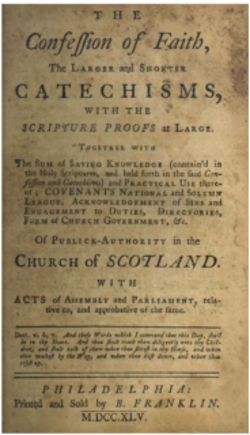
Westminster ConfessionAs complex as that may seem, what we would identify as a “Reformed system of theology” is a little more difficult to pin down these days. The Reformed confession with the widest subscription is the Westminster Confession, although there are quite a number of other historical confessions that are important among the Reformed, including the Belgic Confession (Dutch Reformed) and the Gallic Confession, all of which would be strongly identified with the teachings of Calvinism. However, also falling under the umbrella of a “Reformed system of theology” are the teachings of Arminianism, which have influenced many Baptist groups since the 17th Century, and which characterize the theology of Methodist and Wesleyan traditions. While there are a variety of confessions and “teachings” which would officially fall under the umbrella of a “Reformed system of theology,” there is the added problem that, generally speaking, there does not seem to be firm commitment among those who identify themselves these days as “Reformed” to any specific confession or body of theology. Although there seems to be a growing confessional movement among some Reformed Calvinists, for the most part, we see Reformed teaching as a continuum between Reformed Calvinism and Reformed Arminianism – and this is especially the case in modern American Evangelicalism, which, due to its inherent ecumenism, tends to broadly yet non-specifically identify with Reformed teaching.

Anyway, I checked out the church body you are a member of – the Associate Reformed Presbyterian Church (ARP) – and according to your doctrinal statements, your church body confesses the Westminster Confession, placing you square within a Calvinist confession. The doctrinal statements of our church body, the Wisconsin Evangelical Lutheran Synod (WELS), can be found online in the document entitled, This We Believe, which is a document which clearly states, in thesis/anti-thesis format, our position with respect to Christian doctrines that are generally disputed. Another document, entitled, What the Bible and Lutherans Teach is a positive description of the doctrines that all confessional Lutherans, and many other Christians, agree on. Unfortunately, neither of these documents appear to be available from the WELS website in PDF format anymore, so these web documents will have to suffice for the purposes of comparison with the PDF your church body provides. In addition, Luther’s Large Catechism and Small Catechism are contained in the Lutheran Book of Concord, and may make for an interesting comparison with the large and small Westminster Catechism’s, as well.

Given the availability of these documents, what I am not going to do is walk through them line by line (since I am sure that you are fully capable of doing so). Instead, I will describe in sentence-paragraph format some of the main differences between Reformed (Calvinist) and confessional Lutheran teaching as I have encountered them, starting with a bit of history, and then concluding with recommendations for additional books, if you’re interested in further study.

The School of Athens, by Raphael
Some influences on the Swiss and German Reformers, both common and divergent

The foundation for both the agreement and the disagreement we find between Reformed Calvinist and confessional Lutheran bodies of doctrine can be traced to the period of the Reformation itself, generally to the Renaissance, which carried with it the very positive humanist priority of ad fontes, of returning to the sources of knowledge – like the original texts of the Bible, of the Greek philosophers, of the Roman statesmen, etc. This was a reaction against the method of Mediæval and Scholastic traditions of education, which at that time bound contemporary knowledge to the accumulated wisdom of the ages that was represented, not in the original documents themselves, but in commentaries of the originals, and commentaries on the commentaries, and commentaries on those commentaries, etc., compounded through the centuries. Along with this new-found fidelity to the sources, came a new form of learning which rested on examination and assimilation of those sources.Mediaeval Commentary

We also find more specific, and divergent, influences in the social, political and religious realities of the regions where the Swiss and German Reformations took place. While Germany and the Alsace were firmly within the rule of the Holy Roman Empire, France was independent from it, the nobility of France having been established since the time of the Carolingians, and Switzerland was growing in its independence from the Empire, having formed a confederation of independent states, adopted a republican form of government and even graduated by then to a form of democratic-republic. The leaders of the Reformation in Germany were Dr.’s Martin Luther, Phillip Melanchthon and (at first) Andreas Karlstadt. In the generation following Luther, Dr. Martin Chemnitz led the Lutherans to unity, serving as principle author of the Formula of Concord, and gathering the other confessional documents into a single collection called the Book of Concord, to which all Lutherans, in order to be Lutherans, would unconditionally subscribe. In Switzerland, the leaders of the Reformation were Ulrich Zwingli (German Switzerland), and later, John Calvin and Theodore Beza (French Switzerland). John Knox led the Reformation in Scotland, following from his association with John Calvin.

In Germany, Luther, as an Augustinian monk and professional theologian, wrestled with the reality of his own salvation, struggling under the unbalanced notions of God as a Righteous Lawgiver and angry Judge, who demanded that man follow His Law for the sake of his own salvation. He realized that he, as a depraved sinner, could not keep the Law; but the collected wisdom of the Roman church taught that he must.

Dr. Martin LutherAs a professor at the University of Wittenberg, Luther lectured on the books of the New Testament. Influenced by the new Renaissance learning, rather than relying on the old commentaries, Luther prepared for his lectures by meticulously studying the books of the New Testament directly, not only in Latin, but in their original language, as well. There he discovered that indeed, the Law is harsh and demanding, that man is depraved and incapable of its demands, but most importantly, that man is Justified, not by the works of the Law, but by faith alone in the promises of Jesus Christ. When he discovered that the Church’s teaching under the Roman Pope was false and damnably misleading, he sought to reform the Roman Church, to return the Church to the true apostolic doctrine and biblical practice. Thus the German Reformation under Luther was principally about man’s relationship with God (i.e., by God’s grace alone through faith alone in Christ’s redemptive work alone), the importance of pure Scripture doctrine to maintain the correct view of that relationship (Scripture alone), and the subordinate role of human reason to the authority of Scripture. The German Reformation was a conservative one – one which looked back through the history of the Church to the teaching of the Apostles, seeking to correct only what was in error while conserving the rest, and maintaining the character, unity and continuity of the Church. The resultant separation from Rome and loss of visible unity was something that was necessary due to Rome’s obstinacy, but which was neither planned nor desired.

Ulrich ZwingliSuch was not the case in Zurich, however. Ulrich Zwingli, a Roman Catholic priest, had involved himself deeply in the humanist movement and had earned a reputation as an outspoken activist. He was very active in politics, as a proponent of the cause of Swiss unity and independence. This cause faced itself in the direction of the future, not the past, and thus required a new platform for social order. Hence, when he sequestered himself in his house to study the Scriptures, Zwingli’s purpose was not to reform the Church. The Swiss needed a new one. On the contrary, his purpose was to ‘develop a true philosophy of Christ’ which would ‘impact social and political change.’ Thus the Swiss Reformation, under Zwingli (and later, Calvin and Beza), was not a conservative one, but radical. Without knowing what they may be, one can perhaps already appreciate that such differences of purpose would result in differences of doctrine.

Luther and Zwingli meet to discuss doctrine
Marburg ColloquyNevertheless, the Renaissance principles of humanist learning at the time – principles shared by all the reformers – required fidelity to the sources. The result was that, even though they approached the Scriptures from essentially incompatible starting points, Zwingli and Luther found themselves in such agreement that they desired to meet, to debate those points of disagreement in hopes of resolving them and of declaring their unity under the teachings of Scripture. They met in 1529. The event is known as the Colloquy of Marburg. With fifteen critical points of doctrine separating them when they met, after their debate the separation was reduced to only one, that of the presence of Christ in the Eucharist – Zwingli and his followers having conceded every other point of doctrine to Dr. Luther. On this final point, Luther opened the discussion by drawing a large circle on a table and within it writing the words “This is my body.” Zwingli objected to the plain meaning of the words offered in Scripture on the basis that “the physical and the spiritual are incompatible,” and that therefore the presence of Christ can only be spiritual. He insisted that the words must be symbolic, and no more. Despite their fundamental disagreement, however, Zwingli conceded to the same use of language as the Germans under Luther, if only between them they understood that while Luther meant that Christ was both physically and spiritually present, Zwingli meant that He was only spiritually present. At this, Dr. Luther became incredulous. It was one thing to misunderstand Scripture – to be a weak and erring brother – but it was quite another to knowingly allow a misrepresentation of Scripture to stand for the sake of outward unity. The result is not Scriptural unity – full agreement regarding what the Scriptures teach. On the contrary, such a compromise would result in a purely outward, political unity. That Zwingli was willing to compromise regarding what he was convinced, as a matter conscience, the Scriptures taught, signaled to Dr. Luther that all of his concessions at Marburg were just that – compromises. Thus Dr. Luther pronounced to Zwingli, “Yours is of a different spirit than ours,” cutting Zwingli to the bone, and ending the Colloquy. Six months later, Dr. Luther was proven correct: Zwingli reversed all of the concessions he made at Marburg, announcing that he never really agreed to them in the first place.


Significant differences between Reformed and Lutheran teaching remain

From this episode of history, we learn of several differences which impact Reformed and Lutheran teaching to this day, beginning with the role of human reason relative to the Scriptures, and extending to the teachings of Predestination, of Christology, of God’s Grace and the Means through which He works, of Baptism, and of the Lord’s Supper. There are other doctrines impacted, of course, but these will suffice.

They differ regarding the role and authority of human reason with respect to Scripture
Plato and Aristotle discuss philosophy, from School of Athens by RaphaelLuther and Zwingli, like Calvin and Beza who followed him, were exceptionally well-educated men, learning, teaching and leading during an exciting time of rediscovery, intellectual cultivation and application of the classical sources. The gift of the Renaissance was that men once again learned the art of human reason from the masters. But if reason were to remain a true gift, and not a Trojan Horse, what authority should it carry in matters of Scripture’s teaching? Luther insisted that human reason must remain subordinate to the very words of Scripture – as “the handmaiden of Scripture.” If seeming paradoxes of Scripture could be harmonized through use of reason, without compromising the plain meaning of the statements of Scripture as one would understood them in their natural context, then such was considered helpful. If, however, such harmonization required that the plain meaning of the Scriptures be understood differently than they directly stated, then the words of Scripture, along with the paradox, stood, while reason was subordinated to them. Zwingli, and later Calvin, thought differently. They reasoned that Scripture, as pure Truth revealed by God, could not contain paradox or mystery. As a result, they required a closed system of theology, against which unsanctified reason was powerless, since all questions were reasonably answered. Thus, in Reformed systems of theology, reason is more than just the “handmaiden” of Scripture, but in many cases, stands as its arbiter.

They differ regarding the starting point of Christian teaching and central teaching of Scripture
John CalvinOne of the first evidences of the difference between Reformed and Lutheran teaching regarding the role and authority of human reason, is in the starting point of their respective systems of theology. John Calvin saw the unfolding of Scripture – the power of God’s Word that by it He could speak the universe into existence, that infractions of His Holy Law would carry eternal consequences, that He accomplished man’s Salvation and is solely responsible for it apart from man’s miserable efforts – as the story of God’s omnipotence. A very reasonable conclusion, indeed. Hence, God’s Sovereignty, according to Calvin, is the subject of Scripture, and is therefore the starting point of the Calvinist system of theology, with the central doctrine being that of Sovereign Grace – that God has mercy on those whom He will, apart from any effort of their own. Lutherans, on the other hand, while not denying the Sovereignty of God in any respect, nor that He alone, apart from man’s efforts, is responsible for man’s salvation, take Scripture’s own testimony regarding its subject: Jesus refers to the Old Testament Scriptures as “they which testify of Me” (Jn. 5:39), and the New Testament directly testifies the same regarding itself – in other words, according to the direct testimony of the Bible, its subject is the Messiah, Jesus Christ. Thus, the starting point in the Lutheran system of theology is not God’s Sovereignty, but the person of Jesus Christ, and our central doctrine is Justification by Faith Alone – the teaching by which we gain access to His gracious work on behalf of all mankind (Ro. 5:1-2).

They differ regarding the person of Christ
But Who is Jesus? We Lutherans, like the Reformed, teach that Jesus is both fully God and fully man. But there the similarity ends, for we Lutherans, confessing with Scripture that, “in Him dwelleth all the fullness of the Godhead bodily” (Co. 2:9), also believe and teach that Jesus in His divine nature shared in His human attributes, and in His human nature shared in His divine attributes. As Luther taught, Wherever you can say, “There is the Son of Man,” there also you must say, “There is the Son of God.” The Reformed reject the teaching that Jesus in His human nature shared in His divine attributes, that the Son of Man is omniscient (though Jn. 1:43-51; 11:3-11; Mt. 16:21 show Jesus’ omniscience as man), omnipotent (Mt. 9:6; 28:18 show Jesus claiming omnipotence to Himself as man) or bodily omnipresent (Mt. 28:20; Ep. 1:23; 4:10 show Jesus as bodily omnipresent). This may seem like much ado over nothing, until one asks himself the following questions:Christ on the Cross, by Peter Paul Rubens
    Who was it who died on the cross? Surely, Jesus in His human nature died on the cross, but did Jesus in His divine nature also share in that death? Did "God" die on the cross, or did just a man die on the cross?
We Lutherans confess with St. Peter, who, preaching to the Jews following Pentecost, accused them by identifying the Man who died on the cross according to His divinity, saying, “You have killed the Prince of Life” (Ac 3:13-15). But how could an eternal God die, and yet still be eternal? Scripture doesn’t say – but it says most clearly both that God is eternal and that He shared in the experience of Christ’s death. Scripture teaches both, and we believe, teach and confess both. But look at the astounding consequences of this death, and the positively galvanizing reality of what St. Peter was preaching to his fellow Jews. Not only did Christ, by His death as man, pay the penalty of man’s sin, finishing His work on behalf of mankind, His death as God terminated the Old Covenant with Israel – for we know that the death of one or both parties to a covenant is the only condition which legally terminates it. What St. Peter was preaching was that, no matter how the Jews or anyone else looks at the situation, there is absolutely no hope for them in the Old Covenant. None whatsoever. The work is finished, and the manner of its completion leaves no doubt regarding the status of that covenant, since the completion of Christ’s work also supplies the legal criteria for its termination. Rather, their only hope is in the “New Testament,” or the new promise, of the Man Who in His human body lived perfectly under God’s Law, Whose precious blood was shed as a propitiation for the sins of the World, and Who, by His Resurrection, showed Himself to be the eternal God that He claimed to be, and Who now promises forgiveness of sins and righteous standing before God to those who through faith receive them. This teaching gives no quarter to Dispensationalism, or any other system of belief which tries to retain a special arrangement between God and the Jews, for “There is neither Jew nor Greek, there is neither bond nor free, there is neither male nor female: for ye are all one in Christ Jesus” (Ga. 3:28).

They differ regarding the presence of Christ in the Eucharist
Dr. Martin ChemnitzAnd this “New Testament” was exactly what Luther and Zwingli debated at Marburg. Christ, in the night in which He was betrayed, took bread, and when He had given thanks, broke it saying, “Take, eat; this is My body, which is given for you. Do this in remembrance of Me” (Lk. 22:19; Mt. 26:27; Mk. 14:22; 1 Co. 11:24). In the same manner also He took the cup when He had supped, and when He had given thanks, He gave it to them, saying, “Drink ye all of it; this cup is the New Testament in My Blood, which is shed for you for the remission of sins. This do, as oft as ye drink it, in remembrance of Me” (Lk. 22:20; Mt. 26:28; Mk. 14:23-24; 1 Co. 11:25). This “New Testament” offered by Christ in His Blood, was a specific kind legal arrangement that is common in probate law even to this day. Luther, who was trained as a lawyer before entering the Augustinian Order, knew very well the ancient principles involved, and we are informed in great detail by his contemporaries why it was that Luther held so strictly to the very words of institution: Christ, in using this phraseology, was offering his “last will and testament.” Very fitting, given that He knew that He was going to die on the cross the very next day. What this means for the bequeathed, if they would benefit from the Testator’s will, is that, if it is established that the Testator was of sound mind when He issued His will, and if the words coherently express the Testator’s wishes, the words must be followed precisely and to the letter – even if they sound unreasonable. This in order that the will of the deceased may actually be honored. For example, if Uncle Felix bequeathed to his nephew Horace his entire estate, on the condition that Horace hop on his right leg three miles into town, bark like a dog for five minutes in the town square, and then hop on his left leg back home, that means that if Horace wants his inheritance, he had better get hopping – the will of Uncle Felix is clear, even if it makes no sense why Horace needs to do what is requested of him in order to receive his inheritance. In other words, the objections of reason against the clear will of the Testator are invalid.

Jesus Christ is the Testator of the New Testament (He. 9:14-17). “Do this” was the clear instruction that Christ gave as He issued His “last will and testament”; and in “doing this,” it is clear that we are to regard the bread and wine as not only bread and wine, but as Body and Blood – as the very Body and Blood that was given and shed. But how can bread and wine also be Body and Blood? We Lutherans don’t claim to know. But we are quite certain that the same God Who can speak the universe into existence, Who can also pull off the Incarnation and the Virgin Birth, can, by His command and institution, also manage the sacramental union of His Body and Blood with the elements of the Eucharist. The question isn’t how can this be? but what do the Scriptures say?:
    This cup of blessing which we bless, is it not the communion of the blood of Christ? The bread which we break, is it not the communion of the body of Christ? For we being many are one bread, and one Body; for we are all partakers of that one Body (1 Co. 10:16-17).
Communion, Consecration of the ElementsBut what are the implications of this teaching for the Lutheran communicant? They are quite significant. Jesus Christ, in His human body, lived a perfect life under God’s Law. In this perfect body, He became sin for our sake, taking on the sin of the World, and suffering sin’s penalty – death and separation from God. The perfect Blood He shed in His death for our sin, was considered by God to be sufficient payment for the World’s sin, for the sin of each individual. He was found to be Just in the sight of God, and returned to life. When the Lutheran communicant receives the consecrated bread and wine in the Holy Supper, he is not merely partaking in a “meal of remembrance”. Rather, Christ Himself physically comes to the communicant and gives Himself to him. The Lutheran communicant is actually physically united with the perfect Body of Christ, which lived perfectly in the sight of God under His Law and continues its perfect existence in the presence of God. The Lutheran communicant is actually united with the Blood of Christ, which was declared by God to be Just payment for his sins. Thus united with Christ, the Lutheran stands united with those communicants who have likewise received Christ’s Body and Blood; and together they stand before God in the work and righteousness of Christ – their sin is atoned for and they are fully righteous in the sight of God. And this is our inheritance as sons of God, is it not? There is no more personal, more intimate assurance of our “remission of sins” than this, for in the Holy Supper, the Logos, the Word of Forgiveness Himself, is physically united with us.

Zwingli objected, “Christ physically ascended into heaven, therefore He is physically present only in heaven. He cannot be present in heaven and also be present here on earth, in the Eucharist, as well. Therefore, we can say only that He is spiritually present in the bread and wine.” Calvin concurred with this, though attempted a mediating position between Zwingli and Luther, claiming that the communicant, as he receives the bread and wine, is transported to heaven where the body of Christ is located, and is united with Him there, apart from the bread and wine. We Lutherans agree that Christ bodily ascended and is present locally in heaven. But this is not the limit of His bodily presence. Responding with Scripture to Zwingli’s objection, we confess: “Christ fills all” (Ep. 1:18-23; 4:9-10). Further, there is no basis in the testimony of Scripture for dividing the natures of Christ or separating His divine from His human attributes, while there is every reason to require that they remain united: “the Word became flesh” (Jn. 1:1-5,14) and “the fullness of God dwelt in Him bodily” (Co. 2:9). Therefore, we conclude with Scripture that Christ fills all in His human, as well as His divine natures; and if Christ can fill the whole universe, He can also be physically present in the bread and wine. Likewise, we can also trust His promise, “I am with you always, even to the end of the world” (Mt. 28:20), and believe that He is actually here with us.

They differ regarding Grace, and the Means by which the sinner gains access to it unto Salvation
God’s Word, a Means of GraceBut Zwingli also countered, “The physical is incompatible with the spiritual.” That is to say, divine perfection can have no part with the “fallen matter” that makes up the physical world, since it is infected with sin. Calvin concurred. Not only did this notion impact their formulations regarding the presence of Christ in the Eucharist, it also lies at the root of some very serious differences between Reformed and Lutheran doctrines. The Reformed teach a doctrine called Immediate Grace, that is, that God works apart from means of any sort, that He works directly in an individual, strictly apart from any means, to bring him to Salvation. We Lutherans, on the other hand, teach that God the Holy Spirit works to produce and strengthen saving faith only through the Gospel, and the Gospel comes to man only through means. We call them the Means of Grace, and have identified three such means appointed by God in His Holy Word, through which He works:
  1. the Word of God (which was “written that we might believe,” Ro. 10:17; Jn. 20:31)
  2. the Sacrament of Holy Communion (given “for the remission of sins,” Mt. 26:28), and
  3. the Sacrament of Holy Baptism (which is “for the remission of sins” and which “does save us,” Ac. 2:38; 22:16; 1 Pe. 3:18-22)
Thus, in response to Calvin and Zwingli, we Lutherans answer, not only does the Bible state directly that God works through the Gospel in Word and Sacrament to create and strengthen faith, we can find no evidence in Scripture that He works apart from these Means. Sure, our reason tells us that since the Scriptures say God is sovereign and omnipotent, He can do any thing He wants, any time He wants, any way He wants. But this, alone, is of no comfort to the Christian at all, who wants assurance of God’s working in himself, and wants to direct others to God where He can be found.

“How do I know that God is at work in me?” This question becomes all the more critical when we consider another teaching regarding Grace that is espoused in Reformed doctrine: Particular Grace. In this teaching, we are told that God, in His sovereignty, has turned His gracious countenance toward only some, and not others, that God does not love all sinners equally, and that as a result, He did not come to atone for the sins of all mankind, but only for the sins of some. Thus, the Reformed also teach, Limited Atonement. After all, Hell will be populated, and it would place limitations on God’s omniscience if we were to assume that He did not know beforehand who would populate it! If He knew beforehand, then certainly it is reasonable to conclude that God’s sovereign plan of salvation was limited to only some, that His saving Grace was reserved for particular persons and not others. This leaves the poor Christian wondering if he were one of those God had chosen at the foundation of the world; and without the comfort of objective means through which he is promised that the Holy Spirit will work in him, he is left to look within himself, searching for evidence that he is among God’s elect. The consequence is that Reformed preaching tends to equip the believer for this task, by focusing on issues of Sanctification.

Lutherans, on the other hand, do not teach that Grace is “particular” or that Christ’s atoning work was “limited” to some, but not to others. Instead, we confess what the Scriptures directly say, and teach Universal Grace (Jn. 3:16) and Universal Atonement (1 Jn. 2:2; Co. 1:19-22). Moreover, because the Scriptures teach that the Holy Spirit is present and working through the Gospel in Word and Sacrament, the Lutheran is confident that (a) since God loves all people, (b) since God atoned for the sins of all people, and (c) since God works to produce and strengthen faith through His appointed Means, then (d) the Christian can confidently seek God outside of himself, placing his trust in the objective promises of the Gospel, knowing that the Gospel is intended for him, and that God is at work through it to save him and to keep him as His own; and (e) the Christian can confidently preach this same message to unbelievers, knowing that He is faithful to work through His appointed Means to produce faith and thereby bring the unbeliever from death into life as His own dear child. The consequence is that true Lutheran preaching dwells, not on subjective themes of Sanctification, but on the objective message of Law and Gospel, on the message of Justification by Faith Alone.

They differ regarding Predestination
This is the one big difference that everyone likes to start with when discussing the differences between Reformed and Lutheran teaching. I thought it best to end with this particular teaching in my little summary of theological differences, in order to display in leading up to it the Lutheran attitude toward the authority of Scripture and the role of reason relative to it. Obviously, we Lutherans are not unaware of the challenges reason hurls at our body of teaching. Calvin himself was rather merciless in his criticism of Luther, and Lutheran doctrine, declaring us guilty of “stupefying irrationalities.” Yeah, we get it. Nevertheless, we consider it safer to stand on the very word of God, than to deviate from it in either “jot or tittle.”

Predestination, or “Election to Grace,” is a biblical teaching. Both Reformed and Lutherans teach this doctrine. Scripture refers to those who have faith as the elect (Ep. 1:3-14; 2 Th. 2:13-14), as those chosen by God at the foundation of the World. However, we Lutherans are quick to point out that 2 Th. 2:13-14 makes clear this election to grace was not a naked decree, but includes in the eternal act of God’s choosing the Means and process through which one’s election is made sure – “through sanctification of the Spirit and belief of the truth” (v13). That is, God’s choosing of His elect included the preaching of the Gospel and the work of the Holy Spirit through the Gospel to create faith in the heart of its hearer.

In addition to “Election to Grace,” Reformed Calvinists also teach that, as a consequence of God’s Sovereign omniscience, He also predestined some to Hell. This teaching is called “Election to Reprobation,” and it is a teaching rejected by Lutherans. It is nowhere stated in Scripture. Some Reformed authors will cite Jude 4, Romans 9:17-24, or 1 Peter 2:8 in support of this doctrine, but upon close examination it is found that these verses fail to teach this doctrine. In Jude 4, prographo (“before … ordained”) is not a reference to ancient or eternal decree and is never used in this sense in any of the other places it is used in the New Testament (like Ro. 15:4; Ga. 3:1; Ep. 3:3), but is used to indicate writing beforehand, and probably refers to those St. Peter warned of in 2 Peter 2:3, given that Jude writes after St. Peter to the same audience, describing the same people that St. Peter warned of. Likewise, use of 1 Peter 2:8, “whereunto also they were appointed”, ignores the context, that such appointment is the consequence of their rejection of the Gospel, not antecedent to it.

By far, Romans 9:17-24 seems to be given the greatest weight by Reformed commentators defending “Election to Reprobation.” Often, however, the difference between “fitted for destruction” (v22) and “afore prepared unto glory” (v23) is glossed over. Those vessels “fitted for destruction” were so fitted as a consequence of their rejection of God’s repeated and long-suffering overtures of grace toward them, not antecedent to their rejection. On the other hand, those “afore prepared unto glory” are so prepared from eternity, consistent with the doctrine of predestination that Lutherans and the Reformed agree to.

We Lutherans confess that Scripture teaches Predestination, or “Election to Grace,” but that it does not teach “Election to Reprobation.” Rather, we confess that Scripture teaches it is God’s antecedent will that all men be saved (1 Ti. 2:3-6 – God’s will from eternity for all mankind), but it is His consequent will that those who reject Him suffer damnation (God’s will in response to an individual’s rejection of His grace, not from eternity). “Double Predestination” or “Election to Reprobation” is the Reformed Calvinist’s way of reconciling what appears to be divine paradox – that (1) it is God’s eternal will that all men be saved, and (2) not everyone will be saved – and is accomplished by qualifying the word “all” as “all those He came to save.” The way of the Reformed Arminian is to elevate the role of the human in his own salvation, by making him a co-operator through his own will and intellectual assent. The Bible speaks against this as well. In John 1:13 it makes clear that the will and decision of man is not involved; and the second chapter of 1 Corinthians clearly teaches that man’s intellect is of no aid to him in understanding the things of God (for to him it is all foolishness), but that God’s truth must be taught to him by the Holy Spirit, apart from Whom true knowledge of God is impossible.

The fact is, all attempts to harmonize the statements of Scripture regarding election result in two errors. The first error is that statements not contained in Scripture are held up as Scripture's doctrine (i.e., God predestines some to hell [Calvinist], or, man co-operates in his own salvation [Arminian]). The second is that clear and direct statements of Scripture are rejected (i.e., it is not God’s will that all mankind be saved [Calvinist], or, there is no eternal election [Arminian]). Further, the Holy Spirit has offered no harmonization of these statements in His Word. So how do we Lutherans handle this? First, we believe, teach and confess that it is God’s will that all mankind be saved – His gracious countenance shines on all mankind. Second, we believe, teach and confess that Hell is a real place, prepared for the Devil and his angels, and that those who obstinately reject the gracious overtures of God in the promises of His Gospel, will spend an eternity in that place, separated from God forever. In other words, the Bible teaches both that God wants all people to be saved, and that Hell will be populated. The Bible teaches both. We believe both. And we leave it at that – accepting these statements of Scripture as they stand and leaving them unresolved.

Conclusion
The Renaissance, they say, was the bridge from the Mediæval period to the Modern period of Western history. From the Renaissance, Luther faced backward in time, looking through history to the teaching of the Apostles. Though benefiting from the Renaissance humanism and classical learning of his time, he was square within a Mediæval frame of mind, fully comfortable with the mysteries placed before him in the clear and certain testimony of Scripture. To this day, genuine Lutheran theology retains this distinctly Mediæval character, comfortable, as we stand on the direct positive statements of Scripture, with the divine mysteries of the person of Christ, His presence in the Eucharist, or the work of the Holy Spirit through the Means of Grace, and as we continue to move into the future by facing the past, by looking through the Reformation to the teachings of the Apostles, and by retaining the historic and Scriptural practices of the Church which have given expression to those teachings over the millenia. Zwingli and Calvin, on the other hand, were building toward a future of Modernism. With Scripture as foundation, they faced forward in time from the Renaissance into an unknown in which human reason would be king. Now that Modernism has passed into history, now that Materialistic Rationalism is itself flailing violently near the throes of death, now that we are entering into a Postmodern Era, it will be interesting to see the impact of these two similar, yet divergent, “systems of protestant theology.” Will they continue to retain their character?


If any of the Lutheran teachings discussed above are of interest to the lay-reader, I supply the following list of books for further investigation:


Finally, if you’re interested in what confessional Reformed and Lutheran dialogue sounds like, a good radio program to listen to is The White Horse Inn Classic, a program in the weekly line-up of Pirate Christian Radio.

Creative Commons License
This work is licensed under a Creative Commons Attribution-Noncommercial-No Derivative Works 3.0 United States License