Showing posts with label church discipline. Show all posts

Friday, December 9, 2011

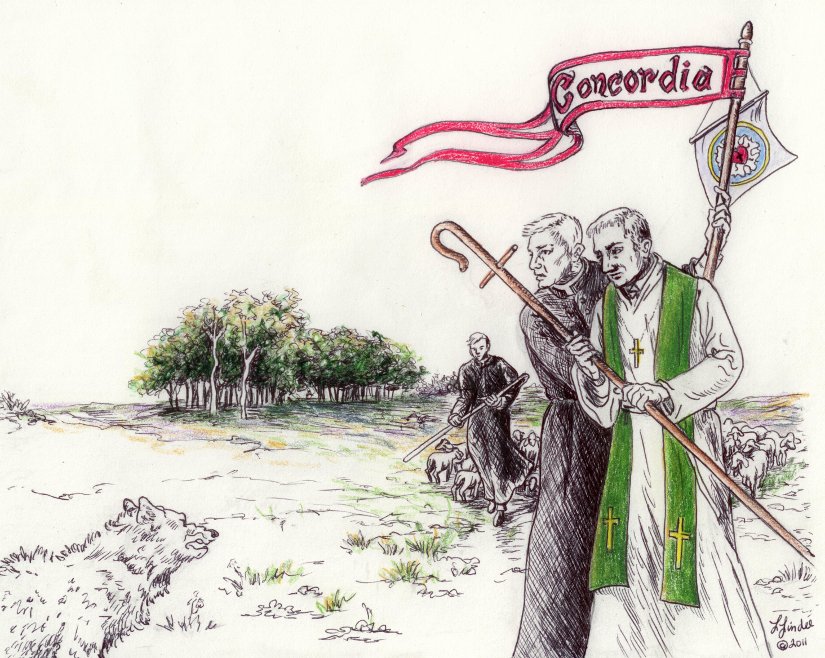
Shepherds, watching their field...

Tending the Flock

QUESTION: Is tending a flock essentially a spectator sport?

Friday, July 22, 2011

Reprise: 'non rockaboatus' is an organizational disease: Lectures by Walter Martin

In commentary following yesterday's post, Michele Bachmann as an Example of the Importance of Catechesis, David Kreuter suggests that certain attitudes regarding ways of thinking about or dealing with problems, or, one may reasonably conclude, "established processes" which descend from a culture described by such attitudes, could "destroy" our "ability (or Will) to think critically about the most important things."

Intrepid Lutherans has existed for just over a year now, and in that time we have "rocked the boat" by publicly discussing public manifestations of "problems" such as the following:
  • pulpit plagiarism from sectarian sources
  • the growth of sectarian worship
  • the willingness to invite pop-culture to dominate the church's practices
  • laymen ministering without Divine Call
  • the increasing use of Cell Groups (Ecclesiolae in ecclesia)
  • the decline of sound Law & Gospel preaching
  • dangerously sloppy expression of our central teaching, "Justification by Faith Alone" (and the thinking and practice which descends from such sloppy expression)
  • the abuse of overly broad definitions of "love" and "adiaphora"
  • decline in respect for pure doctrine and the significance of doctrinal differences between Christians (which impacts our understanding and practice of Fellowship)
and most recently we have expressed concerns regarding
  • the need for periodic examination of pastors, and
  • our choice of Bible translation and the principles we employ in making that choice
In this time, we have publicly defended against the unjust excommunication of a layman – who still does not know what his error is – and we have publicly admonished celebrity WELS pastors for their very public involvement leading and promoting a conference entitled "Change or Die," an entirely wrong notion which exalts man's genius and effort in achieving numeric growth in the church at the expense of exclusive reliance on the Means of Grace. In nearly every issue we have addressed, we have done so in a way that not only “exposes the issues”, but remediates these issues through application of sound Lutheran doctrine, and we have always been willing to entertain discussion on such issues. Just check our Catalog of Intrepid Posts to read through our blog posts over the past year.

For this "boat rocking" we have been roundly criticized. Some even regard us as the greatest threat that WELS is currently facing (no kidding!). Some of those who have expressed concerns resonating with ours have been warned not to participate in our public discussion. Even outside of those who have received such expressed warnings, although there are many who enthusiastically agree with and support Intrepid Lutherans (despite our failings!), few feel free to do so publicly.

Why is this? Should we even concern ourselves with an answer to that question?

In answer to the latter question, we are re-posting our blog post from May 9, 'non rockaboatus' is an organizational disease: Lectures by Walter Martin, which features audio lectures, with some key transcriptions, telling the tale of American Christianity's demise in the last generation from the perspective of one who valiantly fought epic battles against error, and lost – and who is warning what's left of Christianity to be on guard. Error is separate from Truth, it divides people by gathering to itself adherents from among those easily beguiled and those dissatisfied with the Truth, and it divides organizations by populating established structures with its adherents and abusing their otherwise wholesome processes to serve its own ends. This is what happened to American Christianity. It did happen. It is what happens.

Are we on guard? Have we lost our will to think critically about the most important things? May we heed Dr. Martin's warnings.


Harmony with God, in EdenGiven that a number of our Lutheran readers may resonate more with non-Lutheran commentators than they do with confessional Lutheran authors and speakers, we thought it would be of interest for them to hear a little from a renowned Baptist of the previous generation, regarding the maintenance of doctrinal integrity in the face of liberalism: Dr. Walter R. Martin.

Dr. Martin was an expert on the occult, and from the 1960’s onward, disseminated countercultic and apologetic information through his organization, Christian Research Institute (CRI). After his death, he was succeeded as “The Bible Answer Man” and President of CRI by Hank Hanegraaff – a popular commentator who can be heard these days on many, though not all, “Evangelical” radio stations. At least one of Dr. Martin’s works, The Kingdom of the Cults, remains a very valuable resource, one which I consult with semi-regularity as need arises.

Over the past two years, several of Dr. Martin’s lectures have been featured by Chris Rosebrough on his internet radio show, Fighting for the Faith – a daily program in the lineup of Pirate Christian Radio (PCR). I remember these PCR features, since I am of about the same age as Mr. Rosebrough, and remember Dr. Martin’s voice and manner of teaching from my youth, in a way similar to Rosebrough’s reminiscences. Anyway, lest we Lutherans should fall under the mistaken impression that our struggles are unique to us, I supply links to the following lectures, along with selected quotes, in which Dr. Martin defines liberal theology as “cultic,” and makes it clear what the orthodox Christian’s response ought to be. Others have already gone through what we are approaching – it may be of some use to examine and appreciate their own assessments.


Walter Martin on the Cult of Liberalism


(lecture begins @~58min, 30sec)

1hr 12min, and following...
“Any person who does not know that today in the United States, and in denominational structures worldwide, we are in an accelerating apostasy, does not know, I repeat, does not know what is going on... There was a time when one could pick a Presbyterian church, a Methodist church, an Episcopal church walking down the street, send somebody into it, and be reasonably sure that he would hear the Gospel of Jesus Christ. Today before you'd send people into most of these churches, you would need a psychiatrist if you opened the door and just said 'Go'... because you would know what you did!

“The Episcopal church which I came from, has a rigid orthodox background. Thirty-nine articles of the church, Apostles Creed, Nicene Creed... good solid theology. Yet, the Episcopal church fell so far from its position that it let James Pike continue as one of its representatives. They didn't dare bring him before the House of Bishops – want me to tell you publicly why? Pike said so, I might as well quote him. He said, 'You will never take me to trial before the House of Bishops for my theology, which you say is heretical, because I am an attorney, and I will defend myself, and I will prove that you, in the House of Bishops, are as heretical as I am.' Do you think they listened to him? You bet they listened to him. Because Pike would have proven it. Do you realize that James Pike was an Episcopal Bishop in the United States, denying the Trinity, the Deity of Christ, the Virgin Birth, Salvation by Grace, the Vicarious Atonement, and the Bodily Resurrection of the Lord, the Nicene Creed, the Apostles Creed, all the creeds of Christendom, and the Episcopal Church never touched him?! Know why? Because they are as corrupt as he is! They don't dare touch him... The Presbyterian denomination has suffered the same inroads. Today you can be ordained in the Presbyterian Church and deny the Deity of Jesus Christ. The Baptists have had their fare share – we’re up to our eyeballs with it! The Missouri Synod fought them to the death, and won. They said, 'We don't know how we're going to get along without you, but we're going to.' And they threw them out... The Southern Baptists are fighting the same war right now – I know, I'm in the Convention. We don't know how we're going to get along without them, but we are going to. Because if we don't, there is no such thing as a little bit pregnant... you are or you're not! Well, there's no such thing as a mild form of cancer. It's cancer. If you don't get rid of it, you don't deal with it, it get's you! We have to deal with these things today. If we don't, they'll end up getting what's left of the Church... What did the Apostle Paul say? 'They will gather to themselves teachers who will tickle their ears, and the Truth of God will be turned into mythology.' It's here!”

1hr 20min, and following
“Every major theological seminary that has turned from orthodox Christianity began with disbelief of biblical doctrine... Corrupt Bibliology led them to the next step. Theology began to be touched by it. Their view of the Cross and the Virgin Birth immediately was questioned. Then came the miracles of Christ. And finally they had emptied the Gospel of all its content, and simply were using the outward shell so that they could go on collecting money from the people and the churches, because they knew that if the people in the pews knew that they were apostate they'd throw them out. So the strategy was: hang on to the trust funds, hang on to the money that we've got, hang on to the properties we control, we will gradually educate the laymen into this new approach to theology. And then, finally, we will take control of everything. This is the gradual process of feeding you theological poison, until you become immunized enough so that you don't know what is happening to you. And when you wake up to what is happening to you, it's too late. They've got everything.”

1hr 28min, and following
“Look what happened... Look at the votes. We were very subtly, systematically, squeezed out. All of the positions of leadership were given to people who denied the foundations of the faith...”

1hr 34min, and following
“The Jehovah's Witness is easily detected. The Mormon has his bicycle. The Christian Scientist has the Monitor to get you to subscribe to. The religious science people are telling you that you can have health and prosperity and you can rise above all these torrents of life, floating over them as the ping-pong ball soars over Niagra Falls... You can see these people in the cults and the occult if you have any degree of discernment at all, because they are outside the church. But how do you see the Presbyterian, Methodist, Baptist, Lutheran, Episcopalian professor of theology? How do you get him in a place where you can find out what his theology really is? The moment you question him, he reverts to orthodox terminology, and then if you press him for the definitions of his terminology, he claims that you're being suspicious, bigoted and unloving. The average layman is defenseless! He's got to take what comes from behind the pulpit and recommended by his church authority because the moment he opens his mouth, he's accused of being divisive in the church, unloving, and disturbing the fellowship of the faith! When it is the devil behind the pulpit, not the victim in the pew, that's responsible for it! I've used the term ‘devil’ a couple times. That's mild. God uses much stronger language. He describes those who pervert the Scriptures as enemies of the Cross of Christ, whose end is destruction, whose god is their appetites, and whose glory is in their earthly shame...”

1hr 37min, and following
“That is why I am concerned about the cult of liberalism. We can identify the other cults, but how do you identify somebody that looks like you, acts like you, sounds like you...? Do you want the answer? ...1 Thessalonians 5:21ff ...put everything to the test, cling tenaciously to what is good.”

2hr 19min, and following
“[Liberalism] is a cult because it follows every outlining structure of cultism. It has its own revelation, its own guru's, and its denial, systematically, of all sound systematic Christian theology. It is a cult, because it passes it's leadership on to the next group, that takes over either modifying, expanding or contracting the same heresies, dressing them up in different language, and passing them on. It is theologically corrupt, because it is bibliologically corrupt; it denies the authority of Scripture and ruins its own theology. And, it ends in immorality.

“Because the only way you could have gotten to this 'homosexual,' morally relativistic garbage, which is today in our denominational structures, is if the leadership of those denominations divide the authority of the Scriptures, and Jesus Christ as Lord. That is the only way we've gotten there. And there is a remedy for this, brothers and sisters. The remedy? Is to start asking questions! Start demanding definitions of terminology. Start insisting that people tell you what they're giving your money to before you give them a dime. Examine the people that occupy the chairs of theology in the seminaries, and if they are not given to the historic Christian faith, out with the rascals! Examine your churches, your sessions, your boards... and find out who is in the faith! You're told to do this in First Corinthians. You're told to do this in Galatians. You're told to do it everywhere in Scripture: Examine to see whether they are in the faith; test all things; make sure of what is true! I'm not being harsh. I'm not being judgmental. I am being thoroughly consistently Christian, in the light of historic theology and the Holy Bible. And I think we have a right to demand that the men who occupy the seats of learning and who preach from the pulpits either preach Jesus Christ or we cut off their pensions, their salaries, their golf club memberships, and let them go on living as social workers, because it is obvious they don't have any theology that is going to save anybody. With Luther, Here I Stand.”


Walter Martin: It's Not Unloving to Confront Error


(lecture begins @~18min)

18min, and following
“Tonight we are dealing with an extremely complex subject, we are dealing with 'positive confession' and the health and welfare groups, some of which have crossed over from merely Christian forms in their expression of theology, into the area of the Kingdom of the Cults. Ten years ago... I did a paper on the 'Errors of Positive Confession.' I was vilified, rather openly, by a large number of charismatics on the ground that I was being divisive and unloving, and because I was being 'critical of brothers'. The fact is, you can be a brother and be in very serious doctrinal error, and if you have a large ministry and a lot of people watching you on television or listening to you on radio, and if you are not responsive to your peers it is possible for you to lead literally millions of people into false doctrines – not meaning to do so, but being in ignorance yourself. And we are dealing today with doctrines which have progressed from simply ignorance to outright heresy, and finally, to blasphemy.

“If the Christian church does not address these subjects, if Christian leaders... pastors and teachers do not stand up and say 'Enough! this is what the Scripture says, and you are answerable to Scripture!,' then we are going to have false doctrine running rampant all over the Christian world, and nobody will be able to police it or stop it... [To whom is anyone accountable, theologically??]

“...So the gospel of the checkbook has replaced the Biblical Gospel of authority in the church. Now, so long as nobody insists on accountability, then it will go on; but, the church has awakened, and people are demanding accountability, and that is as it should be. No minister should be afraid to account for his theology, privately or publicly. And if he has questions about it, and he won't answer them, then we have every right to suspect him. That is not unloving, it is not heresy hunting, it is not divisive, it is not unloving, it is thoroughly Biblical. Often, when I cite people's names publicly, they say, 'But, why can't you just name the thing? Why do you have to name the person?' Because, in Scripture, Paul gave us our example; when he confronted evil in the church, he said 'Hymenaeus and Philetus have erred concerning the Truth, they are teaching that the Resurrection has passed, and they are overturning the faith of some.' He named them. And then Hymenaeus and Alexander... So, consistently through church history it has been necessary to confront evil. It doesn't make you popular, alot of people don't love you, but the people that will end up loving you are the one’s delivered because of the confrontation.”


If our Lutheran leaders and laymen won’t listen to fellow Lutherans who quote Scripture and the Confessions, maybe they prefer the testimony of the Baptists?
Monday, May 9, 2011

'non rockaboatus' is an organizational disease: Lectures by Walter Martin

Harmony with God, in EdenGiven that a number of our Lutheran readers may resonate more with non-Lutheran commentators than they do with confessional Lutheran authors and speakers, we thought it would be of interest for them to hear a little from a renowned Baptist of the previous generation, regarding the maintenance of doctrinal integrity in the face of liberalism: Dr. Walter R. Martin.

Dr. Martin was an expert on the occult, and from the 1960’s onward, disseminated countercultic and apologetic information through his organization, Christian Research Institute (CRI). After his death, he was succeeded as “The Bible Answer Man” and President of CRI by Hank Hanegraaff – a popular commentator who can be heard these days on many, though not all, “Evangelical” radio stations. At least one of Dr. Martin’s works, The Kingdom of the Cults, remains a very valuable resource, one which I consult with semi-regularity as need arises.

Over the past two years, several of Dr. Martin’s lectures have been featured by Chris Rosebrough on his internet radio show, Fighting for the Faith – a daily program in the lineup of Pirate Christian Radio (PCR). I remember these PCR features, since I am of about the same age as Mr. Rosebrough, and remember Dr. Martin’s voice and manner of teaching from my youth, in a way similar to Rosebrough’s reminiscences. Anyway, lest we Lutherans should fall under the mistaken impression that our struggles are unique to us, I supply links to the following lectures, along with selected quotes, in which Dr. Martin defines liberal theology as “cultic,” and makes it clear what the orthodox Christian’s response ought to be. Others have already gone through what we are approaching – it may be of some use to examine and appreciate their own assessments.


Walter Martin on the Cult of Liberalism


(lecture begins @~58min, 30sec)

1hr 12min, and following...
“Any person who does not know that today in the United States, and in denominational structures worldwide, we are in an accelerating apostasy, does not know, I repeat, does not know what is going on... There was a time when one could pick a Presbyterian church, a Methodist church, an Episcopal church walking down the street, send somebody into it, and be reasonably sure that he would hear the Gospel of Jesus Christ. Today before you'd send people into most of these churches, you would need a psychiatrist if you opened the door and just said 'Go'... because you would know what you did!

“The Episcopal church which I came from, has a rigid orthodox background. Thirty-nine articles of the church, Apostles Creed, Nicene Creed... good solid theology. Yet, the Episcopal church fell so far from its position that it let James Pike continue as one of its representatives. They didn't dare bring him before the House of Bishops – want me to tell you publicly why? Pike said so, I might as well quote him. He said, 'You will never take me to trial before the House of Bishops for my theology, which you say is heretical, because I am an attorney, and I will defend myself, and I will prove that you, in the House of Bishops, are as heretical as I am.' Do you think they listened to him? You bet they listened to him. Because Pike would have proven it. Do you realize that James Pike was an Episcopal Bishop in the United States, denying the Trinity, the Deity of Christ, the Virgin Birth, Salvation by Grace, the Vicarious Atonement, and the Bodily Resurrection of the Lord, the Nicene Creed, the Apostles Creed, all the creeds of Christendom, and the Episcopal Church never touched him?! Know why? Because they are as corrupt as he is! They don't dare touch him... The Presbyterian denomination has suffered the same inroads. Today you can be ordained in the Presbyterian Church and deny the Deity of Jesus Christ. The Baptists have had their fare share – we’re up to our eyeballs with it! The Missouri Synod fought them to the death, and won. They said, 'We don't know how we're going to get along without you, but we're going to.' And they threw them out... The Southern Baptists are fighting the same war right now – I know, I'm in the Convention. We don't know how we're going to get along without them, but we are going to. Because if we don't, there is no such thing as a little bit pregnant... you are or you're not! Well, there's no such thing as a mild form of cancer. It's cancer. If you don't get rid of it, you don't deal with it, it get's you! We have to deal with these things today. If we don't, they'll end up getting what's left of the Church... What did the Apostle Paul say? 'They will gather to themselves teachers who will tickle their ears, and the Truth of God will be turned into mythology.' It's here!”

1hr 20min, and following
“Every major theological seminary that has turned from orthodox Christianity began with disbelief of biblical doctrine... Corrupt Bibliology led them to the next step. Theology began to be touched by it. Their view of the Cross and the Virgin Birth immediately was questioned. Then came the miracles of Christ. And finally they had emptied the Gospel of all its content, and simply were using the outward shell so that they could go on collecting money from the people and the churches, because they knew that if the people in the pews knew that they were apostate they'd throw them out. So the strategy was: hang on to the trust funds, hang on to the money that we've got, hang on to the properties we control, we will gradually educate the laymen into this new approach to theology. And then, finally, we will take control of everything. This is the gradual process of feeding you theological poison, until you become immunized enough so that you don't know what is happening to you. And when you wake up to what is happening to you, it's too late. They've got everything.”

1hr 28min, and following
“Look what happened... Look at the votes. We were very subtly, systematically, squeezed out. All of the positions of leadership were given to people who denied the foundations of the faith...”

1hr 34min, and following
“The Jehovah's Witness is easily detected. The Mormon has his bicycle. The Christian Scientist has the Monitor to get you to subscribe to. The religious science people are telling you that you can have health and prosperity and you can rise above all these torrents of life, floating over them as the ping-pong ball soars over Niagra Falls... You can see these people in the cults and the occult if you have any degree of discernment at all, because they are outside the church. But how do you see the Presbyterian, Methodist, Baptist, Lutheran, Episcopalian professor of theology? How do you get him in a place where you can find out what his theology really is? The moment you question him, he reverts to orthodox terminology, and then if you press him for the definitions of his terminology, he claims that you're being suspicious, bigoted and unloving. The average layman is defenseless! He's got to take what comes from behind the pulpit and recommended by his church authority because the moment he opens his mouth, he's accused of being divisive in the church, unloving, and disturbing the fellowship of the faith! When it is the devil behind the pulpit, not the victim in the pew, that's responsible for it! I've used the term ‘devil’ a couple times. That's mild. God uses much stronger language. He describes those who pervert the Scriptures as enemies of the Cross of Christ, whose end is destruction, whose god is their appetites, and whose glory is in their earthly shame...”

1hr 37min, and following
“That is why I am concerned about the cult of liberalism. We can identify the other cults, but how do you identify somebody that looks like you, acts like you, sounds like you...? Do you want the answer? ...1 Thessalonians 5:21ff ...put everything to the test, cling tenaciously to what is good.”

2hr 19min, and following
“[Liberalism] is a cult because it follows every outlining structure of cultism. It has its own revelation, its own guru's, and its denial, systematically, of all sound systematic Christian theology. It is a cult, because it passes it's leadership on to the next group, that takes over either modifying, expanding or contracting the same heresies, dressing them up in different language, and passing them on. It is theologically corrupt, because it is bibliologically corrupt; it denies the authority of Scripture and ruins its own theology. And, it ends in immorality.

“Because the only way you could have gotten to this 'homosexual,' morally relativistic garbage, which is today in our denominational structures, is if the leadership of those denominations divide the authority of the Scriptures, and Jesus Christ as Lord. That is the only way we've gotten there. And there is a remedy for this, brothers and sisters. The remedy? Is to start asking questions! Start demanding definitions of terminology. Start insisting that people tell you what they're giving your money to before you give them a dime. Examine the people that occupy the chairs of theology in the seminaries, and if they are not given to the historic Christian faith, out with the rascals! Examine your churches, your sessions, your boards... and find out who is in the faith! You're told to do this in First Corinthians. You're told to do this in Galatians. You're told to do it everywhere in Scripture: Examine to see whether they are in the faith; test all things; make sure of what is true! I'm not being harsh. I'm not being judgmental. I am being thoroughly consistently Christian, in the light of historic theology and the Holy Bible. And I think we have a right to demand that the men who occupy the seats of learning and who preach from the pulpits either preach Jesus Christ or we cut off their pensions, their salaries, their golf club memberships, and let them go on living as social workers, because it is obvious they don't have any theology that is going to save anybody. With Luther, Here I Stand.”


Walter Martin: It's Not Unloving to Confront Error


(lecture begins @~18min)

18min, and following
“Tonight we are dealing with an extremely complex subject, we are dealing with 'positive confession' and the health and welfare groups, some of which have crossed over from merely Christian forms in their expression of theology, into the area of the Kingdom of the Cults. Ten years ago... I did a paper on the 'Errors of Positive Confession.' I was vilified, rather openly, by a large number of charismatics on the ground that I was being divisive and unloving, and because I was being 'critical of brothers'. The fact is, you can be a brother and be in very serious doctrinal error, and if you have a large ministry and a lot of people watching you on television or listening to you on radio, and if you are not responsive to your peers it is possible for you to lead literally millions of people into false doctrines – not meaning to do so, but being in ignorance yourself. And we are dealing today with doctrines which have progressed from simply ignorance to outright heresy, and finally, to blasphemy.

“If the Christian church does not address these subjects, if Christian leaders... pastors and teachers do not stand up and say 'Enough! this is what the Scripture says, and you are answerable to Scripture!,' then we are going to have false doctrine running rampant all over the Christian world, and nobody will be able to police it or stop it... [To whom is anyone accountable, theologically??]

“...So the gospel of the checkbook has replaced the Biblical Gospel of authority in the church. Now, so long as nobody insists on accountability, then it will go on; but, the church has awakened, and people are demanding accountability, and that is as it should be. No minister should be afraid to account for his theology, privately or publicly. And if he has questions about it, and he won't answer them, then we have every right to suspect him. That is not unloving, it is not heresy hunting, it is not divisive, it is not unloving, it is thoroughly Biblical. Often, when I cite people's names publicly, they say, 'But, why can't you just name the thing? Why do you have to name the person?' Because, in Scripture, Paul gave us our example; when he confronted evil in the church, he said 'Hymenaeus and Philetus have erred concerning the Truth, they are teaching that the Resurrection has passed, and they are overturning the faith of some.' He named them. And then Hymenaeus and Alexander... So, consistently through church history it has been necessary to confront evil. It doesn't make you popular, alot of people don't love you, but the people that will end up loving you are the one’s delivered because of the confrontation.”


If our Lutheran leaders and laymen won’t listen to fellow Lutherans who quote Scripture and the Confessions, maybe they prefer the testimony of the Baptists?
Tuesday, March 8, 2011

Lutheran Martyr: The story of Dr. Robert Barnes as a lesson in the realities of “Political Unity”

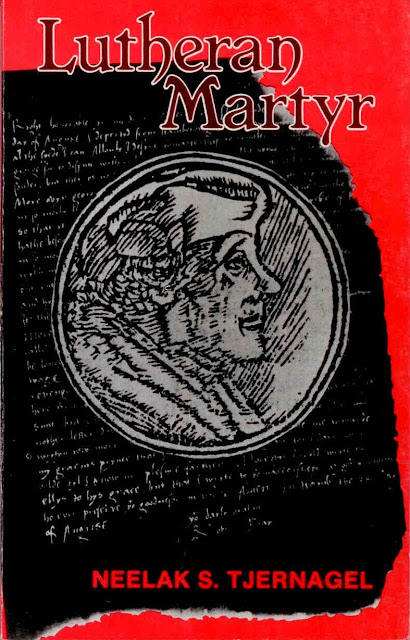
Lutheran Martyr, by Neelak S. TjernagelI happened to find myself rereading, this weekend, the opening pages of Neelak S. Tjernagel’s biography of Dr. Robert Barnes (~1495-1540), Lutheran Martyr. Dr. Barnes was an Englishman, who lived during the reign of King Henry VIII. Like Luther, Barnes was an Augustinian – though at Cambridge. Following in the footsteps of Erasmus, he left Cambridge for the continent to acquire an education at Louvain, returning in 1523 with his Doctor of Divinity. Recognized for his scholarship, his order made him Prior of his house, a position he used to introduce the classical learning he had been exposed to at Louvain. Of course, knowledge of Luther and his theology was not hidden on the Cambridge campus, but, being Roman Catholic, such theology was officially forbidden and rejected. Knowing that it was being discussed anyway, at times the University even conducted searches for heretical books or pamphlets that may have made their way from Germany. For this reason, scholars often met off campus, to study the text of the Bible and discuss theology. One place they met was the White Horse Inn. Among the group who met there was Dr. Barnes, who was the indisputable leader of that group, Thomas Cranmer, who would later become Archbishop of Canterbury, and William Tyndale and Miles Coverdale – important Bible translators and publishers – along with many others who would later be referred to as the Cambridge Reformers.
Meanwhile, from the period of 1509 to 1547, King Henry VIII was active, not only marrying and divorcing women, but positioning himself between the Roman Emperor Charles V and King Francis I of France, to antagonize their relationship in an effort to prevent either one or both of them from taking action against England. This exacerbated already complicated issues as he sought permission from the pope to divorce Catherine. Roman Catholic when Henry ascended the throne, he worked to change the Church in England due to four primary factors:
  1. The insecurity of the Tudor crown. Because of the public scandal of the King’s marital incontinence, and the religious offense it created among Roman Catholics, many – consistent with their religious teaching – prophesied the King’s death or removal from the throne by divine means. Under Henry, such sentiments, if made known, were made punishable by death.
  2. Following this was Henry’s determination to force his subjects to accept his divorce from Queen Catherine.
  3. In a move to create political separation from Rome, parliament named the King as the “Only Supreme Head of the Church of England” – and Henry demanded that every subject in England recognize this fact.
  4. Finally, the King and the parliament were determined, by this act and others, to suppress the monasteries and “enrich the state at the expense of their vast properties.”
    “For good or for ill, Henry was to triumph... Only a small minority opposed the changes that altered [the Church of England] during his reign.

    Tjernagel, N. (1982). Lutheran Martyr. Milwaukee, WI: Northwestern Publishing House. pg. 15
Such were the politically motivated reasons for opposing the Roman Catholic Church in England, for changing it to the liking of England’s leader. Roman opposition within England, what little of it there was, came mostly from churchmen: cardinals, bishops, monks, abbots, nuns, and leaders of state, like Sir Thomas Moore, were publicly executed, either by burning, hanging, beheading or some other gruesome means. Some were drawn and quartered. Of those executed by Henry VIII during this time, fifty were officially named as martyrs by the Roman Church.

On the other hand, after Sir Thomas Moore had become Chancellor in 1529, there arose some concern that Protestantism, in addition to causing unwanted reform within the Church, may well cause political unrest as well – something which, again, amounted to a threat to the royal authority of the Tudor family. Prior to this, persecution of protestants was largely within the domain of the Church, and was nearly limited to laymen – mostly common laborers – who were unable to defend themselves against the charges of heresy. In fact, from the time of Wycliff (ca. 1380) up to this time, nearly 4/5 of all protestant martyrs were laymen. In 1529, Cardinal Wolsey, Chancellor of England since 1514, and the pope’s personal representative to the King since 1521, was dismissed from his position for failing to obtain permission from the pope for Henry to divorce his wife, Catherine. Sir Thomas Moore was appointed Chancellor in his place, and as Chancellor, set into motion policies for the execution of religious protestants – policies under which he himself was deprived of his Chancellorship in 1531, and finally executed in 1535, for refusing to recognize the King as Head of the Church, refusing to recognize his divorce from Catherine, and refusing to endorse England’s separation from Rome.

By 1529, however, Dr. Barnes had already gotten himself into serious trouble under Wolesy. In 1525, the Cambridge Reformers agreed that Christmas would be the day that they would announce their allegiance to evangelical theology, and that Dr. Barnes would deliver that announcement in a sermon, from the pulpit of St. Edward’s Church – the chapel of Trinity Hall and Clare Colleges of Cambridge University. As a result, he was arrested, tried and imprisoned, but by 1528, had escaped, finding his way to the University of Wittenberg where he studied under Dr. Martin Luther, fully absorbing his theology, until 1531.

(NOTE: While in the company of the German Reformers, Dr. Barnes wrote a Treatise, addressed to King Henry VIII, defending the Doctrine of Justification by Faith Alone. His full Treatise on Justification was published on this blog in 2015, and can be read at the following link: Treatise on Justification, by Rev. Dr. Robert Barnes – Lutheran Reformer, Ambassador to the Smalcaldic Princes, and Christian Martyr)

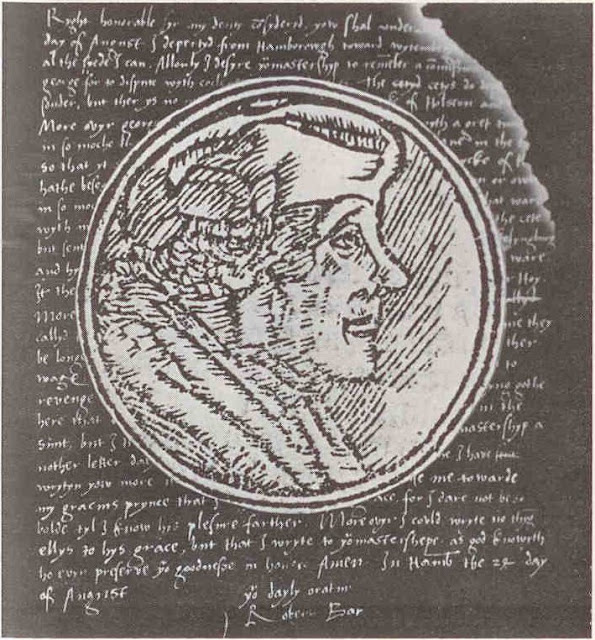
Woodcut of Barnes, from one of his booksIn 1532, Thomas Cromwell, friend of the Reformation, was appointed Chancellor of England to replace Moore. He successfully orchestrated Henry’s divorce from Catherine. He also played a key role moving forward Henry’s ambitions to forge political alliance with the Lutheran Princes of Germany. As a result of the extended and embarrassing altercation with Rome over his divorce, Henry was eager to return the favor in a way that would deprive Rome of further political influence. Establishing political relations with the Lutherans was the expedient he required. About this time, Dr. Barnes, who was still in Germany, began writing. His first work was a theological sourcebook demonstrating his thorough acquaintance with, and commitment to, Lutheran theology. His second work was a book entitled, Supplication to Henry VIII. This work was a collection of essays, giving strong indication of his loyalty to the King, vindicating himself of the charges he faced under Wolsey, and defending Lutheran theology. This book found its way to King Henry, along with the Augsburg Confession and the writings of two of Barnes’ White Horse Inn colleagues, Tyndale and Frith. King Henry not only approved of Barnes’ writings, but urged that they all, by any means, be brought back to England.

Frith returned, but upon examination was found to hold Zwinglian ideas, denying the Real Presence of Christ in the Eucharist. Refusing to recant, he was burned at the stake in 1533. Tyndale refused to return to England unless the English translation of the Scriptures be freely distributed to the King’s subjects. His request was refused, and so Tyndale remained in exile until his arrest in 1535 and execution a year later. Barnes, on the other hand, returned to England over the Winter of 1531-1532, under the King’s promise of safe conduct, and returned to Europe the following spring. Later in 1532, Thomas Cranmer, a Protestant and another one of Dr. Barnes’ associates from the White Horse Inn, was appointed Archbishop of Canterbury – an appointment secured by the family of the woman King Henry VIII wished to marry after his divorce from Catherine.

Dr. Barnes was politically useful to King Henry – useful in his endeavor to achieve political independance from the Roman Catholic Church. Barnes' intimate relationships with the key figures of the German Reformation, and his thorough knowledge of their doctrine, would serve Henry as he sought political alliance with the Lutheran princes. Barnes was recalled to England in 1534, to enter the King's service, initially as a liaison to Germany, then as ambassador to the Lutherans of the Smalcaldic League, eventually securing in 1536 a theological formula which could serve as a basis for opening political relations with them. Barnes was rather positive regarding this formula. On the other hand, the Germans had also produced a decision regarding the divorce of King Henry, which was disapproving. This latter development cost Dr. Barnes his job, regardless of the formula he had returned with. The situation had changed, and the formula was no longer a priority: both Catherine and her replacement had died, eliminating the political issue of Henry’s divorce and remarriage. Thus, given that political priorities had changed, Henry was disposed to reject the formula Barnes and his fellow ambassadors had developed with the Germans, and assert England’s independence by writing his own document to secure religious unity and open political relations. His document was entitled The Ten Articles. Upon examination, Melanchthon declared that they must have been “composed in confusion.” By the end of 1536, Barnes was in prison again.

Political winds continuing to shift, in Spring of 1538 Cromwell secured Dr. Barnes’ release from the Tower Prison in London to participate through the Summer in further theological and political discussions with the German Lutherans on behalf of the King. The immediate result was Cromwell’s 1538 publication of The Thirteen Articles, which, having the approval of the King, represented the religion of the Church of England. The hand of Barnes is evident in these articles, as they are a very near approximation of Lutheranism. Following this, Barnes enjoyed freedom as a “freelance preacher,” spreading, under the authority of these Articles, the doctrines of the Lutheran Reformation throughout England. His influence during this time upon Cranmer and his development of a vernacular liturgy is also evident, as the Anglican Book of Common Prayer of 1549 retained such a Lutheran character that during colonial times in America, it was referred to by Germans as “the English speaking Lutheran Church.”

In 1539, however, Charles V and Francis I found themselves on peaceful terms, forcing England to make some form of favorable political overature in order to avoid war. Therefore, sponsored by religious parties favoring the teachings of the pope, Parliament passed the Act of Six Articles, hoping to maintain open lines of communication with Rome. This Act affirmed transubstantiation, declared communion in both kinds unnecessary, forbade the marriage of priests and required that they take vows of chastity, required private masses for priests, and required the practice of private confession for all Christians. The Germans were stunned. “Luther cried out against the king who had deprived the pope of his name and property in England, but was perpetuating the pope’s doctrine and ‘abominations’” (Tjernagel, pg. 140).

Yet, Henry did not enforce the Articles, reviving hope among the Germans and Henry’s ambassadors that alliance could yet be attained. And such appeared to be necessary. Fearing certain war with Charles and Francis, and desperate for an alliance in such a conflict, Henry not only renewed negotiations with the Germans and reached out to the Danes, but agreed to marry a relative of one of the German Princes. Barnes was not involved in these negotiations, but continued to preach, and by Lent of 1540, was appointed to a pulpit at St. Paul’s Cathedral in London. In this short time however, the fragile peace between France and Rome had disintegrated, once again eliminating Henry’s need for alliance with Germany. He ignored their overtures following the negotiations of the previous year, and sought divorce from his third wife, terminating any further hope of a political relationship with Germany.

Barnes and his companions, at the stake

The failure of German negotiations resulted, by this time, in the veritable freefall of Chancellor Thomas Cromwell, as he was attacked mercilessly by Parliament for his inability to establish political relations with the Smalcald Lutherans. The Lenten season of 1540 was rather unkind to Dr. Barnes as well. He was attacked from the pulpits of Roman sympathizers in London, who pointed to the Lutheran "heresy" of Justification by Faith Alone which was openly preached by Barnes. He and his compatriots were arrested and imprisoned four months. On July 28, 1540, Thomas Cromwell was beheaded for, among other things, supporting the "heresies" of Dr. Robert Barnes. Two days later, however, something rather interesting happened – which brings us to where this brief history started: the opening pages of Tjernagel’s biography of Barnes.
    On 30 July 1540 six men, bound on hurdles, were drawn from the Tower of London to Smithfield market for execution. Two men (one a Roman Catholic, the other a Protestant), were tied to each hurdle for this melancholy progress. They were to die at a slaughter house dumping grounds, the customary site for the burning of heretics. Three of them were to be burned as heretics. The others were to be hanged, drawn and quartered for treason.

    Each of these men had strong religious convictions, yet their execution had no real religious significance. Purely political considerations had determined the identity of the victims and the time and manner of the executions. None of them had the martyr’s option of saving his life by renouncing his faith.

    All of them were sentenced to death by acts of attainder. [A] legal device... it permitted the English parliament to condemn and sentence without trial and without naming the charges on which the sentence was based.

    A religious coloring was given to the politically motivated executions on this occasion by the fact that all of the victims were university men and noted preachers. All had previously had some encounter with the authorities on religious issues.

    Contemporaries identified the three Catholics, Thomas Abel, Richard Fetherston and Edward Powell, as doctors of divinity... [of Oxford and Cambridge]... [They] had been defenders of Queen Catherine during the divorce proceedings... Powell had been given the highest praise by Oxford University for a book attacking Martin Luther.

    A short time before their deaths the three Protestant victims had been honored by Thomas Cranmer, the Archbishop of Canterbury, with an invitation to preach the Sunday sermons during Lent at Paul’s Cross, an open air pulpit at St. Paul’s cathedral in London. [These Protestants were William Jerome and Thomas Garrett, both of Oxford and Cambridge Universities, and] Robert Barnes, [who] had been educated at Cambridge and Louvain... He was prior of the Augustinian monastery in Cambridge and later served as chaplain to Henry VIII and as the king’s envoy in foreign diplomacy from 1531 to the time of his death.

    We now know that Dr. Barnes was the primary victim in the executions of 30 July 1540. His sentence was due to a political gesture made by king and parliament in that month. Garrett and Jerome went with him because they shared his views and were associated with him in the preaching of the Lenten Sunday Sermons at Paul’s Cross. The three Catholic theologians were sent to death on the insistence of the Protestant members of the King’s Council. They feared that the execution of three Protestants, condemned to death chiefly for political reasons, might be interpreted as a triumph of the Catholic party in the government.

    Tjernagel, N. (1982). Lutheran Martyr. Milwaukee, WI: Northwestern Publishing House. pp. 11-14
In other words, to maintain the appearance of impartiality, the King and his Parliament could not discipline members of one religious party, without also disciplining members of the opposing party. Too bad they were so consumed with managing appearances. Too bad that despite the obvious division about them, they were willing to satiate both religious parties in hopes of maintaining political harmony, even though it only perpetuated and entrenched the division. Who knows how history would have unfolded, had they actually been concerned with the Truth, with agreement and unity in principle, and with dealing transparently with others under it.

Political unity, in contrast to confessional unity, is built on compromise – a considerable problem when matters of principle are treated as the disposable expedients necessary to achieve it. It is a pity, not only for the sake of the Truth and for matters of conscience which have suffered such compromise, but for the so-called "unity" which results. It is not true unity, but a fabrication, a mere appearance of unity; it is nothing more than an agreement between parties to act as if true unity exists, even though it doesn't, even though it cannot since conscience has been compromised to attain it. Moreover, such "unity" never lasts, but over time requires further compromise in order to satiate the fundamentally dissatisfied parties involved, and continue to maintain the facade of peace and harmony. Regarding this, Luther, I am told, is credited with the following very true statement, one which ought to be well-heeded by all leaders of Church and State, and anyone who would enter into confessional unity of any sort and desire to remain in it:


Compromise never leads to peace, it only postpones conflict.


Monday, November 29, 2010

Pastoral discipline - An encouragement

The confessional Lutheran status of a synod is determined, not at the synodical level, but at the congregational level. Our work together as a synod flows from and is directly related to our faithfulness as individual pastors, teachers and congregations.

Below is an article written for Intrepid Lutherans by a brother pastor, calling our pastors to faithfulness in the area of church discipline. We thank Rev. Strand for his contribution in favor of sound confessional Lutheran doctrine and practice.

_____________________________________________________________________________________

Dear Brothers and Sisters in our Advent King,

The editors of Intrepid Lutherans have asked me to contribute an article to their website. My article focuses on the phrase in the pastor's call form that reads, “(Our congregation) solemnly charges you... to admonish indifferent and erring members of our congregation (2 Timothy 4:2).” 2 Timothy 4:2 reads, “Correct, rebuke and encourage with great patience and careful instruction.” In this article, I hope to encourage our pastors to carry out this difficult part of their call.

A pastor often badly neglects this part of his call. We hear WELS members say things like, “We have 500 members... on the books.” Most congregations have members living together outside of marriage, members well known around town for their drunkenness, members who are attending heterodox churches, etc. When a fellow Christian falls into such sins, our Lord Jesus tells us, “Go and show him his fault,” (Matthew 18:15 NIV). When a pastor knows his members have fallen into such sins, the Lord says to him, “Son of man, I have made you a watchman for the people of Israel; so hear the word I speak and give them warning from me. When I say to the wicked, ‘You wicked person, you will surely die,’ and you do not speak out to dissuade them from their ways, that wicked person will die for their sin, and I will hold you accountable for their blood. But if you do warn the wicked person to turn from their ways and they do not do so, they will die for their sin, though you yourself will be saved” (Ezekiel 33:7-9 NIV). When congregations neglect church discipline, they sin. When pastors fail to admonish indifferent and erring members of the congregation, they sin.

This part of a pastor's call is difficult and sometimes it is scary. We are afraid of what the sinner will say; we are afraid we won't know what to say; we are afraid the congregation will turn against us for doing this work. And so, the first person in the congregation to call out, “Lord, have mercy!” is the pastor. Brothers, it is right for you to confess these sins. It is right for you to confess, “Merciful Father in heaven, as I read my call form, I see what a wretched man I am. I neglect and fail in every area of my call. I have also neglected my straying and erring sheep. I have not gone to them to correct, rebuke and encourage them as I should. For this, I deserve your punishment, both now and in eternity. But trusting in my Lord Jesus Christ, I pray: Lord, have mercy on me, the sinner!”

But then it is also right for you to remember Jesus' gracious words, “Son, take heart! Your sins are forgiven.” When you were born, Jesus already knew every sin you would ever commit, including your failure to shepherd your straying sheep, but in the waters of Holy Baptism, He washed you clean and took you as His own anyway. In His Holy Supper, Jesus gladly welcomes a sinner like you and eats with you, giving you forgiveness, life and salvation in His Body and Blood. When you see your shortcomings as a pastor, call a fellow pastor and confess them, then trust that man's words of absolution as if Jesus himself were speaking them to you: “Your sins are truly forgiven and eternal life is yours.” And then listen to his admonition and encouragement, “Now go and sin no more.” Our Justification and Sanctification are rooted in and flow from one and the same place: the forgiveness of sins in Jesus Christ.

And now, as God's new creatures, we pastors want to carry out the calls He has given us: faithfully until death. But what about that toughest and scariest part of our call: “to admonish indifferent and erring members?” As with many parts of the ministry, God gives us principles to follow rather than step-by-step instructions. Each pastor is different and each situation is different. I don't claim to be an expert at anything, but with God's help and with trembling hands (though they tremble less the more I do the work), I have worked hard at this part of my call during my ministry. Here are some things I've learned from Scripture, experience and other brothers along the way:
  1. Pray continually (1 Thess 5:17). Pray, pray, pray for your members who are falling into sin. A wise pastor told me to pray through the membership directory once a week. I've followed that man's advice and that has allowed me to pray for indifferent and erring members once a week. Also, pray before, during and after calling/ visiting those members. God will not put off your prayer.

  2. Don't write letters. Letters are an easy way to do this work, but they are not in keeping with Jesus' command, “Go and show him his fault.” Letters can be taken the wrong way and they don't give people a chance to respond. I try two phone calls to set up a visit and then I go and knock on the door. If none of that works, I leave a letter taped to the door in an envelope, so they know I came. I only write letters (or try by Facebook, etc.) if the individual leaves me no other option.

  3. Don't try to do all the work at once. A wise pastor told me, “When you get to a new congregation, start with the people who have been away from communion the longest and work your way down.” I came to my current church in summer 2009. The church had 58 confirmed members who had not received Holy Communion in at least four years. Fifteen months later, I have made at least two attempts by myself with all of these and have now taken an elder with me to knock on each of their doors. Do the work little by little.

  4. Don't have a script. These calls/ visits seldom go like you think they will. Ask questions, “What is keeping you from church? What can I do?” Hear them out. According to God's Word in Ezekiel above, the main thing you must do is warn them about their sin. Tell them that they are sinning against this or that commandment and that this sin is ruining their (and their children's) faith. Respond to their arguments with Scripture in a humble, but confident way.

  5. Keep the congregation posted. In sermons, newsletter articles, meetings, etc., tell the people that you and your elders are working hard to carry out the duties God has given you. Ask them to pray for you.

  6. Rejoice in the one who repents. Of those 58 I mentioned above, only one has shown fruits of repentance by coming to receive communion since my visit. I have six members who are attending heterodox churches. I've warned all six of the danger and this morning, one of them is on the answering machine asking to talk to me.

  7. Give all glory to God for the success of the Gospel. And thank Him for entrusting that Gospel to a jar of clay like you. To paraphrase Charles P. Krauth: We are poor sinners, so we don't claim that we cannot fail; we only claim that we will not fail, because the Ascended Lord Jesus is with us always to hear our prayer, give us strength and bless the preaching of His Word until He comes again.

God bless your efforts with your straying and erring sheep.

In Jesus' name,

Pastor Jim Strand

Creative Commons License
This work is licensed under a Creative Commons Attribution-Noncommercial-No Derivative Works 3.0 United States License