Showing posts with label Spener. Show all posts

Thursday, November 27, 2014

A Devotion and Prayer for Thanksgiving Day

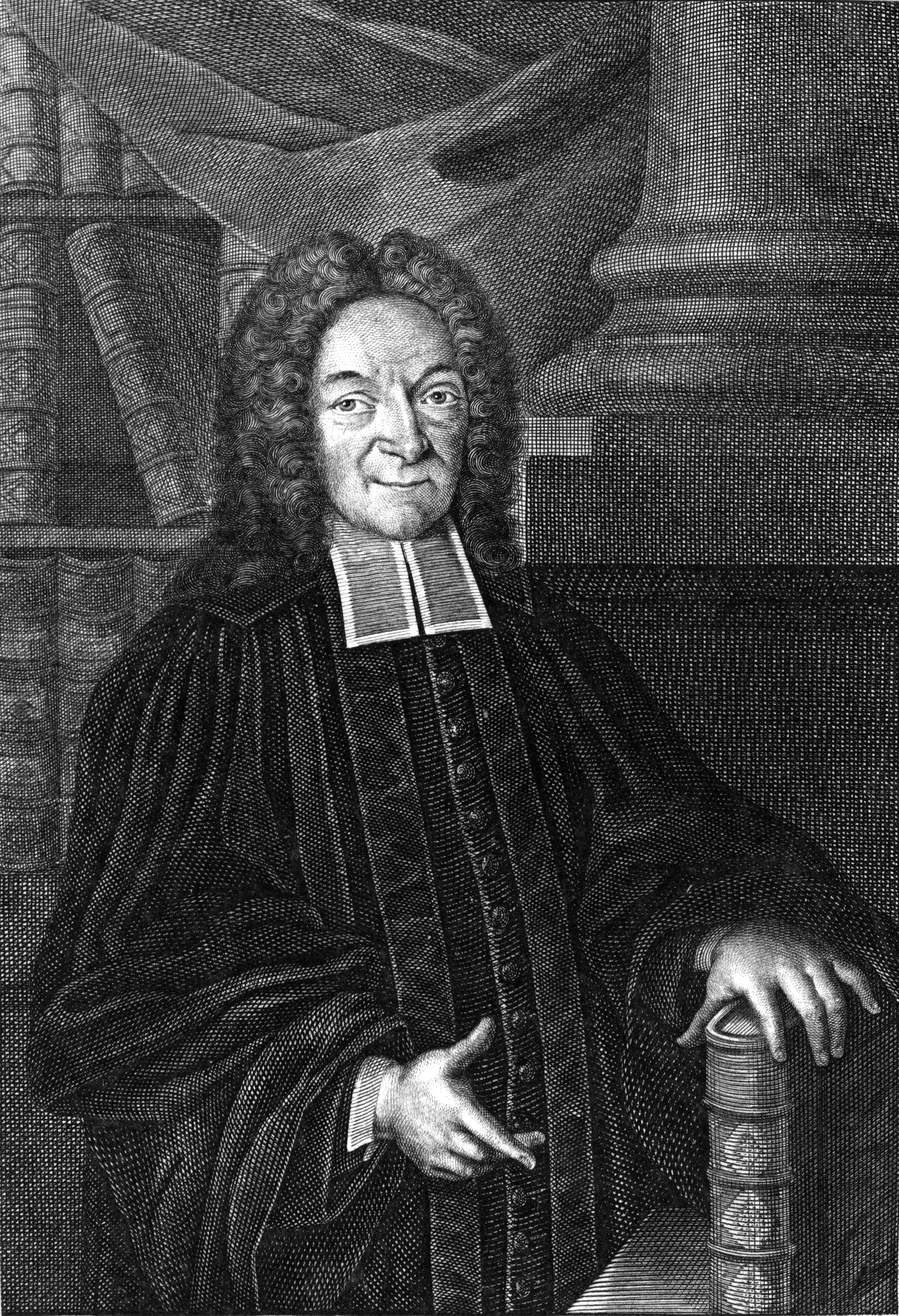
Rev. Johann Friedrich Starck
successor to Philipp Jakob Spener – the “Father of Pietism” – in Frankfurt, DE (early 18th Century)
The following devotion and prayer was written by noted devotional author and poet, Rev. Johann Friedrich Starck, of Frankfurt am Mainz, in his mightily influential devotional work, Daily Handbook in Good and Evil Days, first published in 1728, here translated into English by Rev. Joseph A. Stump in 1904, from the posthumous and final edition of 1776. Starck was also a noted pietist, the successor of Philipp Jakob Spener (d. 1705) in Frankfurt, and evidently a preferred devotional author of Rev. Dr. Franz Pieper (LCMS): in 1900, Concordia Publishing House (CPH) – the publishing organ of the Lutheran Church - Missouri Synod (LCMS) – published a German edition of Starck’s devotional work that had been “Missouri-ized” by Pieper; and in 1921, Concordia subsequently published an English edition in two separate volumes, entitled, Starck’s Prayer-Book and Starck’s Motherhood Prayers. Both can be purchased today in a single volume from Emanuel Press as Stark’s Prayer-Book: Concordia Edition.

Regarding Stump’s translation, the translator of the 1921 Concordia Edition (W.H.T. Dau), had this to say in his Preface: “The translation is made from the German edition of Dr. Pieper of 1900. Comparison was possible to the translator only with the editions published by Kohler and the German Literary Board. Each of these editions has its distinct merit, the latter excelling by its faithful adherence to the original, its apt renderings, and happy paraphrases.” Regarding Starck, his Prayer-Book and Pieper’s endorsement of it, Dau comments further in his Preface, as follows:
    “Johann Friedrich Starck, a favorite author of evangelical Germany in the era of Pietism, has more than other writer of devotional literature maintained his hold on the hearts of practising (not merely professing!) Christians. Even Arnd’s True Christianity booksellers assert, does not equal the incluence which Starck still exerts on thousands of Christians by his Prayer-Book...

    Rev. Dr. Franz Pieper (LCMS)
    Rev. Dr. Franz Pieper (LCMS)
    published a German edition of Starck’s Prayer-Book for LCMS Lutherans
    “Starck’s predecessor in Frankfurt had been Spener, ‘the father of Pietism,’ and it fell on Starck’s lot to water what Spener had sowed. For thirty years he conducted ‘private’ devotional exercised on Sunday afternoons. These exercises, which were attended by a number of earnest souls, were private only in as far as they were distinct from the regular publis services at the church. At these exercised Starck endeavored to impress the evangelical truths of Christianity, the priceless privileges of the grace of Christ and the Christian ordinances, and the practical duties of a consistent Christian life on his individual hearerswith true pastoral tact...

    “Starck loved nothing sensational, nothing that was for mere display in matters of religion. Christian life, to him, was real and earnest, to be conducted in a sober mind... While he maintained the confessional position of the Evangelical Lutheran Church, and rejoiced to be a member of it, his teaching was tinged with the peculiarities of the Pietistic tendency... However, this defect occurs only occasionally, perhaps least in the Prayer-Book, and there are so many sections in Starck’s writings that are entirely free from error that Starck himself supplies the needed correction for his occasional deviations from the straight path of the sound doctrine.

    “When Dr. F. Pieper, years ago, examined the Prayer-Book with a view to applying, wherever needed, this self-correction of Starck, this was done with no sacrilegious hand, but really to secure for Starck a fuller reward of his faithful labors for a sincere and zealous Christian life. The revisor really helped Starck to speak his full Christian mind everywhere, and to discard what was of inferior value or even misleading in his presentation of Christian truths...”
Both Stump’s and Dau’s English editions included English hymns. I preferred neither that were included with the following devotion, so concluded it with my own selection from The Lutheran Hymnal.


JOHN FREDERICK STARCK’S
“DAILY HAND-BOOK IN GOOD AND EVIL DAYS”


CONTAINING ALL THE MEDITATIONS AND PRAYERS OF THE
COMPLETE GERMAN ORIGINAL EDITION
TOGETHER WITH AN APPROPRIATE SELECTION OF STANDARD ENGLISH HYMNS
FOR GENERAL USE, FOR THE AFFLICTED, THE SICK, AND THE DYING

TRANSLATED BY
REV. JOSEPH A. STUMP, A.M.
Pastor of Grace Evangelical Lutheran Church, Phillipsburg, NJ

Burlington, Iowa
German Literary Board


THE CHRISTIAN THANKS GOD
AFTER THE HARVEST HAS BEEN GATHERED.


MEDITATION.

For she did not know that I gave her corn, and wine, and oil, and multiplied her silver and gold, which they prepared for Baal. Therefore will I return, and take away my corn in the time thereof, and my wine in the season thereof, and will recover my wool and my flax given to cover her nakedness (Ho. 2:8-9).

IF there be a striking manifestation of God’s goodness which is apparent to all men, it is undoubtedly the annual harvest, when God, after having guarded the seed throughout the winter in the earth, having let it bloom and grow and bear fruit in the summer, and having warded off hail and damage by storm, fills barn and cellar with His blessings. But if there be a benefit of which the world makes light and for which it is least thankful to God, it is this very harvest. For ungrateful men imagine that it must be so; that according to the course of nature things must grow, and that God has nothing to do with it. For this reason God in just anger sometimes makes the harvest a failure, in order that all men may see that the ground cannot produce if He does not make it do so, and that nothing can grow without His blessing.

A Christian views the matter differently. When he beholds the full ears of grain, and the vines heavily laden with grapes, (1) he lifts his eyes to heaven, and praises the almighty Creator, Giver, and Preserver of these blessings, who from one grain has produced so many grains, and from an insignificant vine has brought forth such precious fruit. (2) He praises God’s Providence, which has sent the early and the latter rains in their seasons, warded off hurtful thunderstorms, drought, hail, and floods, and preserved the harvest. And when he now sees the grain harvested and hauled into the barn, and the grapes crushed in the wine-press, (3) he receives all these gifts with grateful heart and hands. (4) He uses them and enjoys them with thanksgiving. He acknowledges that God nourishes, sustains, and preserves him. (5) He lets the goodness of God lead him to repentance. If men are thankful to their fellow-men for the gift of clothing or food, and avoid offending their benefactors, why should not we give thanks to our greatest Benefactor, who gives us all things?


PRAYER.

O give thanks unto the Lord; for He is good: and His mercy endureth for ever. Thus I say, O my God, now that I have seen another blessed harvest gathered. O gracious God, how great is Thy mercy to us! Thou hast laid the foundations of the earth, that it should not be removed forever. And in this earth Thou hast laid Thy glorious treasures, and makest it bring forth the fruits which nourish and sustain us. Thou hast crowned this year abundantly with Thy goodness; and Thy paths drop fatness. Thou hast watered the hills from Thy chambers; the earth is satisfied with the fruit of Thy works. Thou hast caused the grass to grow for the cattle, and herb for the service of man: that Thou mightest bring forth food out of the earth.

O faithful Father! Thou hast this year again bestowed upon us. Thy unthankful children, food and drink; Thou hast preserved the harvest. Heaven has heard the cry of the earth; and the earth has brought forth corn and wine. Thou hast given us the early and the latter rains in their seasons. And now our fields have bloomed and offered us the bounty with which Thy blessing covered them. Our trees have brought forth all manner of beautiful fruit, and the vine has made us glad. Loving God and Father, Thou hast spread the wings of Thy mercy over all the land: Thou hast let the sunshine ripen the crops, and hast protected them from hail and blight and drought and flood. When we slept. Thou didst wake; Thou wast Guardian and Keeper over our fields. O Lord, how manifold are Thy works! In wisdom hast Thou made them all: the earth is full of Thy riches. All creatures, men and beasts, wait upon Thee, that Thou mayest give them their meat in due season. That Thou givest them, they gather; Thou openest Thine hand, they are filled with good.

Yes, abundantly indeed hast Thou, O God, blessed us this year with Thy gifts. And now we thank Thee from our inmost soul. O come, let us worship and bow down; let us kneel before the Lord our Maker. Let us enter into His gates with thanksgiving, and into His courts with praise. Let us say with grateful heart: The Lord hath done great things for us; yea, the Lord hath done great things for us; whereof we are glad. O Lord, Lord, grant us grace not to misuse these gifts and benefits which Thou hast bestowed, but to learn from them to appreciate Thy love and faithfulness toward us. And if, O God, some unthankful souls should abuse Thy gifts by gluttony or intoxication, do not on that account withdraw Thy blessing from us, but preserve it unto us according to Thy mercy.

O Father, who hast loved us with an everlasting love, and who through these bodily blessings also hast drawn us with loving-kindness, desiring that in the gifts we may recognize the Giver, and in the benefits the Benefactor; grant, that Thy goodness may lead us to repentance, and that, whenever we see Thy gifts before us on the table or take them into our hands or mouth, we may lift up our eyes to Thee, the Fountain of all blessings. And as by these gifts Thou dost sustain our body, so let us be nourished and strengthened in the inward man, and increase in faith and love and holiness through the means of grace which Thou hast ordained; that we may grow in all goodness, and be changed from glory to glory, till at last we shall be admitted to the enjoyment of the heavenly blessings of eternal life through Jesus Christ. Amen.


HYMN.
    O Lord, whose bounteous hand again
         Hath poured Thy gifts in plenty down,
    Who all creation dost sustain
         And all the earth with goodness crown,
    Lord of the harvest, here we own
    Our joy to be Thy gift alone.

    Oh, may we ne’er with thankless heart
         Forget from whom our blessings flow!
    Still, Lord, Thy heav’nly grace impart;
         Still teach us what to Thee we owe.
    Lord, may our lives with fruit divine
    Return Thy care and prove us Thine.

    Lord, grant that we who so to Thee
         With joy in endless life may reap.
    Of ev’ry heart the Guardian be;
         By day and night Thy servants keep
    That all to Thee may joy afford
    On thy great harvest-day, O Lord.

    Amen.

    The Lutheran Hymnal (1941), #567
      Author: Unknown
      Text: Ps. 65:9
      Strassburg, 1541


Wednesday, August 18, 2010

Lay Ministry: A Continuing Legacy of Pietism

Philipp_Jakob_SpenerPietism was a raging problem among Lutherans in mid-19th Century America. It was a movement begun in mid-17th Century Germany by Lutheran theologian Philipp Jakob Spener (d. 1705), with the 1675 publication of Johann Arndt's postils containing a preface written by Spener entitled Pia Desideria, or "Pious Desires." In this preface, Spener called for six seemingly modest Lutheran reforms that he thought would bring about spiritual renewal among Lutherans, extending Luther's doctrinal Reformation into the life and works of the Church and individual believers:
  1. a greater study of Scripture among Christians, assembled in small groups called "conventicles",
  2. the practicing of the Universal Priesthood of all Believers through lay participation in congregational ministry,
  3. encouraging Christians to live out their faith, rather than mere intellectual assent to Biblical teaching,
  4. a more brotherly treatment of heterodox teachers,
  5. ministerial training that cultivated personal piety as well as academic prowess, and
  6. preaching which dwelled on Sanctification1,2
Never desiring to be outside of Lutheran orthodoxy, Spener insisted that his teaching should not be construed as outside the bounds permitted by clear Scriptural teaching, and that if it did, it was due to his own inadequacy as a teacher. Indeed, through 1689, he enjoyed the endorsement of orthodox leaders in Germany, who themselves noticed and were eager to correct the problems wrought by recent history (devastation of the Thirty-Years' War and the impact of theological attacks from Jesuit Scholasticism resulting from the Catholic Counter Reformation, among other things), even if that meant they had to tolerate his aberrations.

Pietism in Germany
Spener’s Pia Desideria spread like wildfire, spawning the movement known as Pietism, which quickly grew beyond his ability to influence it. Before long, Pietism no longer resembled orthodoxy in the slightest, resulting in increasing criticism from orthodox leaders, particularly from Wittenberg. Unable to cope with their criticism, Spener broke with them to form the University of Halle in 1694, along with August Francke (d. 1727) and others, where he hoped to give some form to Pietism and influence it’s practice in wider Christianity.August-Hermann-FranckeWhat the movement came to represent, however, was the replacement of religious objectivism (the fact that man finds outside of himself in the Gospel and Sacraments the assurance that he is a child of God and heir of eternal salvation) with religious subjectivism (the idea that man finds affirmation of his status before God through the experience of certain emotions, and the ability to display certain works), reducing the objective promises of God's Word to secondary stature, and elevating subjective "conversion experiences" (ictic conversion) and displays of pious works in their place; the rejection of orthodoxy altogether, and its replacement with unionistic theological indifferentism; the denigration of the Means of Grace (God coming to man to give him blessings) to opus operatum, a crutch for the complacent Christian, and replacement of these Means with the fervent prayers of the Christian (man going to God in hope of blessings); and use of the Law to make sweeping accusations against society in order to stir the hearts of Christians and to motivate pious works (Law rather than Gospel motivated works), while use of the Gospel was made to raise questions regarding whether one could really lay claim to a living faith (Gospel used as Law).3

Professor John Brenner of Wisconsin Lutheran Seminary, in a lecture entitled The Spirit of Pietism,4 characterized the most potent and critical influences of Pietism in the following way:
  1. Pietism’s emphasis on Sanctification over Justification resulted in Legalism, by shifting the emphasis in the use of Law from the Second Use (as a mirror) to the Third Use (as a guide) and by prescribing laws of behavior in areas of Christian freedom, leading further to Perfectionism; and
  2. Pietism’s elevation of religious subjectivism, in addition to what has already been mentioned, also “separated God’s Word from the working of the Holy Spirit” (breaking down the Biblical teaching of the Means of Grace), “changed the Marks of the Church from ‘the gospel rightly proclaimed and the sacrament rightly administered’ to ‘where people are living correctly,’” and “divided the church into groups according to subjective standards of outward behavior.”
Valentin Ernst Loescher (d. 1749), an orthodox Lutheran theologian and eyewitness to German Pietism -- who was also one of the most effective opponents of it -- uses the following words to describe the characteristics of Pietism in his work, Timotheus Verinus, and devotes an entire chapter of analysis to each word as it is applied to Spener's movement:
    indifferentism, contempt for the Means of Grace, the invalidation of the ministry, the confusing of righteousness by faith with works, millennialism, precisionism, mysticism, the abolition of the spiritual supports, crypto-enthusiasm, reformatism, and making divisions...5
Valentin-Ernst-L%C3%B6scherThe first wave of Pietism eviscerated orthodox Lutheranism in continental Europe, leaving Christianity unprepared for the next spiritual scourge. Because Pietism viewed the role of intellect in spiritual matters with suspicion and displayed strong preference for emotion and intuition, the Church largely became an unwelcome place for the intellectually capable. So, instead of applying their gifts in service toward God in the Church, such individuals learned to ignore the Church and sought instead to apply their gifts in the realm of secular academia. And so the Enlightenment was born. From the death of Loescher forward, the voice of Lutheran orthodoxy in Germany was rendered silent. The dwindling remnant persevered through remaining pietistic influence and Enlightenment rationalism, until, finally, the Prussian Union -- forced ecumenical mergers between Reformed and Lutheran churches -- rousted what was left of the old, orthodox Lutherans out of Germany. Many of those coming to America landed mostly in Perry County, Missouri and Buffalo, New York.

Ecclesiolae in ecclesia
Throughout the period of German Pietism (~1675-1749), some European governments, acting under the advice of the State churches being decimated by Pietism, sought to restore order by passing anti-conventicle laws, as these conventicles had been identified as the hallmark of pietistic activity. Conventicles, under the encouragement of Spener, Francke, and other pietists, were gatherings of Christians within the congregation, sometimes with, most often without pastoral oversight, where individuals were encouraged to study the Scriptures together, express their own thoughts concerning the meaning of a given text, while taking the expression of others within the group as spiritually edifying. As happens in any assembly of humans, an authority structure naturally developed within these conventicles, a structure that was largely dependent upon displays of external piety among the members, in word and/or deed. Such activity elevated the role of the Universal Priesthood of all Believers, as Spener intended, while subverting the authority of the Office of the Holy Ministry, perhaps not as Spener intended. Nevertheless, conventicles became the seat of division and source of false teaching in the Church, and became known as ecclesiolae in ecclesia, or "little churches within the church." Such were disorderly and contrary to the Doctrine of the Call since ministerial authority within the congregation was established outside the appointed order by which individuals were Called to fill the needs of such an Office. In addition, contrary to the Doctrine of the Church, conventicles established "little churches" within the congregation, not only with lay leaders carrying out the roles of the Public Ministry, but often with the inclusion of individuals outside of the congregation and/or outside the Lutheran Confession. As such, small groups were the source of separatism within congregations and from the church body they were part of: the "little churches," without the Marks, without legitimate exercise of the Divine Call, without a Confession and a basis for true biblical Fellowship, became the essence of church life for their members.

The State also had political interest in controlling or eliminating these conventicles, as a result of another peculiarity of Pietism taught by Spener -- a form of millennialism in which the Christian is to hopefully wait for the "better times" of the one-thousand-year reign of Christ on Earth, with a perfect earthly Church being his seat of government.6 This teaching was known to cause various groups to take it upon themselves to work toward such "better times" rather than wait for them, creating political unrest by considering themselves above both the State and the imperfect visible Church, in some places reminiscent of Thomas Muentzer's peasant uprising.7 In other words, conventicles also became hotbeds of subversive political activity.

Haugean Pietism in Norway
In Norway, such a Conventicle Act was passed in 1741. Under the reign of the pietistic state of Denmark, this Act was intended to institute a healthy Pietism in all of its lands, while avoiding its excesses. Its chief purpose was twofold: "To protect those who evinced true solicitude of the edification of themselves and others from persecution, and secondly, to prevent the disorder arising from those who under the cloak of greater religiousness left their natural calling and wandered about from place to place as preachers without having either a divine or human call to do so."8 The specific provisions of this Act are an interesting commentary on what was regarded as problematic with conventicles and lay leadership, even among the moderating pietistic Danes.

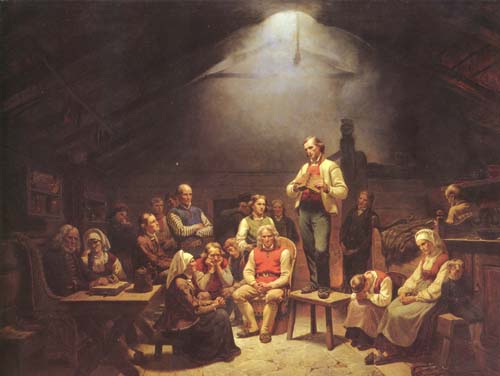
According to popular accounts, this Act did very little to promote Pietism at all, however. It is reported that by the close of the 18th Century, the laity had grown entirely complacent and the clergy was increasingly accused of various forms of corruption, not due to a line of corrupt leadership, but through a state-church system that nurtured an unhealthy political separation of clergy from laity.9 Enter the layman, Hans Nielsen Hauge (d. 1824). Raised a farmer, his upbringing consisted in regular reading of Scripture and devotional works (including those of Johann Arndt), the singing and memorization of Lutheran hymnody, and other generally healthy Christian practices. His family being regular church-goers, his upbringing taught him to take his faith seriously, so much so that he was considered odd by his friends and acquaintances, and was a regular object of their ridicule. He was granted perseverance in his faith. At the age of 25, in 1796, singing a hymn while working his father's fields, he was overwhelmed by spiritual experience, prompting him to pray, "Lord, what wilt thou that I should do," whereupon he was reminded of the prophet's words, "Here am I, Lord. Send me."10 And so he went, to the people of his own nation, in whom he saw so much vice and need for faith and repentance, as a lay evangelist intent upon preaching the Way of Salvation through "repentance and conversion," and to do so reverently as a servant of the Church. Yet, Hauge had no Call to preach. At first, he did so haltingly with reticence, but as time progressed and he discovered the approval of those who heard him, as he saw them repent of their sin and embrace their Saviour, he grew more bold and confident. He wrote many devotional books, preached both publicly and privately on many occasions, traveling from one end of Norway to the other in the process. He was a national sensation. One could say that many good things resulted. Many people were turned to Christ. Hauge, being a very bright man, keen on recent developments in farming and gifted with business acumen, also freely assisted his countrymen in their temporal needs, publishing books and offering business and farming advice, even taking part in the creation of several industries. Many people were lifted out of poverty as a result. Yet, having no regular Call to do so, he continued to carry out the functions of the Pastoral Office. Moreover, he abandonded his own Vocational calling to do so. The Church took notice. So did the State. Hauge, despite all the good it may be said that he had done and was doing, did not have in his possession a Divine Call to carry out the functions of the Pastoral Office. He was in violation of the Conventicle Act of 1741, and he was in violation of Scripture, both of which required such a Call.

Haugean ConventiclesIn 1804, with several short incarcerations already behind him, Hauge was arrested for a tenth, and final time. For ten years he remained in prison, not receiving a finding from the court-commission until 1808, which found him guilty of the following crimes:
  1. He had violated the Conventicle Act of 1741;
  2. He had tried to form a sect and a communistic society;
  3. He had encouraged especially the young people to break the Conventicle Act;
  4. He had in his writings heaped contempt on the official ministry11
This resulted in a trial late in 1813, the verdict of which was rendered a year later, in 1814, finding Hauge "guilty of having preached the Word of God, encouraged others to do the same, and heaped scorn on the ministry,"12 for which he was ordered to pay the equivalent of $1000, plus the cost of the trial, and released from prison.13

Lay Ministry a Cultural Fixture in Norway, Emigrates to America
During his time in prison, other lay preachers followed in Hauge's footsteps. Young pastors in the Church of Norway adopted his practical and relevant sanctification emphasis and common manner of speaking. Coincident with the growth of Haugean Pietism in Norway, between 1796 and 1814, was a growing political predisposition toward independence. These factors coalesced with the defeat of Napoleon at the Battle of Leipzig in 1813, resulting in political crisis in Denmark-Norway, which had allied itself with France. Delegates from across Norway were selected from the State Church (in which Hauge and his followers had been active for nearly two decades), as representatives to Norway's Constitutional Convention, which resulted in a new Constitution in May of 1814, emancipating them from Denmark. The followers of Hauge, farmers and other common folk, soon realized "the power that was given them in the Constitution of 1814."14 As they swiftly gained positions of influence in the Church and State, the Conventicle Act of 1741, long ignored since 1814, was officially repealed in 1842, consistent with movements within the government and cultural religious sentiment, driving the nation toward greater liberty.

Hans Nielsen Hauge married for the first time in 1815, lost his wife that same year as she bore him a son, was remarried in 1817, and himself died in 1824. By then, he had become a folk hero, the legacy of Pietism continuing in Norwegian religious culture as a result of his influence. Politically and culturally, religious liberty became synonymous with lay participation in the functions of the Office of the Ministry within the congregation, such that, by the time of the first wave of Norwegian emigration to the United States in the middle of the 19th Century, not only was the practice of laymen carrying out the functions of the Pastoral Office culturally accepted, it was considered a political right. It was also a theological problem, which vexed the young "Old" Norwegian Synod in America for years. How the "old orthodox Lutherans" assisted them in resolving this issue will be the topic of tomorrow's essay (C.F.W. Walther on the Layman's Role in the Congregation's Ministry).


---------------------------------------

Endnotes
  1. Spener, P. (2002). Pia Desideria. (T. Tappert, Trans.). Eugene, OR: Wipf & Stock Publishers. (Translation originally published 1964, by Augsburg Fortress. Original work published 1675.). pp. 87-122.
  2. Schmid, H. (2007). The History of Pietism. (J. Langebartels, Trans.). Milwaukee: Northwestern Publishing House. (Original work published 1863). pp. 38-51.
  3. Wendland, E. (1991). Present-day pietism. In L. Lange (Ed.) Our Great Heritage (pp. 168-183). Milwaukee: Northwestern Publishing House. pp. 168-183.
  4. Brenner, J. (2006, October). The Spirit of Pietism. In Rev. Thompson (Chair), Confessional Christian Worldview Conference. Golden Valley, MN.
  5. Loescher, V. (1998). The Complete Timotheus Verinus (J. Langebartels & R. Koester, Trans.). Milwaukee: Northwestern Publishing House. (Original work published 1718 [Part 1] and 1721 [Part 2]). pg. 249.
  6. Schmid, H. (2007). The History of Pietism. (J. Langebartels, Trans.). Milwaukee: Northwestern Publishing House. (Original work published 1863). pp. 169-174.
  7. Loescher, V. (1998). The Complete Timotheus Verinus (J. Langebartels & R. Koester, Trans.). Milwaukee: Northwestern Publishing House. (Original work published 1718 [Part 1] and 1721 [Part 2]). pp. 36-42.
  8. Petterson, W. (1926). The Light in the Prison Window: Life and Work of H. N. Hauge. (2nd ed.).Minneapolis: The Christian Literature Company. pp. 18-19.
  9. ibid. pp. 20-26.
  10. ibid. pp. 47-48.
  11. ibid. pp. 165-166.
  12. ibid. pg. 167.
  13. ibid. pg. 167.
  14. ibid. pg. 173.

Creative Commons License
This work is licensed under a Creative Commons Attribution-Noncommercial-No Derivative Works 3.0 United States License