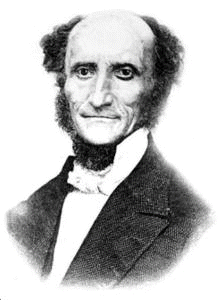
Dr. Philip Schaff (d. 1893) was among America's pre-eminent church historians and theologians of the 19th Century. Together with Dr. John Williamson Nevin (d. 1886), Dr. Schaff assisted in advocating German Reformed theology, a Zwinglian variety of Reformed teaching, contributing to a rise in its prominence that pitted it against the more widely accepted Calvinist theology of Charles Hodge (d. 1878) in a bid for dominance among the Reformed in America. Though this bid was unsuccessful, the Mercersburg Theology, as it was named in honor of the seminary where Nevin and Schaff taught, represented a teaching that was uniquely Christocentric among the Reformed, whose theology typically begins with and centers on the sovereignty of God, rather than the person of Christ.0 This factor, in addition to the impeccable academic credentials of these men, no doubt contributed to the use of their research by prominent confessional Lutherans, like C.F.W Walther and C.P. Krauth, both of whom quote favorably from Schaff and Nevin. In fact, Krauth's Conservative Reformation quotes both Nevin and Schaff with great frequency. We at Intrepid Lutherans quote from Dr. Schaff's
History of the Christian ChurchClick here for a brief biography of Dr. Philip Schaff, and links to download his public domain works, including his 3 volume Creeds of Christendom and his 7 volume History of the Christian Church quite frequently as well.
Dr. Philip Schaff (d. 1893) was among America's pre-eminent church historians and theologians of the 19th Century. Together with Dr. John Williamson Nevin (d. 1886), Dr. Schaff assisted in advocating German Reformed theology, a Zwinglian variety of Reformed teaching, contributing to a rise in its prominence that pitted it against the more widely accepted Calvinist theology of Charles Hodge (d. 1878) in a bid for dominance among the Reformed in America. Though this bid was unsuccessful, the Mercersburg Theology, as it was named in honor of the seminary where Nevin and Schaff taught, represented a teaching that was uniquely Christocentric among the Reformed, whose theology typically begins with and centers on the sovereignty of God, rather than the person of Christ.0 This factor, in addition to the impeccable academic credentials of these men, no doubt contributed to the use of their research by prominent confessional Lutherans, like C.F.W Walther and C.P. Krauth, both of whom quote favorably from Schaff and Nevin. In fact, Krauth's Conservative Reformation quotes both Nevin and Schaff with great frequency. We at Intrepid Lutherans quote from Dr. Schaff's
History of the Christian ChurchClick here for a brief biography of Dr. Philip Schaff, and links to download his public domain works, including his 3 volume Creeds of Christendom and his 7 volume History of the Christian Church quite frequently as well.In 1887, Dr. Schaff, published a little book entitled, Church and State in the United States: Or the American Idea of Religious Liberty and it Practical Effects; with Official Documents. It is a marvelous little book, an indispensable civics guide for the American Christian. In honor of this important day, November 6, 2012, the day of our national election for the Presidency of the United States, we here publish select sections from this book, from pages 53-56 and pages 69-78.
Church and State
in the United States:
or
The American Idea of
Religious Liberty and
its Practical Effect
(excerpts from)
by Dr. Philip Schaff
A.D. 1887
THE NATION AND CHRISTIANITY.
(pp. 53-56)
This seems paradoxical and impossible to all who entertain an absolutist or utopian idea of the state, and identify it either with the government, as did Louis XIV (according to his maxim: L'ttat cest moi),1 or with the realization of the moral idea, as Hegel2 and Rothe,3 or with the nation, as Bluntschli,4 and Mulford.5
The tendency of modern times is to limit the powers of the government, and to raise the liberty of the people. The government is for the people, and not the people for the government. In ancient Greece and Rome the freeman was lost in the citizen, and the majority of the people were slaves. Plato carried this idea to the extent of community of property, wives, and children, in his utopian Republic.6 Against this Aristotle protested with his strong realistic sense, and defended in his Politics the rights of property and the dignity of the family. The American ideal of the state is a republic of self-governing freemen who are a law to themselves. "That government is best which governs least."
The state can never be indifferent to the morals of the people; it can never prosper without education and public virtue. Nevertheless its direct and chief concern in our country is with the political, civil, and secular affairs; while the literary, moral, and religious interests are left to the voluntary agency of individuals, societies, and churches, under the protection of the laws. In Europe, the people look to the government for taking the initiative; in America they help themselves and go ahead.
The nation is much broader and deeper than the state, and the deepest thing in the nation's heart is its religion.
If we speak of a Christian nation we must take the word in the qualified sense of the prevailing religious sentiment and profession; for in any nation and under any relation of church and state, there are multitudes of unbelievers, misbelievers, and hypocrites. Moreover, we must not measure the Christian character of a people by outward signs, such as crosses, crucifixes, pictures, processions, clerical coats, and monastic cowls, all of which abound in Roman Catholic countries and in Russia, on the streets and in public places, but are seldom seen in the United States. We must go to the churches and Sunday-schools, visit the houses and family altars, attend the numerous meetings of synods, conferences, conventions, observe the sacred stillness of the Lord's Day, converse with leading men of all professions and grades of culture, study the religious literature and periodical press with its accounts of the daily thoughts, words, and deeds of the people. A foreigner may at first get bewildered by the seeming confusion of ideas, and be repelled by strange novelties or eccentricities; but he will gradually be impressed with the unity and strength of the national sentiment on all vital questions of religion and morals.
With this understanding we may boldly assert that the American nation is as religious and as Christian as any nation on earth, and in some respects even more so, for the very reason that the profession and support of religion are left entirely free. State-churchism is apt to breed hypocrisy and infidelity, while free-churchism favors the growth of religion.
Alexis de Tocqueville, the most philosophic foreign observer of American institutions, says:
- There is no country in the whole world in which the Christian religion retains a greater influence over the souls of men than in America, and there can be no greater proof of its utility, and of its conformity to human nature, than that its influence is most powerfully felt over the most enlightened and free nation of the earth... In the United States religion exercises but little influence upon the laws and upon the details of public opinion, but it directs the manners of the community, and by regulating domestic life, it regulates the state... Religion in America takes no direct part in the government of society, but it must, nevertheless, be regarded as the foremost of the political institutions of that country, for if it does not impart a taste for freedom, it facilitates the use of free institutions. I am certain that the Americans hold religion to be indispensable to the maintenance of republican institutions. This opinion is not peculiar to a class of citizens or to a party, but it belongs to the whole nation and to every rank of society.7
(pp. 68-79)
There are three interests and institutions which belong to both church and state, and must be maintained and regulated by both. These are
- monogamy in marriage,
- the weekly day of rest,
- and the public school
Monogamy, according to the unanimous sentiment of all Christian nations, is the only normal and legitimate form of marriage. It has been maintained by Congress, with the approval of the nation, in its prohibitory legislation against the new Mohammedanism in Utah, and the Supreme Court of the United States, the highest tribunal of our laws, has sanctioned the prohibition of polygamy as constitutional. The Mormons have to submit, or to emigrate to more congenial climes.
All the States uphold monogamy and punish bigamy. But some of them, unfortunately, are very loose on the subject of divorce, and a reform of legislation in conformity to the law of Christ is highly necessary for the safety and prosperity of the family. It is to the honor of the Roman Catholic Church in our country that she upholds the sanctity of the marriage tie.8
The Christian Sabbath or weekly day of rest is likewise protected by legislation, and justly so, because it has a civil as well as a religious side; it is necessary and profitable for the body as well as for the soul; it is of special benefit to the laboring classes, and guards them against the tyranny of capital. The Sabbath, like the family, antedates the Mosaic legislation, and is founded in the original constitution of man, for whose temporal and spiritual benefit it was instituted by the God of creation. The state has nothing to do with the religious aspect of Sunday, but is deeply interested in its civil aspect, which affects the whole domestic and social life of a people.
The Federal Constitution, in deference to the national sentiment, incidentally recognizes Sunday by the clause (Art. I., Sect. 7):
- If any bill shall not be returned by the President within ten days (Sundays excepted) after it shall have been presented to him, the same shall be a law in like manner as if he had signed it.
During the civil war, when the Sunday rest was very much interrupted by the army movements, the President of the United States issued the following important order:
- Executive Mansion, Washington, Nov. 15, 1862.
The President, Commander-in-Chief of the Army and Navy, desires and enjoins the orderly observance of the Sabbath by the officers and men in the military and naval service. The importance, for man and beast, of the prescribed weekly rest, the sacred rights of a Christian people, and a due regard for the Divine will, demand that Sunday labor in the army and navy be reduced to the measure of strict necessity. The discipline and character of the national forces should not suffer, nor the cause they defend be imperilled, by the profanation of the day or name of the Most High. At this time of public distress, adopting the words of Washington, in 1776, "men may find enough to do in the service of God and their country, without abandoning themselves to vice and immorality." The first general order issued by the Father of his Country, after the Declaration of Independence, indicates the spirit in which our institutions were founded and should ever be defended:
"The General hopes and trusts that every officer and man will endeavor to live and act as becomes a Christian soldier, defending the dearest rights and liberties of his country."
ABRAHAM LINCOLN.
Most of the States protect Sunday by special statutes.
These Sunday laws of the States are not positive and coercive, but negative, defensive, and protective, and as such perfectly constitutional, whatever Sabbath-breaking infidels may say. The state, indeed, has no right to command the religious observance of Sunday, or to punish anybody for not going to church, as was done formerly in some countries of Europe. Such coercive legislation would be unconstitutional and contrary to religious liberty. The private observance and private non-observance is left perfectly free to everybody. But the state is in duty bound to protect the religious community in their right to enjoy the rest of that day, and should forbid such public desecration as interferes with this right.
The Supreme Court of the State of New York, February 4, 1861, decided that the regulation of the Christian Sabbath "as a civil and political institution" is "within the just powers of the civil government," and that the prohibition of theatrical and dramatic performances on that day
- rests on the same foundation as a multitude of other laws on our statute-book, such as those against gambling, lotteries, keeping disorderly houses, polygamy, horse-racing, profane cursing and swearing, disturbances of religious meetings, selling of intoxicating liquor on election days within a given distance from the polls, etc. All these and many others do, to some extent, restrain the citizen and deprive him of some of his natural rights; but the legislature have the right to prohibit acts injurious to the public and subversive of government, or which tend to the destruction of the morals of the people, and disturb the peace and good order of society. It is exclusively for the legislature to determine what acts should be prohibited as dangerous to the community.9
- "all shooting, hunting, fishing, playing, horse-racing, gaming, or other public sports, exercises, or shows";
- "all trades, manufactures, agricultural or mechanical employments";
- "all manner of public selling or offering for sale of any property" (except articles of food and meals);
- "all service of legal process of any kind whatever";
- "all processions and parades" (except funeral processions and religious processions);
- "the performance of any tragedy, comedy, opera," or any other dramatic performance (which is subjected to an additional penalty of five hundred dollars).11
The only class of American citizens who might with justice complain of our Sunday laws and ask protection of the last day of the week instead of the first, are the Jews and the Seventh Day Baptists. But they are a small minority, and must submit to the will of the majority, as the government cannot wisely appoint two weekly days of rest. The Revised Statutes of New York, however, provide that those who keep "the last day of the week, called Saturday, as holy time, and do not labor or work on that day," shall be exempted from the penalties of the statute against labor on Sunday, provided only that their labor do not "interrupt or disturb other persons in observing the first day of the week as holy time." The law of New York exempts also the same persons from military duty and jury duty on Saturday.
The United States present, in respect to Sunday legislation and Sunday observance, a most striking contrast to the Continent of Europe, both Protestant and Roman Catholic, where Sunday is perverted from a holy day of rest and worship into a frivolous holiday of amusement and dissipation,13 dedicated to beer gardens, theatres, horse-races, and political elections. Judged by the standard of Sunday observance, America is the most Christian country in the world, with the only exceptions of England and Scotland.
The relation of state education to religion is a most important and most difficult problem, which will agitate the country for a long time. It is increased by a difference of views within the religious denominations themselves; while on the questions of monogamy and Sunday they are substantially agreed.
The Roman Catholics, under the dictation of the Vatican, oppose our public schools, which are supported by general taxation, for the reason that their religion is not taught there, and that a "godless" education is worse than none. They are right in the supreme estimate of religion as a factor in education, but they are radically wrong in identifying the Christian religion with the Roman creed, and very unjust in calling our public schools "godless." They must learn to appreciate Protestant Christianity, which has built up this country and made it great, prosperous, and free.14 Their Church enjoys greater liberty in the United States than in Italy or Spain or Austria or France or Mexico, and for this they should at least be grateful. They will never succeed in overthrowing the public school system, nor in securing a division of the school funds for sectarian purposes. They have a remedy in private and parochial schools, which they can multiply without let or hindrance. There is no compulsory attendance on public schools in any of our States. The only point of reasonable complaint from Catholics is that they are taxed for the support of public schools which they condemn. Strict justice would exempt them from the school tax.15 But the principal tax-payers are wealthy Protestants, who, for various reasons, prefer to educate their children in private schools at their own expense. The right of minorities should be protected by all means save the destruction of the rights of the majority, which must rule in a republican country. The Roman Catholics would act more wisely and patriotically by uniting with the religious portion of the Protestant community in every effort to improve the moral character of the public schools. They may be sure of a cordial disposition to meet them in every just and reasonable demand. Protestants are just as much concerned for the religious and moral training of their children as they.
The public school is and ever will be an American institution from the Atlantic to the Pacific. It dates from early colonial days in New England, and has always been, next to the church, the chief nursery of popular intelligence, virtue, and piety. The Continental Congress, in the ordinance of 1787 (Article III.), enjoined it upon the territory northwest of the Ohio River, that "schools and the means of education shall forever be encouraged," because "religion, morality, and knowledge are necessary to good government and the happiness of mankind."16 The public school system grows and aims higher every year. It is not satisfied with elementary instruction, but aims at a full college and university education, at least in the West, where large landed endowments come to its aid. The state has the right and the duty to educate its citizens for useful citizenship, and should give the poorest and humblest the benefit of a sufficient training for that purpose. A democratic republic based upon universal suffrage depends for its safety and prosperity upon the intelligence and virtue of the people. But virtue is based on religion, and the obligations of man to man rest upon the obligations of man to his Maker and Preserver. Intellectual training without moral training is dangerous, and moral training without religion lacks the strongest incentive which appeals to the highest motives, and quickens and energizes all the lower motives. Who can measure the influence of the single idea of an omniscient and omnipresent God who reads our thoughts afar off and who will judge all our deeds? The example of Christ is a more effectual teacher and reformer than all the moral philosophies, ancient and modern.
The state recognizes the importance of religion by allowing the reading of the Bible, the singing of a hymn, and the recital of the Lord's Prayer, or some other prayer, as opening exercises of the school. I am informed by competent authority that at least four fifths of the public schools in the United States observe this custom.17 Most of the school teachers, especially the ladies, are members of evangelical churches, and commend religion by their spirit and example. To call such schools "godless" is simply a slander.
Some schools exclude the Bible to please the Roman Catholics, who oppose every Protestant version, and the Jews and infidels who oppose Christianity in any form. Other schools have found it necessary to reintroduce religious exercises for the maintenance of proper discipline.
The Catholics certainly have a right to demand the Douay version as a substitute for that of King James, and both might be read, the one to the Catholic, the other to the Protestant pupils; but they are at heart opposed to the free and independent atmosphere of thought which prevails in the schools of a Protestant community, and which is dangerous to the principles of authority and absolute obedience to the priesthood. It is vain, therefore, to expect to satisfy them by the exclusion of the Bible from the public school, which is advocated by many Protestants as a peace measure.18 It is better to hold on to the timehonored custom of holding up before the rising generation day by day a short and suitable lesson from the Book of books, no matter in what version. The Psalms contain the sublimest lyrical poetry; the Lord's Prayer is the best of all prayers: the Sermon on the Mount is more popular and beautiful than any moral essay; and the thirteenth chapter of First Corinthians is the most effective sermon on charity. A competent committee of clergymen and laymen of all denominations could make a judicious selection which would satisfy every reasonable demand. With unreason even the gods fight in vain.19
The reading of brief Bible lessons, with prayer and singing, is a devotional exercise rather than religious instruction, but it is all that can be expected from the state, which dare not intermeddle with the differences of belief. Positive religious instruction is the duty of the family, and the church, which has the commission to teach all nations the way of life. The state cannot be safely intrusted with this duty. It might teach rationalism, as is actually done in many public schools and universities of Germany, Holland, and Switzerland.
But the state may allow the different denominations to monopolize certain school hours in the school building for religious instruction.20 In this way the problem of united secular and separate religious education could be solved, at least to the reasonable satisfaction of the great majority. Possibly the more liberal portion of our Roman Catholic fellow-citizens might agree to such a compromise. In communities which are sufficiently homogeneous, one teacher would answer; in others, two or more might be chosen, and the children divided into classes according to the will of the parents or guardians.
The state is undoubtedly competent to give instruction in all elementary and secular or neutral branches of learning, such as reading and writing, mathematics, languages, geography, chemistry, natural science, logic, rhetoric, medicine, law, etc.21 The difficulty begins in history and the moral sciences which deal with character, touch upon religious ground, and enjoin the eternal principles of duty. A history which would ignore God, Christ, the Bible, the Church, the Reformation, and the faith of the first settlers of this country, would be nothing but a ghastly skeleton of dry bones. An education which ignores the greatest characters and events and the most sacred interests in human life must breed religious indifference, infidelity, and immorality.
But the people will not allow this as long as they remain religious and Christian. Parents will not send their children to godless schools. They have the power in their own hands; they appoint the school boards, and through them the teachers.22 This is a government "of the people, by the people, and for the people." Republican institutions are a blessing or a curse according to the character of those who administer them.23 And so it is with our public schools. All depends at last upon competent and faithful teachers. If the teachers fear God and love righteousness, they will inspire their pupils with the same spirit; if they do not, they will raise an infidel generation, notwithstanding the reading of the Bible and the teaching of the Catechism. It is in the interest of the educational institutions of the several States, and indispensable to their well-being, that they should maintain a friendly relation to the churches and the Christian religion, which is the best educator and civilizer of any people.
Whatever defects there are in our public schools, they can be supplied by the Sunday-schools, which are multiplying and increasing in importance with the growth of the country, by catechetical instruction of the pastor, which ought to be revived as a special preparation for church membership; and by private schools, academies, and denominational colleges and universities. The church is perfectly free and untrammelled in the vast work of education, and this is all she can expect. If she does her full duty, America will soon surpass every other country in general intelligence, knowledge, and culture. Here is an opportunity for every man to become a gentleman, for every woman to become a lady, and for all to become good Christians.24
------------
Endnotes:
- IL Note: For more details, including the impact of this starting place in Reformed-Calvinist and Lutheran systems of theology, please see our essay, Differences between Reformed and Lutheran Doctrines. (Click here to return)
- This corresponds to the Roman Catholic idea that the clergy or hierarchy are the church; while the laity are doomed to passive obedience. Pope Pius IX. said during the Vatican Council: "I am the tradition." (Click here to return)
- Philosophic des Rechts. Hegel calls the state "die Wirklichkeit dcr sittlichen Idee," "die selbstbewusste Verniinftigkeit und Sittlichkeit", and "das System der sittlichen Welt." ("Works," vol. viii. p. 340 sqq.) (Click here to return)
- Richard Rothe, in his Anfange der christlichen Kirche, (Wittenberg, 1837, pp, 1-138), teaches the ultimate absorption of religion into morals, and of the church into an ideal state, which he identifies with the kingdom of God (the basileia tou' qeou'). But the ultimate state is a theocracy where God shall be all in all. (i Cor. xv. 28) (Click here to return)
- Lehre vom modernen Staat. Engl. translation: Theory of the Modern State, Oxford, 1885. (Click here to return)
- The Nation: The Foundations of Civil and Political Life in the United States, Boston, 1870, 9th edition, 1884. This work grew out of the enthusiasm for the nation enkindled by the civil war for its salvation. It is a profound study of speculative politics, with the main ideas borrowed from Bluntschli and Hegel. Mulford wrote afterwards a theological treatise under the title, The Republic of God, Boston, 9th ed., 1886. (Click here to return)
- IL Note: C.F.W. Walther, in his Second Lecture on Communism and Socialism, highlighted this -- Plato's communistic theory of property ownership -- as follows: "Plato, the renowned philosopher, lived 400 years before Christ. He wrote a book treating exclusively of government and the commonwealth. In this book he also says that the most beautiful and most perfect form of a republic is that of communism." (Click here to return)
- Democracy in America, translated by Henry Reeve, New York, 1838, vol. i. pp. 285, 286 sq. (Click here to return)
- IL Note: See the following Intrepid Lutheran post for details on the relationship between Gay Marriage and Polygamy: God, Marriage, and The State In Our World Today. Maintaining the integrity of the institution of marriage, as a monogomous lifelong union between one man and one woman, continues to be a critical factor in maintaining a civilized society, which continues to be attacked by "infidels and anarchists ...zealous in spreading the seed of atheism and irreligion." And by all accounts, the Church in America is acquiescing to the enemies of civilization. In the words of Dr. Schaff, above, I must agree, "It is to the honor of the Roman Catholic Church in our country that she upholds the sanctity of the marriage tie." While to their shame, other Christians are absenting themselves from this critical debate. (Click here to return)
- See the whole decision in Document XI. (Click here to return)
- See "The Penal Code of New York," Title x. ch. 1, Of Crimes against Religious Liberty and Conscience. (Click here to return)
- IL Note: Obviously, if such laws were common, and enforced, today, much of what passes for "Worship" these days (especially among congregations infected with the disease of Church Growth) would be outlawed as "the performance of tragedy, comedy... or any other dramatic performance" as a "public desecration [which] interferes with [the] right [of religious observance]". They would also do away with the frustrating interference of sporting events with Christian religious observance. While it is true that many such laws are no longer on the books, there are still many which remain, some of which are still enforced. As a child growing up in Ohio, hunting seasons were closed on Sundays, nor was liquor sold on Sundays. Many states and localities continue to observe such ordinances as healthy for the community. Whether it is the law or not, many Christian business owners continue to observe the "Christian Sabbath" for the sake of conscience anyway. The owner of Discount Tires, for example, being a devout Roman Catholic (so I was told a few years ago by one of his proud long-time employees), closes his stores nationwide on Sunday. Many businesses remain closed on Sunday. One businesses I had owned in the past, a small store, my business partner and I felt compelled to close on Sunday. Many consultants I know and work with -- especially Christians -- refuse to travel on Sunday. These are good practices that are healthy for Christianity, and therefore, healthy for our Christian nation.
But the principle at work here extends beyond the civic recognition of Sunday as the "Christian Sabbath," the protection of which is enjoined for the benefit of society. In my honest opinion, it extends to all public Christian practice, especially protection from state coercion to civic practices that violate Christian doctrine. One such example facing Christians today is the enforcement of health care provisions requiring Christian businessmen and various religious organizations to violate their Christian conscience by providing for the use of abortifacient in the health insurance they offer to employees. Rev. Matthew Harrison, LCMS Synod President, courageously testified before a Congressional hearing against this horrifically anti-Christian practice, and was later joined by WELS Synod President, Rev. Mark Schroeder and other Christians, in a publicly issued declaration denouncing the government's interference with people who act according to religious conscience. In these and in every case, the freedom of Christians to publicly practice their religion according to conscience is tied to the connection of that practice to their doctrine. While advocates of the Church Growth Movement strive at every turn to convince Christians that all practice is completely free, is completely separate from Christian doctrine, and is therefore, totally arbitrary and open to the whim of the individual, they are also sweeping away all grounds on which Christians may claim protection for any public manifestation of their religion: none of the Christian's practice is a matter of religious conviction, it is completely a matter of his arbitrary opinion, having as its foundation any one thing or another, and if it so happens that doctrine is involved in his opinion, it is not necessarily involved, but only incidentally involved. They engage in all forms of verbal thrashing in order to create room enough to justify, not just liberty, but open license to engage in all manner of irreverent worship practice, and in this way unwittingly deny themselves and all those associated with them any foundation for religious liberty in society. (Click here to return) - See documents of the New York Sabbath Committee, Nos. xv., xvi., xxvi., xxvii., and the author's essays on the Christian Sabbath, in "Christ and Christianity," New York and London, 1885, pp. 213-275. The most recent German demonstration in protection of the Sunday and Excise laws took place November 1, 1887, at a mass meeting in Cooper Institute, New York, against the "Personal Liberty Party," which would claim the half of Sunday from 2 P.M. till midnight for the special benefit of the liquor trade, while all other trades are prohibited. All the speeches were made in the German language and met with enthusiastic applause. (Click here to return)
- IL Note: To the shame of American Christians, they have allowed the same to occur here in the United States, since the time Dr. Schaff wrote this treatise. (Click here to return)
- IL Note: Dr. Schaff may seem to be overreaching here, but he is right. Roman Catholics did not start emigrating to the United States in any significant number until the mid-19th Century. (Click here to return)
- IL Note: Note Dr. Schaff's reasoning, here. It is very reasonable and fair. The same applies to any group of Christians, who are forced to condemn a public school system as a godless enemy of Christianity. (Click here to return)
- IL Note: It is very important to recognize that, in the purpose of education to prepare "citizens for useful citizenship," in order to secure for the future, as much as possible, "good government and the happiness of mankind," "knowledge" was regarded by our Founders as only one of three necessary components. The other two necessary components of education were Religion and Morality. Note also that "training in the performance of manual tasks" was not (and has never been) considered a legitimate aspect of a real education. Education addresses the mind and character of the human. Manual training does not. You can train a monkey, after all; but you can't educate him. We at Intrepid Lutherans have addressed the topic of Education several times. A good place to start is to read the "Nurturing the Fine Arts in the Church" section in our recent post, Confessional Lutheran Evangelism: Confessing Scripture's Message about Advent & Christmas, and follow the links from that post to our other posts on Education. (Click here to return)
- E, E. White, LL.D., Superintendent of Public Schools in Cincinnati, in his paper read before the National Educational Association in Topeka, Kansas, July 15, 1886, says (p. 10): "The great majority of American schools are religious without being sectarian; and it is high time that this fact were more universally recognized. It is doubtless true that the most impressive forms of presenting religious sanctions to the mind and heart of the young are prayer, silent or spoken, and the reverent reading of the Bible, especially those portions that present human duty in its relations to the Divine Will — forms still permitted and widely used in four fifths of the American schools." (Click here to return)
- IL Note: Today, of course, the majority of Christians of all stripes, having been effectively schooled on the the subject by the United States Supreme Court in its 1962 and 1963 decisions prohibiting prayer and all activities which "advance or inhibit religion" or "result in an excessive entanglement between government and religion" (with the term "excessive entanglement" now taken to mean "any connection with"), are active advocates for the removal of wholesome Bible reading from the school. Dr. Schaff is correct: it is vain to think that would satisfy anyone, especially those among the "infidels and anarchists ...zealous in spreading the seed of atheism and irreligion" who so boldly attack Christianity in all of its forms. They didn't stop at prayer, they took the Bible, and not satisfied with that, they now wage open war against Christianity while openly embracing and advocating nearly all other forms of "alternative religion," including atheism. American Christians have lost contact with their Christian conscience, either through lack of education and catechesis, or through sufficient bullying from the institutions of government and the liberal church. (Click here to return)
- IL Note: Notice that Dr. Schaff's defense for wholesome Bible reading in the public schools has nothing whatsoever to do with "nurturing the faith of the reader," but, properly within the sphere of public education, is a Natural Law defense focusing on the aims of education itself: cultivating the intellect and moral character of the individual. (Click here to return)
- IL Note: When I was a high-school student in a small school district in northwest Wisconsin, not only were teachers prohibited from assigning homework on Wednesdays (the day most commonly set aside by the churches for catechism and mid-week worship), but absences on Wednesdays for day-time catechism and religious instruction were automatically approved. Of course, these activities did not occur in the school building, but this was the next best thing that a largely Christian community could do considering the anti-Christian edicts of the United States Supreme Court. (Click here to return)
- IL Note: Theoretically, yes, "the state is undoubtedly competent to give instruction..." In actuality, especially following Dewey's Progressivistic "Education Revolution" in the early 20th Century, which has now been co-opted by post-Modern Epistemological Learning Theories, like Social and Radical Constructivism, we cannot share Dr. Schaff's confidence in the state to provide competent education. As mentioned in footnote 16, please see the "Nurturing the Fine Arts in the Church" section in our recent post, Confessional Lutheran Evangelism: Confessing Scripture's Message about Advent & Christmas, and follow the links from that post to our other posts on Education, for more information. (Click here to return)
- IL Note: O how many Christian parents have abdicated their involvement in public affairs, especially that of the local school board, to the "infidels and anarchists ...zealous in spreading the seed of atheism and irreligion!" And how American Education and Society has suffered! We are now staring the veritable collapse of Western Civilization square in the eye. And no one would care even if they were equipped to recognize it!. (Click here to return)
- IL Note: And, hence, the necessity of education to address the character of the individual, which necessarily forces education to come into positive contact with religion. The two cannot be separated. (Click here to return)
- IL Note: And here, in pointing to the positive civic and social impact of a robust Christian influence in American Society, Dr. Schaff echoes Dr. Walther, who in his First Lecture on Communism and Socialism stated:
- "If, then, there is to be any help for the world, the people must become Christians, as said above. There is no other way. There are, however, many thousands of people who are called Christians, but who are not such... We must admit, that it is even so, that there are many scoundrels among those who bear the Christian name, who are not worthy of the name. But when we speak of Christians we do not mean those who simply have the name, but those who do not only believe in the Bible, but who, in their life, manifest and carry out the principles contained in the Bible. These alone are Christians, and if all were such Christians, we would have heaven on earth, and the cross, which we must expect, would be easy to bear."
- "To this must be added, that where the true Christian religion takes possession of the human heart, there it changes the relation between man and man and actually improves it. It is then that the relation between the rich and poor, between rulers and subjects, between employers and employees, and between the lofty and the low, is really improved. That true faith produces these fruits when it takes possession of the heart, we learned in the last lecture. For when great necessity came upon the Christian congregation at Jerusalem, when the sword hung, as it were, by a hair over the Christian’s head, the Christians had all things common, neither said any of them that aught of the things which he possessed was his own, and all only provided that none might be in want. And such will be men’s relation to each other, where persons have become true Christians, who do not carry their faith at their tongue’s end, but in whose hearts faith dwells."